

A Financial Claim Lawsuit in Kuwait is used to claim an amount due that the other party has failed to pay. However, the existence of an outstanding amount does not mean that all claims follow the same judicial route. The source of the debt, the extent to which it can be proven, and its due date must first be identified before choosing the appropriate legal procedure for the case.
For this reason, a claim usually begins with reviewing the documents and understanding the nature of the relationship between the parties before filing a lawsuit. If the claim forms part of a broader debt or overdue receivables, it may be appropriate to consult a Debt Collection Lawyer in Kuwait to understand the collection stages that may come before or after litigation.
Procedural Summary: Financial claims do not follow one single route. A claim may be filed through ordinary court proceedings, while some debts may meet the requirements for a payment order. Once the appropriate route is identified, the statement of claim or petition and its supporting documents are prepared, followed by the filing, registration, and service procedures in accordance with the applicable rules.
Do you have an outstanding amount and are concerned that missing documents or choosing the wrong procedure could weaken your claim? Lawyer Riyadh Mutni Al-Fadhli can review the nature of the debt and the available evidence and determine the appropriate legal route for pursuing the claim before you take the next step.
Contact Lawyer Riyadh Mutni Al-Fadhli to Review Your Claim
Or continue reading the article first to learn about the claim process and the methods of proving your right.
Table of content
When Can You File a Financial Claim Lawsuit in Kuwait?
Going to court becomes an option once the payment becomes due and the debt remains unpaid, provided there is a legal and evidentiary basis for the claim. The source of the right varies from one case to another, so the relationship from which the amount arose should be identified before preparing the lawsuit.
A financial claim may arise from different situations, including:
- A loan that has not been repaid.
- The price of goods that were delivered.
- Payment for a service that was performed.
- Amounts due under a contract.
- Financial accounts between individuals or companies.
- An amount acknowledged by the debtor as due but left unpaid.
Decree-Law No. 39 of 1980 concerning evidence in civil and commercial matters provides that the creditor must prove the obligation, while the debtor must prove that the obligation has been discharged. Therefore, the strength of a claim is not determined by the amount alone, but by the evidence establishing the origin of the debt and the fact that it has become due.
Is Every Financial Claim Filed as an Ordinary Lawsuit in Kuwait?
The Kuwaiti Civil and Commercial Procedures Law regulates the payment order procedure for certain financial claims. Its legal requirements should therefore be checked before choosing the ordinary lawsuit route.
The ability to use a payment order depends on specific legal conditions, while the ordinary procedure is followed when those conditions are not met, such as cases in which the amount of the debt is not determined or the payment date has not yet fallen due, depending on the circumstances of each claim.
Therefore, before preparing a statement of claim for a financial claim, the nature of the debt, the document supporting it, and its due date should be identified rather than treating all financial claims in the same way.
What Should a Financial Claim Statement of Claim in Kuwait Include?
An ordinary lawsuit begins with a statement of claim prepared in accordance with the Procedures Law. In a Financial Claim Lawsuit in Kuwait, the statement should present the facts and requests in a clear and coherent manner. It should specifically state:
- The parties to the lawsuit and their legal capacities.
- The reason the debt arose.
- The amount being claimed.
- The date on which it became due.
- Any amounts previously paid.
- The documents supporting the claim.
- The relief requested from the court.
A lengthy statement of claim is of little value if the origin of the debt remains unclear. What matters is that it explains how the claim arose, how the amount was calculated, and which document supports each material fact.
What Documents Support a Financial Claim?
The documents required vary depending on the nature of the transaction and the reason the debt arose. They may include:
- The contract or agreement.
- An acknowledgment of debt.
- Bank transfers.
- Invoices.
- Purchase orders.
- Account statements.
- Delivery or completion documents.
- Correspondence relating to the amount or payment date.
The strength of an evidence file is not determined by the number of documents it contains, but by how closely each document relates to the fact that needs to be proven. It is therefore useful to arrange the documents according to the sequence of the transaction and identify what proves the creation of the debt, its performance or maturity, and any payments made toward it.
When there are multiple invoices and transfers or discrepancies appear between the figures shown in the documents, organizing the financial file becomes an important step before starting the claim. In this situation, the matter may be reviewed with a Financial Disputes Lawyer in Kuwait.
How Does a Financial Claim Differ Depending on the Debtor?
The way a claim file is prepared differs depending on the debtor’s status and the nature of the relationship from which the debt arose. Documents relied upon in a dispute between two individuals may differ from those used in commercial dealings with companies.
Financial Claim Against an Individual
A financial claim against an individual requires the reason for the amount to be clearly explained, especially when the parties did not enter into a clear written contract.
A bank transfer may prove that money moved from one person to another, but the reason for the transfer may remain disputed. One party may claim that it was a loan that must be repaid, while the other may argue that it was a gift, a contribution to a project, or settlement of a previous account.
For this reason, transfers should be reviewed together with correspondence, acknowledgments, and any earlier or later agreement that may clarify the nature of the amount and when it was supposed to be repaid. As a general rule, the creditor remains responsible for proving the debt being claimed.
Financial Claim Against a Company
In a financial claim against a company, it is particularly important to reconcile the amount being claimed with the actual course of the commercial relationship, especially when there are multiple invoices and payments or when the relationship between the parties has continued for a long period.
Before filing the claim, it should be confirmed that the amount claimed matches those documents and that the claim is directed against the company or other party legally responsible for payment. Any partial payments or previous objections to the account should also be taken into consideration.
Can a Financial Claim Be Filed Without Evidence?
The expression “financial claim without evidence” requires clarification because the absence of a written contract does not necessarily mean that no evidence exists.
Bank transfers, correspondence, acknowledgments, or other documents may be available and can be assessed under the applicable rules of evidence. The evidentiary value of each item depends on the nature of the transaction and the surrounding circumstances.
If there is nothing that proves the existence of the obligation or explains the reason for the amount, the claim becomes more difficult because, as a general rule, the creditor bears the burden of proving the debt. The applicable evidence provisions published by the Ministry of Justice may be consulted in this regard.
The absence of a written contract should therefore not automatically be treated as the end of the claim before reviewing any remaining evidence that may be relied upon under the rules of evidence.
Steps for Filing a Financial Claim Lawsuit in Kuwait
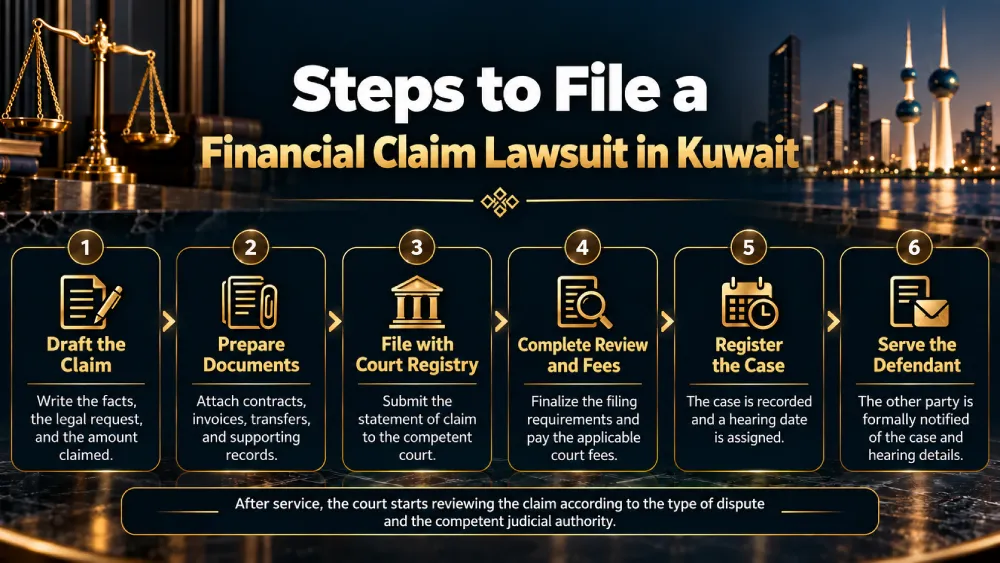
The process of filing a Financial Claim Lawsuit in Kuwait begins after preparing the basis of the claim and the supporting documents and identifying the appropriate judicial route. When the ordinary lawsuit procedure applies, filing the claim involves several procedural steps connected with the Court Registry and service of process.
- Preparing the Statement of Claim: Once the claim details are complete, the statement of claim is drafted in its final form for filing, while ensuring that the requested relief is consistent with the facts and supporting documents.
- Preparing Copies of the Statement of Claim and Documents: The original statement of claim and copies according to the number of defendants are submitted together with the supporting documents and explanatory memorandum as required under the Procedures Law.
- Filing the Statement of Claim with the Court Registry: The lawsuit is filed by depositing its statement of claim with the Court Registry. From that date, the legal effects of filing the lawsuit arise in accordance with the Procedures Law.
- Completing Review and Fee Procedures: The statement of claim and its attachments are reviewed, and the procedures relating to court fees are completed before the case is registered in accordance with the applicable process.
- Registering the Case and Setting the Hearing: The Court Registry records the case in the designated register and sets a hearing date for its consideration.
- Serving the Defendant: The statement of claim and its copies are delivered to the service authority so that the defendant can be formally served. The Ministry of Justice indicates that service of statements of claim requires information such as the case number, the court circuit, and the full address of the person to be served.
Once service has been completed, the lawsuit moves to the stage of being heard before the court in accordance with the procedures applicable to the type of claim and the competent judicial authority.
What Does the Ministry of Justice Specify for the Statement of Claim Service?
The Kuwaiti Ministry of Justice publishes practical information about the Statement of Claim service, including the required documents, such as the original statement of claim and its copies, as well as a copy of the power of attorney or Civil ID depending on the case.
It also states an estimated time of five minutes for completing the administrative transaction described in the service. This period does not represent the time required for the court to hear or decide the lawsuit.
The fees for filing a statement of claim depend on the relief requested, according to the information published by the Judicial Fees Department. It is therefore not appropriate to assume that one fixed fee applies to all financial claim lawsuits.
Mistakes to Avoid Before Filing a Financial Claim Lawsuit
Proving a claim may become more complicated when the claimant starts legal proceedings before properly organizing the facts and documents. Mistakes to be aware of include:
- Failing to document how the final balance was calculated when there are multiple payments or transactions.
- Claiming an amount that does not match the supporting documents.
- Filing the claim against a person or entity in an incorrect legal capacity.
- Relying on a financial transfer without explaining the reason for the transfer.
- Choosing the lawsuit route before checking which procedure applies to the claim.
If the dispute specifically concerns recovering an amount that was paid or transferred, it may be appropriate to consult a Funds Recovery Lawyer in Kuwait for a more focused review of this issue.
Frequently Asked Questions About a Financial Claim Lawsuit in Kuwait
What happens if the debtor denies owing the money?
If the debtor denies the debt, the court will examine the evidence presented by both parties. The claimant may rely on contracts, bank transfers, invoices, acknowledgments, correspondence, or other admissible evidence. The strength of the claim depends on whether those documents establish the origin, amount, and due date of the debt.
Can WhatsApp messages be used to support a financial claim in Kuwait?
WhatsApp messages or other electronic correspondence may help clarify the nature of a transaction, acknowledgment of an amount, or discussions about repayment. Their evidentiary value depends on the circumstances and applicable evidence rules. They should therefore be reviewed together with contracts, transfers, invoices, and other documents rather than relied upon in isolation.
Does a bank transfer alone prove that a debt exists?
A bank transfer proves that money moved from one account to another, but it may not by itself establish why the payment was made. The other party may argue that the amount was a gift, investment, repayment, or another type of payment. Additional documents or correspondence may be needed to establish its legal basis.
Can a financial claim include several unpaid invoices?
A claim may involve several unpaid invoices when they arise from the same commercial relationship or account. The amounts should be reconciled carefully with payments, credit notes, account statements, and any objections raised by the debtor. Presenting a clear calculation helps the court understand how the final claimed balance was reached.
Before filing a Financial Claim Lawsuit in Kuwait, the case file should be assessed to determine whether the available documents support the claim and which procedural route applies. Reviewing the file with a Lawyer in Kuwait can help identify any gaps in the documents or calculations before court proceedings begin.
If the other party denies the debt, there is no clear contract, or the evidence is spread across bank transfers, invoices, and correspondence, you can contact the lawyer Riyadh Mutni Al-Fadhli and present the file for an assessment of the nature of the claim and the procedure that best fits its circumstances. The outcome of a lawsuit cannot be guaranteed before reviewing the evidence and the other party’s defense.
Disclaimer: This content is intended for general legal awareness only. It does not constitute legal advice for an individual case, and reading it does not create an attorney-client relationship. Procedures and outcomes vary depending on the facts and documents of each case and the applicable laws.

Lawyer in Kuwait, Registration No. 8342. Through this personal platform, he provides educational legal content covering contracts, companies and investment, arbitration, and commercial dispute resolution. The content is presented in a clear and precise manner to help individuals and businesses understand their legal options and reduce potential risks.