
The procedures for filing a discharge of liability claim in Kuwait begin by clearly identifying the debt or obligation in dispute and reviewing the reason for challenging it, whether because the amount has already been paid, the obligation has ended, or the amount was never legally due. The supporting documents are then collected, the statement of claim is prepared, and the filing, registration, and service procedures are completed before the competent court.
It is not enough for a person simply to claim that the debt has been paid or is not due. The court examines the facts, documents, and requests presented before it. Therefore, if you receive a demand for an amount you have already paid, notice a discrepancy in the claimed balance, or continue to face a demand despite having a release or financial records, start by organizing the contract, transfers, account statements, and correspondence before taking any court action.
Are you being asked to pay an amount you have already settled, or are you facing a dispute over a debt you believe is not legally due? Lawyer Riyadh Matni Al-Fadhli can review the claim and supporting documents and determine whether a discharge of liability claim is the appropriate legal procedure for your situation before you take any further step.
Contact Lawyer Riyadh Matni Al-Fadhli
Or continue reading first to understand the procedures for a discharge of liability claim and what you need to prepare before starting.
Table of content
When Might You Need a Discharge of Liability Claim in Kuwait?
A discharge of liability claim may become relevant when there is a specific financial demand while the person disputes the existence of the obligation or argues that part of it is no longer outstanding.
Situations that may give rise to this type of dispute include:
- Being asked to pay an amount you have already paid.
- Continued demands despite evidence that the obligation has ended.
- A dispute over the remaining balance after partial payment.
- A demand for an amount you believe is no longer due.
- A discrepancy between the amount claimed and the accounts or transactions between the parties.
Published judgments available through the Kuwait Institute for Judicial and Legal Studies have addressed cases in which parties sought judgments declaring them discharged from liability for disputed amounts. This shows that such a claim concerns a specific dispute over an existing or alleged financial obligation rather than a general request for a declaration that no debt is owed.
If you are a creditor seeking to recover an amount owed by another party, the legal route is different. You can refer to a Debt Collection Lawyer in Kuwait to understand the procedures for claiming and recovering a debt from the creditor’s perspective.
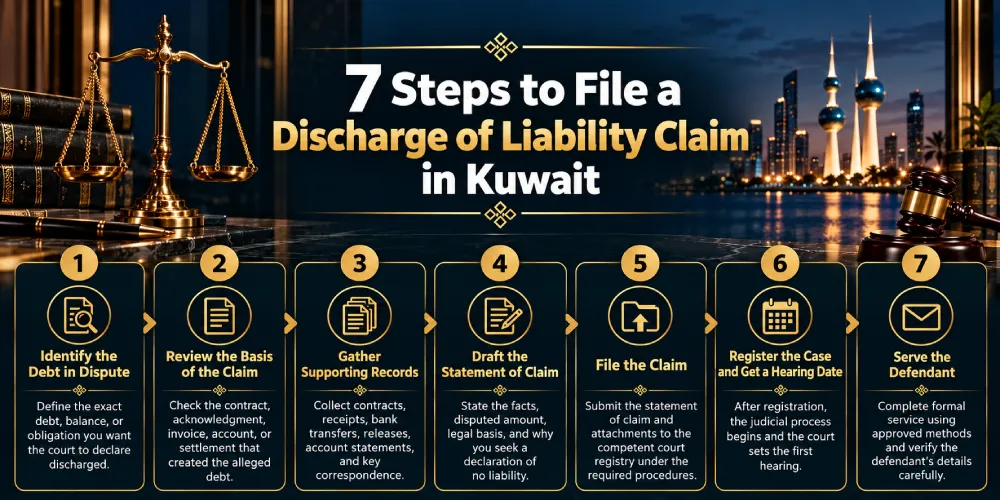
Procedures for Filing a Discharge of Liability Claim in Kuwait
The procedures for filing a discharge of liability claim involve several connected stages. Proper preparation at each stage affects how clearly the request and its supporting grounds are presented before the court.
1. Identify the Debt or Obligation in Dispute
Start by identifying the obligation from which you want the court to declare you discharged. The dispute may concern the original debt, part of an outstanding balance, a payment that the other party claims was not made, or an amount arising from the performance of a contract or another financial transaction.
This step defines the scope of the claim so that the requested judgment remains limited to the specific debt or amount in dispute rather than extending to other obligations that are not part of the case.
2. Review the Source of the Claim
After identifying the debt, review the document or transaction from which the obligation arose. Proof of payment alone may not be enough without understanding the legal or contractual basis of the claim.
The debt may arise from:
- A contract or agreement.
- An acknowledgment of debt.
- An invoice or a series of invoices.
- Ongoing commercial transactions.
- A bank account or credit facility.
- A previous financial settlement.
The source of the obligation affects how the dispute is analyzed and which documents are needed to prove or challenge it. The evidence required in a contractual dispute, for example, may differ from what is required in a running account or financial settlement.
If the case depends heavily on account statements, transfers, and numerous financial transactions, it may be useful to consult a Financial Disputes Lawyer in Kuwait to understand how to organize financial records and connect each transaction to the disputed claim.
3. Prepare Documents Supporting the Discharge of Liability
There is no single set of documents that applies to every discharge of liability claim in Kuwait. The required documents depend on the source of the obligation and the grounds on which the claimant seeks a declaration that the liability has ended or does not exist.
Depending on the case, the file may include:
- The contract or agreement that created the obligation.
- Payment receipts.
- Bank transfers.
- Releases or settlement receipts.
- Account statements.
- Invoices.
- Correspondence exchanged between the parties.
- Settlement or payment schedule agreements.
- Previous judgments or court orders related to the claim.
It is preferable to arrange these documents chronologically and connect each payment to the debt it relates to. In ongoing financial dealings, the existence of a bank transfer alone may not be sufficient if the parties still dispute the purpose of the transfer or the obligation it was intended to satisfy.
This review becomes particularly important when the parties have competing claims or disagree over the same balance. One party may argue that it has been discharged from the amount claimed, while the other relies on a financial claim seeking recovery of that same balance. The documents should therefore be read within the context of the entire financial relationship rather than treating each document in isolation.
4. Prepare the Statement of Claim
After understanding the claim and organizing the documents, the next stage is preparing the statement of claim for discharge of liability. This document presents the facts of the dispute and the claimant’s requests to the court in an organized manner.
The Civil and Commercial Procedures Law regulates the required information in statements of claim and the procedures for filing them. Details vary depending on the nature of the case, but the statement generally includes the parties’ details, the competent court, the facts of the dispute, the relief requested, and the legal grounds supporting the request.
The statement should accurately reflect the case file and explain:
- The legal relationship from which the claim arose.
- The debt or amount in dispute.
- The reason for requesting discharge from that liability.
- The documents supporting the stated facts.
- The specific relief requested from the court.
For this reason, one standard form cannot be suitable for every case. The way the claim should be presented depends on the grounds for requesting discharge of liability and the documents supporting those grounds.
5. File the Statement of Claim
Once the statement of claim and supporting documents are ready, the filing stage begins with the court registry in accordance with the applicable procedures.
The Kuwaiti Ministry of Justice explains through its Statement of Claim Service that the procedure includes printing the statement, reviewing the service documents, obtaining the relevant case officers’ stamps and fee stamps, and submitting the original statement and required copies, together with a copy of the power of attorney or civil ID, depending on the circumstances.
The competent court and judicial circuit are determined according to the nature and value of the dispute, the status of the parties, and the applicable jurisdiction rules.
6. Register the Case and Set a Hearing
A distinction should be made between registering the case and the time required to obtain a judgment. Completing the registration process means that the judicial proceedings have begun, but it does not mean that a judgment will be issued within a fixed period or that the dispute ends once the case is registered.
7. Serve the Defendant
After registration, service on the defendant is one of the essential procedures required for the litigation to proceed.
The Kuwaiti Ministry of Justice has emphasized the importance of valid judicial service. Electronic service methods in Kuwait were also expanded under Ministerial Decision No. 125 of 2025 to include approved channels such as Kuwait Mobile ID, Sahel, Sahel Business, and registered email, subject to the applicable requirements.
The defendant’s information should therefore be reviewed carefully before filing. Incorrect details or inaccurate contact information may delay the proceedings or require service to be repeated.
How Long Does It Take to Register a Statement of Claim in Kuwait?
The Ministry of Justice publishes an estimated processing time of approximately five minutes for completing the statement-of-claim transaction, depending on the names of the claimant and defendants, on the official procedure page for the Court Registry Department.
This period relates only to completing the administrative transaction. It does not mean that a discharge of liability claim will be decided within five minutes.
The time required to hear and decide the case varies from one file to another depending on factors such as valid service, attendance of the parties, defenses raised, the volume of documents, and whether additional procedures are required during the proceedings.
Are There Fees for Filing a Discharge of Liability Claim in Kuwait?
The Ministry of Justice page for the statement-of-claim procedure lists the fee field as “None.”
However, this should not be understood to mean that no court fees can ever apply to a discharge of liability claim. Fees may vary depending on the nature of the request, the value of the claim, the type of procedure, and the applicable rules governing judicial fees.
It is therefore preferable to verify the fees applicable to the specific case at the time of filing rather than relying on a general figure that may not reflect the circumstances of the file.
Mistakes That May Delay a Discharge of Liability Claim in Kuwait
Problems may begin with the way the case file is prepared, even when the underlying dispute itself is clear. Mistakes to watch for include:
- Failing to specify the amount from which the claimant seeks to be discharged.
- Submitting financial transfers without explaining their connection to the disputed debt.
- Omitting a contract or addendum that affects how payments should be interpreted.
- Submitting an incomplete or poorly organized account statement.
- Entering incomplete information about the opposing party when preparing the statement of claim.
- Drafting a request that is broader than the facts and documents supporting it.
- Treating registration of the case as the end of the procedure and failing to follow up on service or later developments in the proceedings.
How Can a Lawyer Help in a Discharge of Liability Claim in Kuwait?
The role of a Lawyer in Kuwait begins before the statement of claim is prepared. The lawyer examines the nature of the demand and assesses whether a discharge of liability claim is appropriate for the facts of the case. The lawyer also reviews whether the requested relief is consistent with the available documents and determines whether the dispute requires a separate lawsuit or a different legal procedure based on the nature of the relationship between the parties.
This review can help prevent a case from being started on an incomplete understanding of the claim or from relying on a document that does not sufficiently prove the relevant fact.
Frequently Asked Questions About Discharge of Liability Claims in Kuwait
Can a discharge of liability claim be filed after the debt has been paid?
It may be relevant when a creditor continues to demand payment despite full or partial settlement. The claimant should be able to identify the disputed debt and provide documents showing the payments made, such as receipts, bank transfers, releases, or account statements that can be linked to the obligation in question.
What evidence can support a request to be released from a debt?
The evidence depends on how the obligation arose and why it is disputed. Relevant documents may include contracts, payment receipts, bank transfers, account statements, settlement agreements, invoices, correspondence, or previous court documents. The documents should be organized so that each payment or transaction can be connected to the disputed amount.
Can the claim cover only part of an outstanding balance?
A dispute may concern the entire debt or only part of the amount claimed. Where partial payments have been made, the statement of claim should clearly identify the remaining disputed balance and explain how the payments affect it. The supporting records should also distinguish between amounts already paid and amounts still contested.
Does filing the case automatically stop the other party from claiming payment?
Filing a discharge of liability claim begins judicial proceedings, but it should not be assumed that registration alone automatically suspends every other claim or enforcement measure. The legal effect depends on the nature and procedural stage of the dispute. The specific case file should therefore be reviewed before relying on filing as a protective measure.
What happens if the payment records do not explain what the transfer was for?
A bank transfer may not by itself establish which debt or obligation was paid, especially when the parties had several transactions. Supporting correspondence, invoices, contracts, account records, or payment references may help connect the transfer to the disputed obligation and explain why the claimant considers the amount settled.
Can a discharge of liability claim involve a contractual dispute?
Yes. A disputed financial obligation may arise from a contract, agreement, settlement, invoice, credit arrangement, or continuing commercial relationship. In a contractual dispute, the court may need to examine both the terms that created the obligation and the documents showing whether it was performed, paid, reduced, or otherwise ended.
The soundness of the procedures for filing a discharge of liability claim in Kuwait depends on the clarity of the requested relief and how well it corresponds with the facts and available documents. If the dispute involves overlapping financial transactions or multiple documents, it is preferable to assess the file before registration and identify the legal basis on which the claim will rely.
You can contact Lawyer Riyadh Matni Al-Fadhli to review the file and determine the appropriate legal course based on the facts before starting a procedure that may not fit the nature of the dispute.
Disclaimer: This content is provided for general legal awareness only and does not constitute legal advice directed to any individual case. Reading it does not create an attorney-client relationship. The appropriate procedures and requests vary according to the facts, documents, and procedural stage of each case.

Lawyer in Kuwait, Registration No. 8342. Through this personal platform, he provides educational legal content covering contracts, companies and investment, arbitration, and commercial dispute resolution. The content is presented in a clear and precise manner to help individuals and businesses understand their legal options and reduce potential risks.