

A judgment may be issued in favor of the creditor, but collecting the awarded amount does not happen automatically once the judgment is rendered. The enforcement stage begins afterward and requires selecting the appropriate procedure based on the status of the judgment and the available information about the debtor’s assets. Enforcement Seizure in Kuwait is one of the procedures that may be used at this stage. This article explains when enforcement seizure begins, the applicable requirements, documents, and steps, and when garnishment of the debtor’s assets held by a third party may be the appropriate course of action.
Quick Summary: Enforcement Seizure in Kuwait is a compulsory enforcement procedure used to place the debtor’s assets under seizure in order to satisfy a right established by an enforceable instrument. The seizure may apply to movable property, real estate, or assets belonging to the debtor that are held by a third party. The applicable procedures and required documents vary depending on the type of asset and the stage of enforcement.
Have you obtained a judgment in your favor but still have not received the amount awarded? Lawyer Riyadh Matni Al-Fadhli can review the enforceable instrument and supporting documents and determine the appropriate procedure for seizing the debtor’s assets, allowing you to begin enforcement on a clear legal basis suited to your case.
Contact Lawyer Riyadh Matni Al-Fadhli Now
Or continue reading to learn about the requirements, steps, and documents needed for enforcement seizure.
Table of content
When Does Enforcement Seizure in Kuwait Begin?
The Kuwaiti Civil and Commercial Procedures Law requires an enforceable instrument establishing an existing, determined, and due right before compulsory enforcement can begin. Enforceable instruments include judgments, orders, notarized instruments, and court-approved settlement records, as well as any other instruments granted enforceable status by law. This rule is established under Article 190 of Law No. 38 of 1980 concerning Civil and Commercial Procedures.
A distinction must be made between establishing a right and enforcing it. If the creditor still needs to prove entitlement to the claimed amount before the court, the matter precedes the enforcement stage and may, depending on the facts and supporting documents, fall within a financial claim. If the creditor already holds a valid enforceable instrument, the case moves to enforcing the right against the debtor’s assets through the appropriate procedure.
Consulting a debt collection lawyer in Kuwait at this stage can help determine where seizure fits within the debt recovery process, particularly when a judgment has already been issued but the amount remains unpaid.
What Assets Can Be Subject to Enforcement Seizure in Kuwait?
The Kuwaiti Ministry of Justice explains that enforcement departments handle the seizure of movable property, garnishment of a debtor’s assets held by third parties, seizure of real estate and real property rights, as well as shares, bonds, revenues, and ownership interests.
For this reason, Enforcement Seizure in Kuwait varies from one case to another. Information may be available about funds held in the debtor’s bank account or amounts owed to the debtor by a company, while in another case the asset subject to enforcement may be real estate, movable property, or another financial right.
The asset targeted for enforcement determines the type of application submitted to the Enforcement Department. The asset intended to be seized should therefore be identified before selecting the appropriate procedure.
Garnishment of a Debtor’s Assets Held by a Third Party in Kuwait
This type of seizure is used when the debtor’s funds or rights are held by another party. That party may be a bank, company, or other entity holding funds belonging to the debtor or owing the debtor a certain amount.
Decree-Law No. 59 of 2025 amended certain provisions of Article 227 of the Civil and Commercial Procedures Law. Where the seizure does not concern a specific movable asset or a specifically identified debt, the amendment regulates the extension of the seizure, within the limits established by the law, to debts arising in favor of the debtor against the garnishee until the declaration of indebtedness is made. It also contains provisions relating to funds or balances subsequently added unless the seizure is lifted by the Enforcement Department.
This rule must be interpreted within the full legal text and the facts of the particular case. It does not mean that any asset belonging to the debtor may automatically be seized without following the prescribed procedure.
Enforcement Garnishment Record for Assets Held by a Third Party
An enforcement garnishment record concerning a debtor’s assets held by a third party forms part of the procedures directed against a person or entity holding assets that belong to the debtor. The Ministry of Justice states that enforcement departments handle this form of seizure alongside other enforcement procedures.
Decree-Law No. 59 of 2025 also addressed the rules governing the declaration of indebtedness. Under amended Article 234, the garnishee must declare what is owed to the debtor before the Enforcement Department handling the procedure within the legally prescribed period. The declaration must state the amount and basis of the debt and provide the information required by law concerning the assets held under seizure.
The record is therefore not merely a separate procedural document. It forms part of a legal process that creates obligations and legal consequences for the parties involved in the garnishment.
Steps to Request Garnishment of a Debtor’s Assets Held by a Third Party in Kuwait
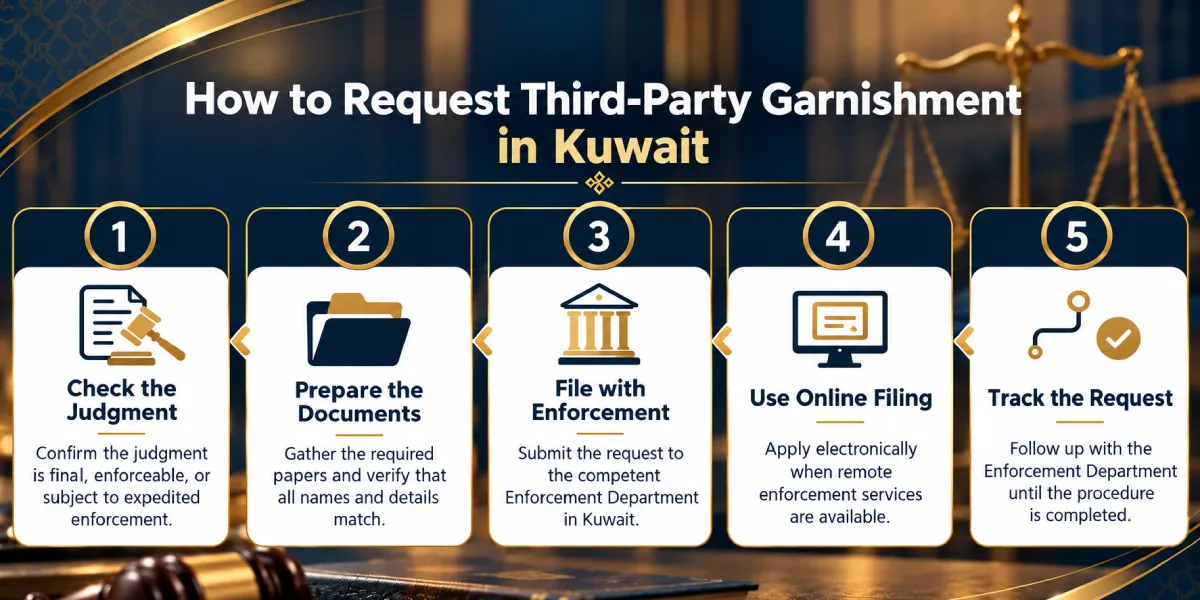
The Kuwaiti Ministry of Justice provides a dedicated service titled Request for Garnishment of a Debtor’s Assets Held by a Third Party. The service page identifies the competent authority, requirements, documents, processing time, and filing method. Based on the information published by the Ministry, the procedure can be arranged as follows:
1. Verify the Status of the Judgment
The Ministry of Justice service page requires the judgment to be final or subject to expedited enforcement. It also refers to cases where an order has been issued by a summary matters judge. The first step is therefore to review the judgment and confirm that it is enforceable before submitting the garnishment request.
2. Prepare the Required Documents
Prepare the application file before submission and confirm that the information is clear and consistent. The documents published by the Ministry of Justice are listed in the following section.
3. Submit the Application to the Enforcement Department
The Ministry of Justice identifies the enforcement departments located across Kuwait’s governorates as the competent authorities responsible for processing the application. The request is submitted to the appropriate department in accordance with the information published for the service.
4. Use Electronic Filing When Preferred
The Ministry states that the request may be submitted electronically after logging in and selecting remote enforcement procedures. According to the published information, filing is therefore not limited to attending the Enforcement Department in person.
5. Follow Up on the Garnishment Procedure
After the request is submitted, the outcome of the procedure should be followed up with the Enforcement Department according to the progress of the application. The approximate processing time published for this service is shown in the table below.
Documents Required to Request Garnishment of a Debtor’s Assets Held by a Third Party
The Kuwaiti Ministry of Justice lists the following documents for this service:
- The defendant’s civil ID.
- A power of attorney from the claimant if the application is submitted through a representative.
- Copies of the judgments.
The published service page does not specify additional general requirements concerning legalization or translation of these documents.
Fees and Processing Time for Enforcement Seizure in Kuwait
Verification date: October 2026. The following information is taken from the Kuwaiti Ministry of Justice service page concerning requests for garnishment of a debtor’s assets held by a third party. The information may change, so the official source should be reviewed when submitting an application.
| Service | Published Fee | Published Processing Time |
|---|---|---|
| Request for Garnishment of a Debtor’s Assets Held by a Third Party | None | Approximately 10 minutes to submit the request, with the garnishment completed in approximately 5 days |
The Ministry also states that an enforcement officer from the Enforcement Department is among the officials involved in processing the application. The approximately five-day period is the published estimated timeframe for carrying out the garnishment. It does not represent a guaranteed date for receiving the money, as the case may require additional procedures depending on the outcome of the garnishment, the assets identified, and any disputes that may arise.
What Can a Debtor Do When Disputing the Underlying Amount?
Enforcement seizure may begin while the debtor maintains that the debt has already been paid, that part of the amount is not due, or that the debtor is not liable for the amount currently being enforced. In this situation, a distinction must be made between a dispute concerning enforcement procedures and a dispute concerning the underlying obligation itself.
If the dispute concerns the existence of the debt itself, an action seeking a declaration that the debtor is discharged from liability may become relevant depending on the basis of the debt, the available documents, and the procedures already taken. However, this does not mean that such an action is appropriate in every case or that merely filing it automatically suspends or terminates the seizure.
Before selecting any course of action, the judgment, enforceable instrument, evidence of payment, notices, and any documents affecting the existence or amount of the debt should be reviewed.
When Should You Consult a Lawyer Before Requesting Seizure?
Legal review can be useful when the enforcement procedures are unclear or when the case contains factors that may affect the choice of the appropriate step. Consulting a lawyer in Kuwait can help assess the situation before submitting a new application, particularly in the following circumstances:
- A judgment has been issued, but the appropriate type of seizure or enforcement procedure is unclear.
- Several judgments or payments are connected to the debt.
- Part of the amount was paid after the judgment was issued.
- A seizure has been imposed while there is an objection to the existence or amount of the debt.
- There is a need to understand the enforceable instrument, notices, and procedures already completed in the case.
Frequently Asked Questions About Enforcement Seizure in Kuwait
Can a creditor seize a debtor’s bank account in Kuwait?
A creditor may seek to seize funds held for the debtor by a bank when the legal requirements for enforcement are satisfied. The procedure generally falls within garnishment of assets held by a third party and must be carried out through the competent Enforcement Department in accordance with the enforceable instrument and applicable procedures.
Does obtaining a court judgment mean the creditor receives payment immediately?
No. A judgment establishing the creditor’s right does not automatically result in payment. If the debtor does not pay voluntarily, the creditor may need to begin enforcement proceedings and select an appropriate measure against the debtor’s assets, depending on the enforceable instrument and the information available about those assets.
Can more than one type of asset be targeted during enforcement?
Different types of assets may potentially be subject to enforcement, including movable property, real estate, financial rights, shares, and funds held by third parties. The appropriate procedure depends on the nature and location of the asset, and each form of seizure may involve different procedural requirements before the Enforcement Department.
What happens if the debtor has already paid part of the judgment amount?
Any partial payment should be documented and considered before further enforcement action is taken. The amount remaining due under the enforceable instrument must be accurately determined, because enforcement should relate only to the outstanding obligation. Payment receipts, transfers, settlement documents, and the judgment should therefore be reviewed together before proceeding.
Can a debtor challenge an enforcement seizure in Kuwait?
A debtor may raise a dispute where there is a legal basis to challenge the enforcement procedure or the amount being enforced. The appropriate course depends on whether the objection concerns the enforcement process itself or the underlying debt, such as prior payment, partial payment, or a dispute over the amount due.
The effectiveness of Enforcement Seizure in Kuwait does not depend on taking numerous procedures. It depends on whether the selected procedure is appropriate for the case and the stage reached in enforcement. Reviewing the documents and the position of the parties before taking a new step is therefore useful, particularly where previous payments have been made, the amount is disputed, or several assets may be subject to enforcement.
If you need your case reviewed, you can contact lawyer Riyadh Matni Al-Fadhli to assess the documents and determine the most appropriate legal course based on the facts of your case.
Disclaimer: This content is provided for general legal information only. It does not constitute legal advice for any specific case, and reading it does not create an attorney-client relationship. Procedures and outcomes may vary depending on the enforceable instrument, facts, documents, and updates issued by the competent authorities.

Lawyer in Kuwait, Registration No. 8342. Through this personal platform, he provides educational legal content covering contracts, companies and investment, arbitration, and commercial dispute resolution. The content is presented in a clear and precise manner to help individuals and businesses understand their legal options and reduce potential risks.