

A creditor may possess a document proving their right, but this does not automatically mean that filing a claim through the ordinary litigation process is the most appropriate procedure. In some debt cases, a payment order under Kuwaiti law provides a special route for claiming a right, although its use is subject to certain requirements and procedures that must be verified before submitting the application.
Therefore, the creditor must first determine whether the nature of the claim allows this route to be used and what requirements must be fulfilled before proceeding. This issue is particularly important in cases handled by a debt collection lawyer in Kuwait, because choosing the correct procedure from the outset helps avoid delays or entering a legal route that does not correspond to the nature of the debt.
Articles 166 and following of the Kuwaiti Civil and Commercial Procedures Law No. 38 of 1980, as amended, regulate payment orders. These provisions underwent important amendments under Law No. 71 of 2025, including matters relating to the demand for payment, service of notice, and objection.
Do you have an outstanding debt and are concerned about choosing a procedure that may not suit your case or missing an important legal deadline? Attorney Riyadh Mutni Al-Fadhli can review the debt instrument and supporting documents, assess whether a payment order is appropriate for your case, and explain the legal steps that should be considered before proceeding.
Contact Attorney Riyadh Mutni Al-Fadhli About a Payment Order
Or continue reading the article first to learn about the conditions, procedures, and deadlines associated with payment orders.
Table of content
What Is a Payment Order Under Kuwaiti Law?
A payment order is a special judicial procedure made available by the legislature to creditors for claiming certain debts through procedures that differ from the ordinary process of filing a lawsuit, provided that the requirements set out in the Procedures Law are met.
This route is used when the debt is of a type that the law permits to be claimed through a payment order, provided that the necessary legal conditions are satisfied, as explained in the following section.
What Are the Conditions for a Payment Order Under Kuwaiti Law?
For a payment order under Kuwaiti law to be the appropriate route for a claim, a number of conditions relating to the debt itself must be verified.
The Right Must Be Established in Writing
The creditor must rely on a written document establishing the right being claimed. The mere existence of correspondence or documents connected to the relationship between the parties is not sufficient; what matters is whether those documents are capable, in light of the circumstances of the case, of proving the debt that is the subject of the claim.
The supporting instrument may be a contract, an acknowledgment of debt, a commercial paper, or another document that may be relied upon depending on the nature of each case.
The Debt Must Be Due and Payable
The debt must also have already reached its due date. If the obligation is deferred until a future date that has not yet arrived, proof that the debt exists is not, by itself, sufficient to use the payment order procedure before the debt becomes due.
The Amount of the Debt Must Be Determined or Determinable
The amount claimed must be specified, or it must be possible to determine it based on clear elements without requiring a separate dispute over its amount.
Accordingly, a claim for a fixed amount supported by documents differs from a claim whose value cannot be determined until an expert examination is conducted, disputed accounts are settled, or compensation that has not yet been quantified is assessed.
The Claim Must Fall Within the Cases Covered by This Procedure
The law also addresses certain cases involving commercial papers. If recourse is limited to the drawer, maker, acceptor, or their aval guarantor, the provisions governing payment orders apply. Recourse against others is subject to the general rules governing the filing of lawsuits.
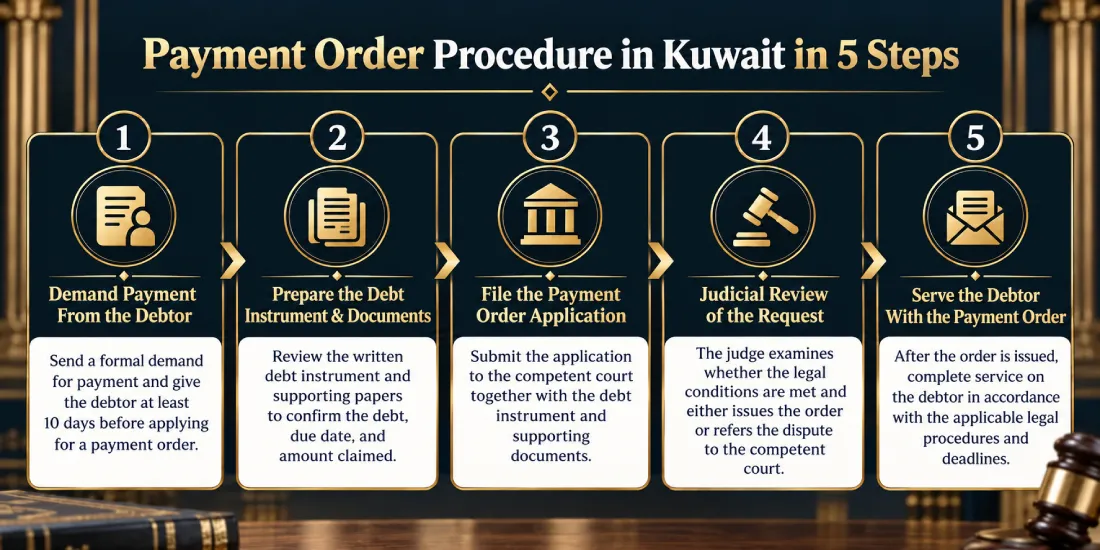
Payment Order Procedures Under Kuwaiti Law
The payment order procedure under Kuwaiti law does not begin merely by submitting an application to the court. A fundamental preliminary step must first be completed by the creditor.
First: Demanding Payment From the Debtor
Article 167, in its current form, requires the creditor to demand payment from the debtor before applying for a payment order and to grant the debtor a period of no less than ten days.
The law permits this demand to be made by registered letter and also allows the use of modern electronic communication methods that can be stored and retrieved, provided that they satisfy the requirements regulated by a decision of the Minister of Justice.
This step should not be treated as a mere formality that can be overlooked. The creditor must be able to prove that the demand for payment was made and that the statutory period was observed.
Second: Preparing the Debt Instrument and Supporting Documents
If the payment period expires without payment being made, the creditor then prepares the debt instrument and supporting documents for the claim while observing the formal requirements for filing the application. These documents should clearly establish the origin of the debt, its due date, and its amount.
The mere existence of a debt instrument is not sufficient for a payment order to be issued. What matters is the substance of the document and whether the claim satisfies the conditions prescribed by law.
Third: Filing an Application for a Payment Order
Article 167 provides that a payment order is issued by the judge of the Summary Court or the head of the relevant circuit at the Court of First Instance, depending on the circumstances.
At this stage, the application is submitted to the competent judicial authority together with the supporting documents so that it may determine whether the legal requirements for issuing a payment order have been met.
Fourth: Judicial Review of the Application
Submitting the application does not mean that the payment order will automatically be issued. If the judge does not consider it appropriate to grant all of the applicant’s requests, or if a reason exists that prevents issuance of the order, Article 168 provides that the judge shall refrain from issuing it and shall schedule a hearing before the competent court. The debtor is then summoned in accordance with the applicable legal procedures.
This depends on the judge’s assessment of whether the application satisfies the substantive and procedural requirements imposed by law in light of the documents submitted.
It is important here to distinguish between refusing to issue a payment order as a special procedural route and a final determination on the underlying debt itself.
Fifth: Serving the Payment Order on the Debtor
Once the order is issued, the procedure moves to the service stage. Article 169 regulates service of the petition and the order on the debtor and also allows certain forms of electronic service in accordance with legally prescribed rules.
Particular attention should be paid to the six-month period from the date on which the order is issued because the law attaches consequences to failure to complete service within that period.
What Documents Are Required for a Payment Order Under Kuwaiti Law?
According to the Payment Order page of the Kuwaiti Ministry of Justice, the documents required to complete the transaction include:
- Civil ID.
- A special or general power of attorney, depending on the capacity of the applicant.
- The debt instrument, such as a bill of exchange, promissory note, cheque, trust receipt, or another document evidencing the debt.
In addition to these formal requirements, it is important to review the claim file itself and ensure that documents are available to establish the elements of the debt, such as evidence of the due date, the amount of the outstanding balance, any amounts already paid, if applicable, and proof of the payment demand and its date.
The objective is not to collect the largest possible number of documents, but rather to ensure that the formal documents and the evidence proving the debt are coherent and clear before the application is filed.
What Are the Important Deadlines for a Payment Order Under Kuwaiti Law?
The key time periods associated with payment orders can be summarized as follows:
| Stage | Time Period |
|---|---|
| Demand for payment from the debtor | No less than 10 days before applying for the order |
| Service of the payment order | The 6-month period provided for in Article 169 must be observed |
| Objection to the order | 10 days from the date the debtor is served |
These time periods are set out in the current texts of Articles 167, 169, and 170 following the 2025 amendments.
Nevertheless, no procedural deadline in a specific case should be calculated in isolation from the date and method of service and the actual circumstances of the file.
Fees for Applying for a Payment Order in Kuwait
Verification date: October 2026. According to the Application for Issuance of a Payment Order page of the Kuwaiti Ministry of Justice, the published court fees are:
| Claim Amount | Published Fee |
|---|---|
| Less than KWD 10,000 | 2.5% |
| More than KWD 10,000 | 2.5% on the first KWD 10,000, then 1% on the remaining amount |
These are official government court fees and do not represent lawyers’ fees.
It is advisable to refer to the official source at the time of filing because the fees or their collection mechanism may be subject to change.
What Should a Debtor Do if a Payment Order Is Issued Against Them?
If a debtor receives service of a payment order, it is important not to treat it as an ordinary financial demand and not to delay reviewing it.
The debtor should first verify:
- The date of service.
- The amount awarded.
- The debt instrument on which the order was based.
- Whether a prior demand for payment was properly made.
- Whether there are substantive or procedural grounds that may support an objection.
Some cases may raise a broader dispute regarding the existence or continuation of the debt, requiring consideration of the appropriate procedure. This may include filing an action for a declaration of discharge from liability where the facts and legal basis of the case justify doing so.
Objecting to a Payment Order Under Kuwaiti Law
Article 170 provides that the debtor may object to a payment order within ten days from the date on which it is served, before the Summary Court or the Court of First Instance, depending on the circumstances.
The objection must state its grounds. Once the objection is accepted procedurally, the court examines the formal and substantive requirements for obtaining the order and then decides the merits of the dispute in accordance with the rules prescribed by law, while observing the rules on jurisdiction.
The current text also provides that the payment order itself may not be directly appealed. However, a judgment issued on the objection may be appealed if it is among the judgments that are appealable under the general rules.
Does an Objection Stay Enforcement of a Payment Order?
It should not be assumed that filing an objection automatically suspends all effects of the payment order.
Article 171 provides that the rules governing provisional enforcement apply to the payment order and to the judgment issued on an objection to it in the cases specified by law.
Therefore, if the payment order enters the enforcement stage and measures such as enforcement attachment begin, the enforcement position should be reviewed alongside the objection. It should not be assumed that one route automatically replaces the other.
The Difference Between a Payment Order and an Ordinary Lawsuit
The main difference between the two routes lies in the nature of the claim itself. The law reserves the payment order procedure for certain types of debts that satisfy conditions allowing this special route to be used, whereas a financial claim lawsuit may be more appropriate where the dispute requires broader examination of the underlying obligation, the evidence, or the amount claimed.
A payment order should therefore not be chosen simply because it is believed to be the faster route, but because its requirements genuinely correspond to the nature of the debt being claimed.
Common Mistakes in Payment Order Procedures
Some of the most common mistakes that may affect payment order proceedings include:
- Submitting the application before the statutory payment-demand period has expired.
- Failing to retain evidence that the demand for payment was made.
- Claiming an amount that does not correspond to the supporting documents.
- Failing to clearly state the debt’s due date.
- Including amounts that require separate accounting, liquidation, or proof without explaining their basis.
- Using inaccurate debtor information that may affect service.
- Failing to follow up on service of the order after it is issued.
- Relying on procedures or deadlines stated in outdated sources that predate the 2025 amendments.
- The debtor delaying review of the service notice until the objection deadline has expired.
When Should You Consult a Lawyer About a Payment Order?
Consulting a lawyer in Kuwait becomes particularly important when the documents alone do not clearly reveal the most appropriate procedural route or when the file contains overlapping elements that require legal assessment before the next step is taken.
Situations in which this may be necessary include:
- The existence of conflicting documents or correspondence that may affect interpretation of the underlying obligation.
- Multiple parties or guarantees connected to the debt, requiring the legal responsibility of each party to be determined.
- The availability of more than one possible judicial procedure, making it necessary to select the route that corresponds to the nature of the dispute.
- The emergence of new defenses or facts after proceedings have begun that may change how the claim should be handled.
- The need to coordinate the legal position where the dispute is connected to other proceedings already pending before the courts.
In such cases, legal review helps assess the combined effect of the documents and procedures and determine the most appropriate next step based on the facts of the file rather than considering each procedure in isolation from the broader context of the dispute.
Frequently Asked Questions About Payment Order Under Kuwaiti Law
When can a creditor use the payment order route in Kuwait?
A creditor may use the payment order route when the claim satisfies the legal requirements governing this special procedure. In general, the debt should be supported by written evidence, already due for payment, and for a specific or determinable amount. The suitability of this route ultimately depends on the facts and documents of each claim.
Is a written debt document enough to obtain a payment order?
No. A written debt instrument is important, but its existence alone does not guarantee that a payment order will be issued. The court also considers whether the debt is due, whether its amount is sufficiently determined, whether the required payment demand was made, and whether the claim otherwise falls within the applicable statutory procedure.
How long must a debtor be given to pay before an application is filed?
Under the current wording of Article 167, the creditor must demand payment before applying for a payment order and allow the debtor at least ten days. The creditor should also retain evidence showing that the demand was properly delivered and that the required period expired before the payment order application was submitted.
Can a debtor challenge a payment order after receiving it?
Yes. Article 170 allows the debtor to object to a payment order within ten days from the date of service. The objection must state its grounds. Once procedurally accepted, the court may examine both the formal requirements for issuing the order and the underlying merits of the dispute in accordance with the applicable rules.
Does filing an objection automatically stop enforcement?
Not necessarily. Filing an objection should not be assumed to suspend enforcement automatically. Article 171 provides for the application of rules concerning provisional enforcement in the situations specified by law. If enforcement measures have already begun, the debtor may need to consider the enforcement position separately while also pursuing the objection within the applicable deadline.
The appropriate step in a Payment Order Under Kuwaiti Law case varies depending on the stage the dispute has reached. A creditor must comply with the procedures required before filing the application and follow up on service, while a debtor against whom an order has been issued must immediately pay attention to the date of service and the applicable objection deadlines.
If you have a debt claim or a payment order has been issued against you, you can contact Attorney Riyadh Mutni Al-Fadhli to review the documents and deadlines and assess the most appropriate legal procedure based on the circumstances of your case.
Disclaimer: This content is intended for general legal awareness under Kuwaiti law and does not constitute legal advice for any individual case. Reading it does not create an attorney-client relationship. Legal assessment varies depending on the facts, documents, and procedures in force at the time the matter is handled.

Lawyer in Kuwait, Registration No. 8342. Through this personal platform, he provides educational legal content covering contracts, companies and investment, arbitration, and commercial dispute resolution. The content is presented in a clear and precise manner to help individuals and businesses understand their legal options and reduce potential risks.