If you are dealing with a bounced cheque in Kuwait, the matter does not end simply because the bank refused to honour the cheque. The case may involve legal deadlines that require close attention, along with potential criminal liability and a financial right you are seeking to recover. In some situations, delaying action or accepting an unclear settlement may limit the options available to you later.
Therefore, your first question should not simply be: “Should I file a complaint?” More importantly, you need to know why the cheque was rejected, its date, and whether any previous payment or existing agreement exists between the parties.
Kuwaiti law regulates the circumstances that may give rise to criminal liability in connection with a cheque, while the Commercial Law also sets the deadlines for presenting it. If your main objective is to recover the debt, reviewing the case with a debt collection lawyer may help you understand the relationship between your financial claim and the criminal process before taking any step.
Do you have a bounced cheque in Kuwait and are concerned about missing an important deadline or signing a settlement that could affect your legal position? Lawyer Riyadh Matni Al-Fadhli can review the cheque and the related documents and explain the legal options available before you file a complaint, reach a settlement, or take any other step.
Contact lawyer Riyadh Matni Al-Fadhli on WhatsApp
Or continue reading the article first to learn about the penalties, deadlines, and settlement options before taking any action.
Table of content
What Is a Bounced Cheque in Kuwait?
A bounced cheque in Kuwait does not necessarily mean that the account was completely empty. The law also covers other situations related to the availability of sufficient funds and actions taken in connection with the cheque where bad faith is established.
For this reason, the mere appearance of the phrase “insufficient funds” is not, by itself, enough to establish that a criminal offence has occurred. The reason for the rejection, what happened to the account, and the facts and documents related to issuing the cheque must also be considered.
When Does Criminal Liability Arise for a Bounced Cheque in Kuwait?
Article 237 of the Penal Code identifies several situations that may give rise to criminal liability, including:
- Issuing a cheque without sufficient funds that are available and capable of being drawn upon.
- Withdrawing all or part of the funds after issuing the cheque so that the remaining balance is insufficient to cover its value.
- Issuing an instruction to the bank not to honour the cheque.
- Intentionally drawing up or signing the cheque in a way that prevents it from being honoured.
- Endorsing or delivering the cheque while knowing that sufficient funds are unavailable or that the cheque cannot be honoured.
The provision requires bad faith to be established. Therefore, the specific details and actual circumstances of each case remain essential in determining the legal position.
Penalty for a Bounced Cheque Under Kuwaiti Law
Under Article 237, the penalty for a bounced cheque under Kuwaiti law is imprisonment for a term not exceeding three years, a fine not exceeding KWD 500, or either of these penalties, provided that the circumstances criminalised by law are established and bad faith is proven.
However, this penalty represents the maximum provided by law and does not mean that every returned cheque automatically leads to the same result. Whether the offence is established and how the case ultimately ends depend on the facts, evidence, defence, and what is proven before the investigation authority and the court.
Post-Dated Cheques and Criminal Protection
The Kuwaiti Commercial Law provides that a cheque is payable on sight. If it is presented before the date written on it as the date of issue, it must be paid on the date it is presented.
From a criminal-law perspective, however, the Penal Code provides that criminal protection for the cheque does not begin until the date stated on it. This creates an important distinction: the ability to present the cheque to the bank is not the same as the date on which criminal protection begins.
Therefore, if you have a post-dated bounced cheque in Kuwait, do not rely only on the date on which it was presented to the bank when assessing your legal position. You should also review the date stated on the cheque and the relevant legal deadlines.
What Should You Do After the Bank Refuses to Honour the Cheque?
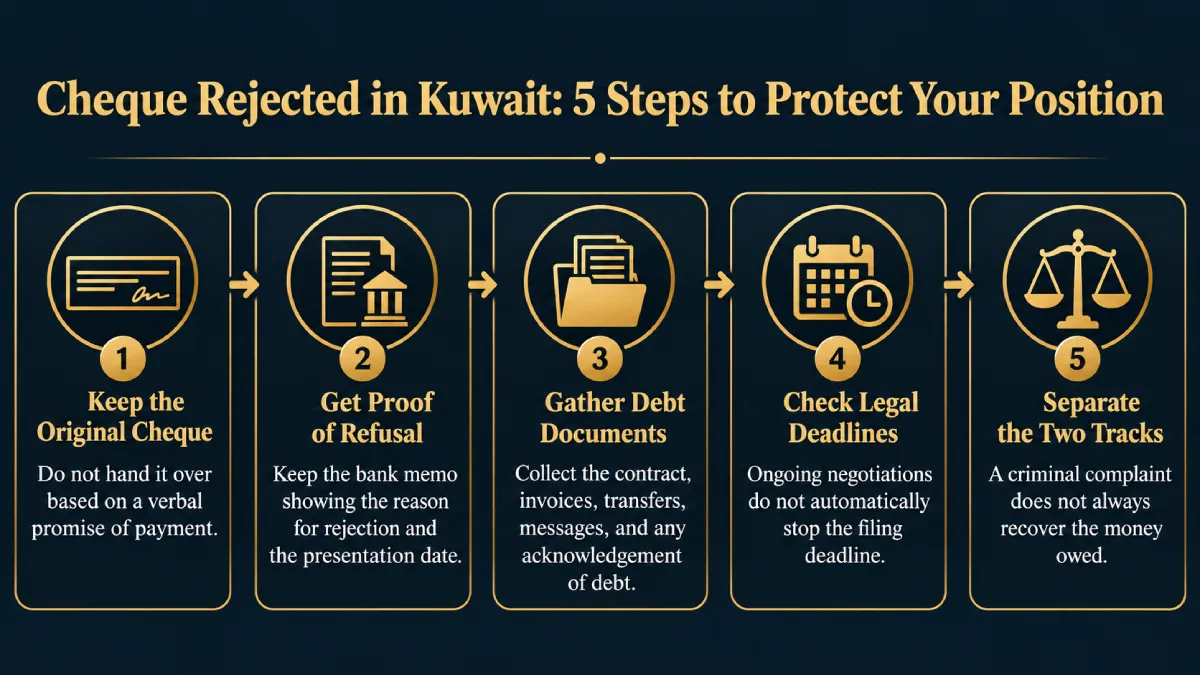
After the cheque is rejected, begin with these basic steps to preserve your documents and properly assess your legal position:
Keep the Original Cheque and Proof of Rejection
Do not hand the original cheque back to the other party in exchange for a verbal promise of payment. You should also retain any document issued by the bank confirming non-payment, the reason for it, and the date on which the cheque was presented.
The Commercial Law allows refusal of payment to be proven by a statement issued by the drawee or the clearing house, in accordance with the situations regulated by law.
Collect Documents Showing the Origin of the Debt
Do not rely on the cheque alone. It is better to collect all documents that explain the underlying financial relationship between the parties, such as:
- The contract or agreement.
- Invoices.
- Purchase or delivery orders.
- Previous transfers.
- Correspondence.
- Any acknowledgement of debt.
- Any previous or subsequent payment agreement.
These documents become even more important if a dispute arises over the reason the cheque was issued or the amount of the debt in question.
Review the Deadlines Before Continuing Negotiations
Negotiations with the debtor may continue, which is not unusual. The problem begins when negotiations continue without knowing whether a legal deadline is expiring while you wait.
Article 237 bis provides that a criminal case will not be brought if the injured party does not file a complaint within four months from the date stated on the cheque if it was drawn in Kuwait, or within six months if it was drawn outside Kuwait and payable in Kuwait. The Public Prosecution instructions also confirm this procedural rule.
Therefore, a promise such as “I will pay next week” may be a reason to give the other party additional time, but it does not, by itself, suspend the legal deadlines.
If some time has already passed since the date of the cheque, it is better to review the applicable period before granting a further extension or signing another agreement.
Separate the Criminal Process from Debt Recovery
Filing a complaint regarding a bounced cheque in Kuwait does not mean that the amount will automatically be recovered. There may be criminal liability on one side, while at the same time a financial right remains that may require a financial claim lawsuit or an application for a payment order, depending on the nature of the debt and the documents available. For this reason, it is important to determine:
- Does the cheque represent the full amount of the debt or only part of it?
- Has any part of the amount already been paid?
- Are there several cheques?
- Are there other forms of security?
- Has a settlement already been concluded?
- Is there a dispute concerning the underlying debt?
The answers to these questions may change how the case should be handled, even if the cheque itself is undisputed.
Deadlines for Presenting a Cheque to the Bank
Under Article 533 of the Commercial Law, the deadline for presenting a cheque varies depending on where it was drawn and where it is payable:
| Cheque Status | Presentation Deadline |
|---|---|
| Drawn in Kuwait and payable in Kuwait | 1 month |
| Drawn outside Kuwait and payable in Kuwait | 3 months |
These periods begin from the date stated on the cheque as its date of issue. It is important not to confuse them with the deadline for filing a criminal complaint, as each process has its own deadlines and rules.
Why Can Delaying the Presentation of a Cheque Be Harmful?
A delay may seem minor at first, but it may lead to important practical consequences, including:
- Losing some documents or having weaker correspondence available.
- Accepting an unclear settlement.
- Handing over the original cheque before full payment is completed.
- Accepting a new cheque without understanding its legal effect.
- Continuing negotiations while the procedural position changes.
For this reason, contacting a lawyer does not necessarily mean starting a dispute immediately. Sometimes, the main benefit is simply understanding what can safely be postponed and what should be dealt with without delay.
Settlement and Payment in Bounced Cheque Cases
Settlements in cheque cases require a high degree of clarity because merely agreeing to payment, or promising to pay, does not necessarily mean that all legal consequences have ended.
The Public Prosecution instructions explain that, during the investigation, an acknowledgement by the injured party that the value of the cheque has been received, or that a settlement, discharge, or waiver has been made, may be a reason for closing the investigation on the grounds of lack of importance.
For this reason, a settlement should not consist only of a general agreement or brief wording. As far as possible, it is better for it to specify:
- The amount agreed to be paid.
- The amount already paid.
- The remaining amount.
- The payment date and method.
- What will happen to the original cheque.
- The effect of the agreement on any ongoing proceedings.
- The consequences of failing to comply with the settlement.
If you have received a settlement offer, reviewing its wording before signing it may be more useful than trying to address the effects of an unclear agreement after it has already taken effect.
Effect of Replacing the Cheque with a New Cheque
According to the Public Prosecution instructions, issuing a new cheque does not, by itself, constitute payment of the value of the original cheque unless the new cheque is actually honoured and the beneficiary acknowledges receiving its value.
Therefore, simply replacing one cheque with another should not be treated as evidence that the matter has ended. It is also preferable not to return the original cheque without complete clarity regarding payment and the agreement between the parties.
Effect of Payment After Filing the Complaint
Payment may have an important effect on the case, but that effect varies depending on when the payment is made and the stage the proceedings have reached.
The Public Prosecution instructions explain the effect of acknowledging receipt of the cheque amount or reaching a settlement during the investigation. However, assessing a payment made after the case has moved to another stage requires consideration of the procedural status at that time.
For this reason, it is important to clearly document any payment, whether partial or full, whether you are the holder of the cheque or the person who issued it.
How to File a Bounced Cheque Complaint Online in Kuwait
The Kuwaiti Public Prosecution provides, through its Electronic Services Guide, a service that allows citizens and residents to file a criminal complaint.
The official guide explains that the service requires the applicant to enter information relating to the person submitting the request, the subject of the complaint, the date of the incident, and the alleged offence. It also requires clear copies of the supporting documents, a copy of the complaint and its attachments, and proof of the applicant’s legal capacity. The guide also states that there were no fees for this service at the time the information was verified.
The Public Prosecution also explains, under its criminal case process, that it receives certain criminal complaints directly from injured parties or their representatives, together with supporting documents and a copy of the power of attorney where the complaint is submitted through an authorised representative.
Documents Required Before Filing the Complaint
It is preferable to prepare the basic documents before starting, including:
- The original cheque.
- Proof that the bank refused to honour it.
- Documents supporting the incident.
- Proof of the applicant’s legal capacity.
- A power of attorney if the application is submitted through a representative.
- Documents relating to the underlying debt where necessary.
Service information last verified: 10 October 2026.
When Do You Need a Lawyer in a Bounced Cheque Case?
Legal review becomes particularly important in certain situations, including:
- A period of time has passed since the date of the cheque.
- You do not know which deadline applies to your case.
- Several cheques are connected to the same debt.
- There is a dispute over the reason the cheque was issued.
- You want to recover the debt but are unsure which legal route is appropriate.
- The case has reached the Public Prosecution or the court.
In these situations, the purpose of legal advice is not necessarily to start a new lawsuit. It may instead be to organise the documents, understand the effect of each step, and determine the most appropriate option, including enforcement attachment procedures if the matter has reached the enforcement stage.
If you have a bounced cheque in Kuwait and are considering filing a complaint, accepting a settlement, or dealing with a partial payment, it may be appropriate to review the original cheque, the bank statement, and the documents relating to the debt with a lawyer in Kuwait before taking a final step.
If You Issued a Bounced Cheque
If the bank returns a cheque that you issued, begin by reviewing the reason for rejection and the circumstances surrounding the issue of the cheque before determining your legal position:
- The reason for rejection recorded by the bank.
- The status of the account balance when the cheque became payable.
- Any instruction that was issued to stop payment.
- The agreement for which the cheque was issued.
- Amounts that have already been paid.
- Any settlement or correspondence exchanged with the beneficiary.
Do not rush into signing an acknowledgement or a new agreement simply because you want to resolve the problem quickly, especially if there is a dispute over the underlying debt that may require consideration of a declaratory action for discharge from liability before determining how this may affect the cheque and the ongoing proceedings.
Frequently Asked Questions About Bounced Cheques in Kuwait
Can a bank-rejected cheque always lead to a criminal case in Kuwait?
No. A bank’s refusal to honour a cheque does not automatically establish criminal liability. The reason for rejection, the circumstances surrounding the cheque, the account position, and whether bad faith can be established all matter. Each case therefore needs to be assessed based on its specific facts and supporting documents.
Does negotiating with the debtor stop the complaint deadline?
No. Continuing negotiations or receiving a promise that payment will be made later does not, by itself, suspend the legal deadline for filing a complaint. If time has passed since the date stated on the cheque, the applicable deadline should be checked before granting another extension or signing a new agreement.
Is filing a criminal complaint enough to recover the cheque amount?
Not necessarily. Criminal liability and recovery of the underlying debt are separate issues. A complaint concerning a bounced cheque may address the criminal aspect, while recovering the money may require a financial claim or another suitable procedure depending on the debt, documents, payments already made, and any existing settlement.
What should a settlement agreement for a bounced cheque include?
A settlement should clearly state the amount agreed, what has already been paid, the remaining balance, the payment date and method, what will happen to the original cheque, and how the agreement affects any existing proceedings. It should also explain the consequences if the agreed payment terms are not followed.
Dealing with a bounced cheque in Kuwait does not depend solely on the fact that the cheque was returned. The reason for rejection, its date, the documents relating to the debt, and the stage the dispute has reached must all be considered. Therefore, it is better to determine the appropriate legal route before taking a step that could affect either the financial claim or the criminal process.
You can contact lawyer Riyadh Matni Al-Fadhli to review the documents and explain the legal options available based on the circumstances of the case, without assuming any particular outcome in advance.
Disclaimer: This content is provided for general educational purposes and does not constitute personalised legal advice. The outcome may vary depending on the facts of each case, the available documents, and the procedures already taken.
Lawyer in Kuwait, Registration No. 8342. Through this personal platform, he provides educational legal content covering contracts, companies and investment, arbitration, and commercial dispute resolution. The content is presented in a clear and precise manner to help individuals and businesses understand their legal options and reduce potential risks.