
A judgment may order the other party to pay you an amount that is legally due, yet days may pass without you receiving the money. At that point, the question is no longer whether you have a judgment, but what you should do next: Is the judgment enforceable? Must the debtor be formally notified first? And what is the appropriate step if the debtor refuses to pay or their assets are unknown?
This article explains Judgment Enforcement Procedures in Kuwait in a practical, step-by-step manner, starting with verifying whether the judgment is enforceable, moving through notification and opening an enforcement file, and ending with determining the appropriate procedure if payment is not made. Attorney Riyadh Mutni Al-Fadhli also explains the key points that can help you understand the status of your file and identify the next appropriate step.
Summary: Compulsory enforcement does not begin automatically once a judgment is issued. You must first confirm that there is a valid enforceable instrument, obtain the executory formula when required, and formally notify the debtor and demand payment before moving to the appropriate enforcement procedure.
Do you have a judgment in Kuwait but still have not received the amount, or are you unsure why enforcement has stopped? Attorney Riyadh Mutni Al-Fadhli can review the status of your judgment and enforcement file and explain the appropriate legal procedure before you take another step.
Contact Attorney Riyadh Mutni Al-Fadhli on WhatsApp
Or continue reading first to understand the enforcement steps and available options before taking any action.
Table of content
How Can a Debt Collection Lawyer in Kuwait Help After a Judgment?
Obtaining a judgment is one thing, while actually collecting the amount is another. A claim may initially begin through a financial claim, or in some cases a creditor may pursue a payment order where its legal requirements are met. Once a judgment has been issued, however, a different stage begins, focusing on whether the judgment is enforceable and what procedures are required to collect the awarded amount.
This is where consulting a debt collection lawyer in Kuwait can help you understand the status of the judgment and enforcement file before taking any further action. Article 190 of the Kuwaiti Civil and Commercial Procedures Law provides that compulsory enforcement may only take place under an enforceable instrument relating to a right that is established, specified in amount, and due for performance. Judgments and orders are among the instruments that may qualify as enforceable instruments.
Reviewing the judgment and enforcement file therefore helps determine the stage the case has reached before any new action is taken, particularly where the delay is connected to the judgment itself, the executory copy, or formal notification.
When Does a Judgment Become Enforceable in Kuwait?
The issuance of a judgment does not necessarily mean that compulsory enforcement is immediately available. Under Article 192 of the Civil and Commercial Procedures Law, judgments may not be compulsorily enforced while they remain subject to appeal, unless expedited enforcement is prescribed by law or ordered by the judgment.
Before beginning enforcement, you should therefore verify the enforcement status of the judgment and then complete the procedural requirements applicable to that judgment.
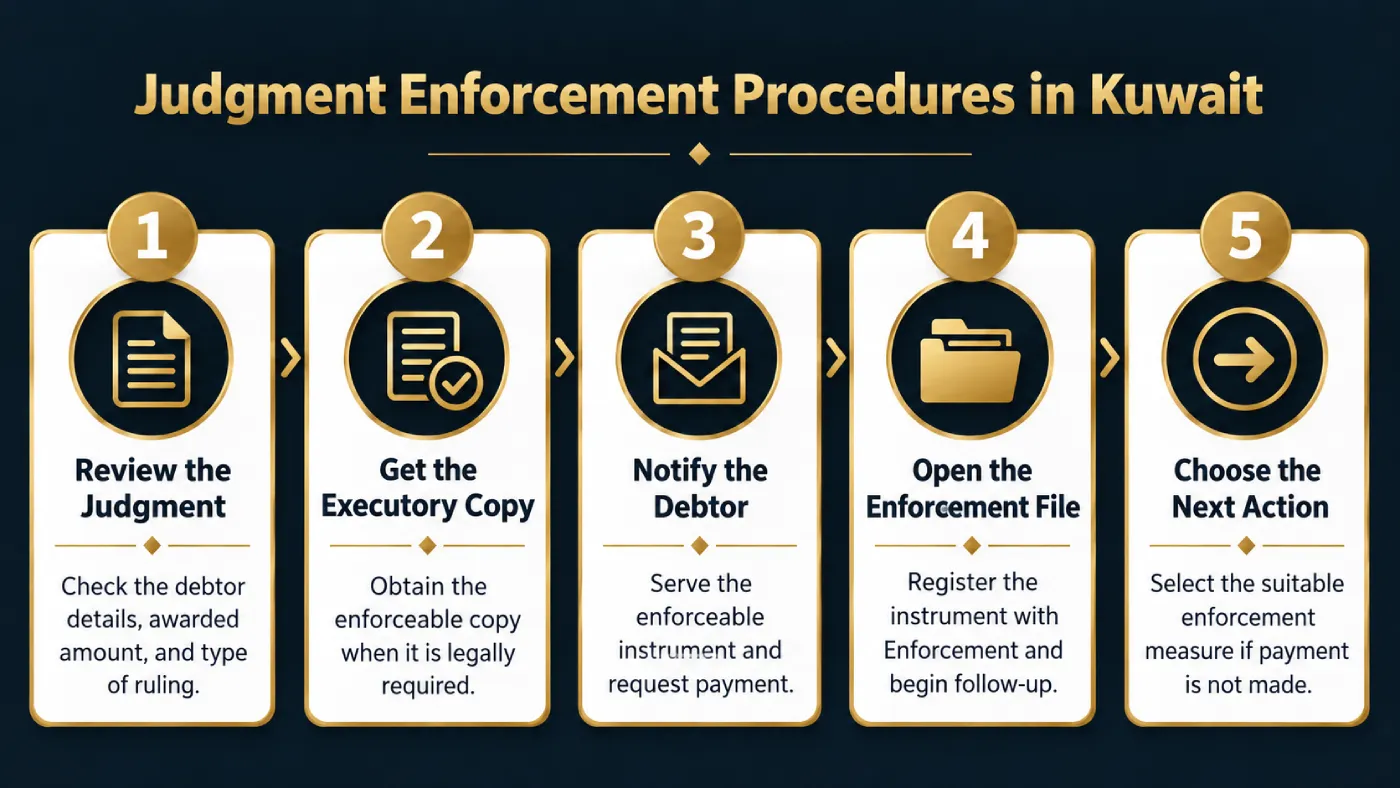
Judgment Enforcement Procedures in Kuwait Step by Step
Judgment Enforcement Procedures involve several connected stages. It is therefore generally inappropriate to move directly to attachment or seizure before confirming that the preceding steps have been completed.
1. Review the Judgment and Its Operative Part
Review the name of the judgment debtor, the amount or obligation awarded, the type of judgment, and whether it is subject to expedited enforcement or requires waiting until its enforcement status becomes settled.
This review also helps confirm that the amount being enforced matches the operative part of the judgment, particularly where the court has granted some claims while rejecting others.
2. Obtain the Executory Formula When Required
The Procedures Law provides that enforcement, except in legally excluded cases, is carried out on the basis of a copy of the enforceable instrument bearing the executory formula.
The Kuwaiti Ministry of Justice lists the service of the judgment’s executory formula among the services provided by the Enforcement Departments. The service requires the executory formula to be placed on the original judgment, together with the civil ID of the applicant and the defendant’s address details. The service page also indicates that no fee is published for this transaction.
Accordingly, merely possessing a copy of the judgment may not be sufficient. You should confirm that you have the form of the judgment that can legally be used for enforcement whenever such a form is required.
3. Serve the Enforceable Instrument on the Debtor
This is one of the most important stages of Judgment Enforcement Procedures.
Article 204 of the Procedures Law provides that enforcement must be preceded by service of the enforceable instrument on the person against whom enforcement is sought in accordance with the law. The notice must identify what is required and include a demand for the debtor to perform the obligation. The rule also provides that enforcement may not begin until five days have passed from the debtor’s receipt of the notice.
A judgment may therefore be valid and enforceable, yet compulsory enforcement may still not begin immediately if the notification procedures have not been completed.
If the debtor’s address is incorrect or the notification details are incomplete, the proceedings may stop at this stage until the issue causing the delay is resolved.
4. Register the Instrument and Open the Enforcement File
Once the preceding steps have been completed, the matter moves into the enforcement follow-up stage.
The Enforcement Departments of the Ministry of Justice receive judicial documents and enforceable instruments, register and serve them, and then allocate enforcement files to enforcement officers to carry out the relevant procedures and record the actions taken.
From this stage onward, the judgment becomes subject to follow-up before the Enforcement Department in accordance with the procedures required by the file.
What Happens If the Debtor Does Not Pay After Notification?
If the debtor does not voluntarily pay, the next step is to determine the appropriate enforcement measure based on the available information about the debtor’s assets.
The debtor may have bank accounts, vehicles, real estate, or financial rights held by third parties, and the appropriate procedure will depend on the type of asset and the stage reached by the enforcement file.
This is where enforcement attachment may become one of the available options after the legal requirements for enforcement have been satisfied. It is not a procedure that begins merely because a judgment exists.
Reasons Enforcement May Stop Despite Having a Judgment
An enforcement file may stop despite the issuance of a judgment because one of the previous stages has not been completed. Identifying the point at which the file was delayed can therefore help before submitting a new request. Matters that may need to be reviewed include:
- Failure to complete the requirements necessary for enforcement.
- Failure to serve the debtor or incomplete debtor information.
- Failure to take the next procedural step after opening the enforcement file.
- Missing documents required for the relevant procedure.
- Insufficient information about the debtor’s assets.
Identifying the reason for the delay first can help determine the next appropriate step without repeating requests that do not address the actual problem.
Documents Worth Preparing for Enforcement Follow-Up in Kuwait
Before proceeding with the next step, it can be useful to gather the case and enforcement documents in one organized file, including:
- A copy of the judgment.
- The executory copy where required.
- Case details.
- Evidence of notification or information showing the stage reached.
- Available information about the debtor.
- Documents relating to any partial payment already made.
- Lawfully available information about assets that may be subject to enforcement.
- A power of attorney if the procedure is being submitted through an authorized representative.
The official documents required differ depending on the enforcement procedure. The Ministry of Justice specifies the documents and conditions for each service separately, so the requirements of the relevant procedure should be reviewed before submission.
When Should You Consult a Lawyer During the Enforcement Stage?
Legal review may become more important when the matter is no longer a routine procedural follow-up and an issue arises that requires legal assessment, such as:
- An objection or enforcement dispute arises.
- There are multiple judgments or procedures connected with the debt.
- Part of the amount has been paid and the remaining balance needs to be determined.
- Information about the debtor’s assets is available, but the legally appropriate procedure is unclear.
- The enforcement file remains delayed despite completion of the basic procedures.
Consulting a lawyer in Kuwait does not guarantee recovery, as the existence of a judgment alone does not guarantee that the debtor has assets available for enforcement. However, legal review can help you understand the status of the file more accurately and identify the procedure permitted by the documents and applicable law.
Frequently Asked Questions About Judgment Enforcement Procedures in Kuwait
Can a debtor voluntarily pay after an enforcement file is opened?
Yes. A debtor may settle the amount due even after enforcement procedures have started. If payment is made, the enforcement file should reflect the amount received and any remaining balance, as the next procedural step depends on whether the obligation has been fully or partially satisfied.
What happens if only part of the judgment amount is paid?
Partial payment does not automatically end enforcement. The amount paid should be documented, and the remaining balance should be identified before any further procedure is taken. This helps ensure that enforcement continues only for the outstanding amount covered by the judgment.
Can enforcement continue if the debtor changes address?
A change of address can affect notification and procedural follow-up. If the debtor cannot be properly served because the address information is inaccurate or outdated, the enforcement process may be delayed until the required notification steps are completed in accordance with the applicable procedure.
What if the debtor has no obvious assets?
The absence of immediately known assets does not itself cancel the judgment. The next step depends on the information available about the debtor and the type of assets that may legally be subject to enforcement. The file should be reviewed before choosing a specific enforcement measure.
In conclusion, Judgment Enforcement Procedures in Kuwait require careful follow-up at each stage and the selection of an enforcement measure that suits the status of the file and the available information about the debtor’s assets. If enforcement has stopped or the next step is unclear, you can contact Attorney Riyadh Mutni Al-Fadhli to review the file and determine the appropriate legal path.
Related Legal Articles:
Procedures for Filing a Discharge of Liability Claim in Kuwait: What should you know before starting?
Legal Disclaimer: This content is provided for general educational purposes only and does not constitute legal advice. Reading it does not create a lawyer-client relationship. Judgment Enforcement Procedures may differ depending on the judgment, facts, documents, and the stage reached by each case.

Lawyer in Kuwait, Registration No. 8342. Through this personal platform, he provides educational legal content covering contracts, companies and investment, arbitration, and commercial dispute resolution. The content is presented in a clear and precise manner to help individuals and businesses understand their legal options and reduce potential risks.