
A financial demand letter is used in Kuwait when you are owed an outstanding amount and want to request payment from the other party in a written and organized manner. The claimant often needs a clear format that can be adapted to the circumstances of the case, while understanding the difference between an ordinary payment request and more formal legal correspondence.
The strength of the letter does not depend on harsh wording or excessive legal terminology. Instead, it depends on presenting the claim clearly and supporting it with information that can be verified. If the debt forms part of a broader collection process, reviewing the services of a debt collection lawyer in Kuwait may help determine the most appropriate type of correspondence before sending it.
A financial demand letter is correspondence in which the creditor states the amount claimed, the basis on which it is due, and the payment date, then asks the other party to pay or respond within a clearly defined period. The more clearly the letter is supported by information and documents, the easier it becomes to review and respond to.
Are you owed money and want to send a financial demand letter without weakening your position because of inaccurate wording or missing documents? Lawyer Riyadh Matni Al-Fadhli can review the letter and its supporting information and help determine the appropriate wording before it is sent.
Or continue reading the article first to learn about the wording, information, and documents that should be reviewed before sending the letter.
Table of content
What Should a Financial Demand Letter in Kuwait Include?
The recipient should be able to understand the claim simply by reading the letter. They should know who is making the claim, why the amount is due, how much is being claimed, when it became payable, and what document or reference supports the claim. Therefore, general statements such as “we request payment of the outstanding amounts” are usually insufficient, particularly where the transaction involves more than one contract, invoice, or payment.
It is preferable for the letter to include:
- The claimant’s name and contact details.
- The name of the person, company, or entity to whom the letter is addressed.
- A brief description of the reason for the claim.
- The contract, invoice, or purchase order number, where applicable.
- The exact amount being claimed.
- The due date.
- Any amounts already paid, if applicable, and the remaining balance.
- The required period for payment or response.
- Payment details where necessary.
- The attached documents supporting the claim.
- The name, capacity, and date of the person issuing the letter.
The amount claimed should correspond with the supporting documents. If the debt arises from several invoices, it is preferable to attach a statement showing each invoice, the amounts already paid, and the remaining balance.
How Do You Write a Clear Financial Demand Letter?
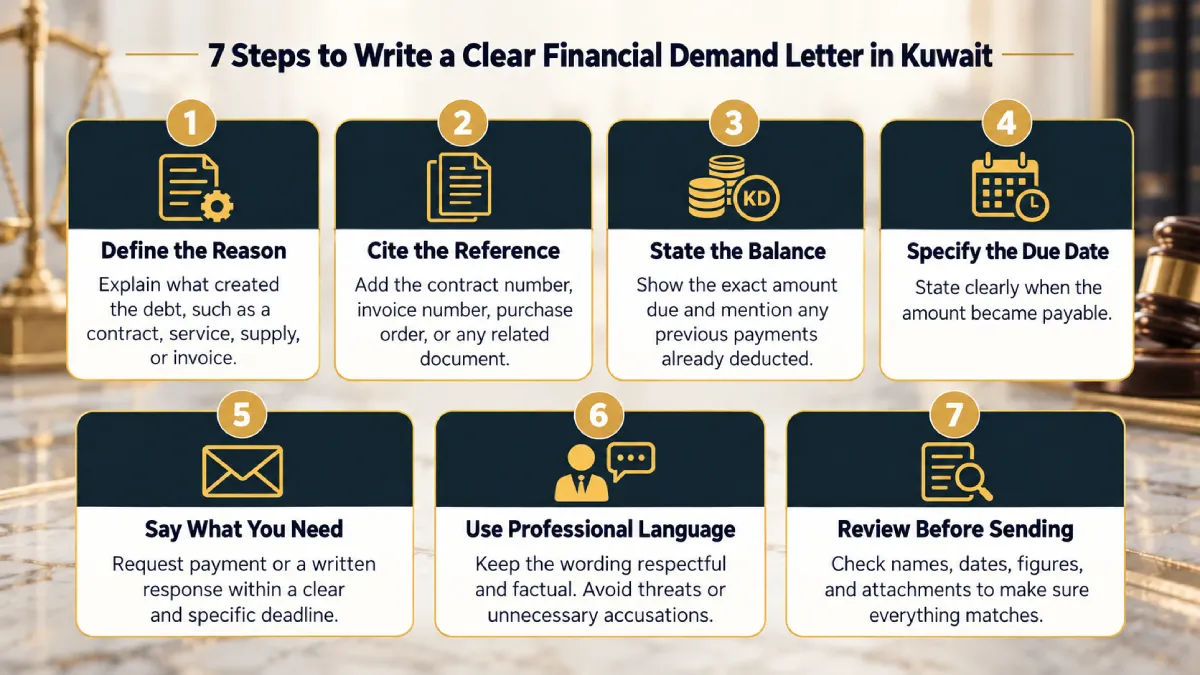
Start with facts that can be verified and arrange the letter so that the reader moves logically from the reason for the claim to the amount due and then to the action required, while avoiding threatening or pressuring language.
The letter can be organized as follows:
- Identify the reason for the claim: Explain the relationship from which the amount arose, such as a contract, service, supply arrangement, or invoice.
- State the relevant reference: Specify the contract number, invoice number, purchase order number, or any other relevant document.
- Clarify the outstanding balance: State the exact amount claimed and identify any previous payments that have already been deducted.
- Specify the due date: State when the amount became payable.
- Explain what is required from the other party: Request payment or a response within a specific and clearly defined period.
- Use professional language: Avoid threats or unnecessary accusations that the other party is deliberately delaying payment or acting in bad faith.
- Review the information before sending: Make sure the names, figures, dates, and supporting documents are accurate and consistent.
This structure helps reduce confusion and errors caused by inconsistent figures, references, or attachments.
Sample Financial Demand Letter to a Company in Kuwait
When preparing a financial demand letter for a company, it is preferable to connect the amount directly to the commercial transaction from which the claim arose. This becomes particularly important where several contracts, purchase orders, or invoices are involved, because the company’s finance or legal department needs to identify the relevant transaction quickly and without ambiguity.
The following format may be used as a guide and adapted to the circumstances of the case:
Dear [Company Name],
Subject: Financial Demand Letter for an Outstanding Amount
Dear Sir/Madam,
With reference to [the contract/purchase order/agreement] No. (…) dated (…), and invoice/invoices No. (…), we wish to inform you that an amount of (…) Kuwaiti Dinars remains outstanding in connection with [brief description of the service, goods, or obligation].
The amount became due on (…), and the remaining balance as of the date of this letter is (…) Kuwaiti Dinars after taking into account any previous payments, where applicable.
Accordingly, we kindly request that you review the outstanding balance and arrange payment within (…) from the date of receipt of this letter, or provide us within the same period with any documented comments concerning the amount claimed.
Payment details: (…)
Attachments: [Contract – Invoice – Account Statement – Relevant Documents]
Yours faithfully,
Name: (…)
Capacity/Title: (…)
Contact details: (…)
Date: (…)
It is not advisable to use this template without modification if part of the amount is disputed. In that situation, the letter should accurately reflect the balance on which the claim is based and identify the supporting documents without ignoring an existing objection that may affect how the amount should be presented.
Sample Financial Demand Letter to a Government Entity in Kuwait
A financial demand letter addressed to a government entity differs from one addressed to a private company in terms of presentation and administrative organization. In this context, it becomes particularly important to identify the competent department, the contract or transaction number, and the document connecting the amount to the relevant entitlement so that the responsible department can review the claim easily.
The following format may be used as a guide:
Mr./Ms. [Job Title of the Competent Official]
[Name of Government Entity]
Subject: Financial Claim Relating to [Contract/Service/Supply] No. (…)
Dear Sir/Madam,
With reference to [the contract/assignment order/purchase order] No. (…) dated (…) concerning [brief description of the subject matter], we kindly request that you review the entitlement to an amount of (…) Kuwaiti Dinars in respect of the referenced [works/services/supplies].
We have attached to this letter the documents relating to the claim, including [invoice/completion certificate/account statement/relevant correspondence], depending on the nature of the transaction.
We kindly request that you review the claim and advise us of its status, or identify any documents or requirements necessary to complete the procedures relating to it.
Yours faithfully,
Name or entity: (…)
Contract or transaction number: (…)
Contact details: (…)
Date: (…)
Attachments: (…)
This template represents a general form of correspondence and does not mean that all government entities follow the same requirements. Procedures and required documents may differ depending on the entity, contract, and nature of the entitlement. The terms of the relevant contract and the requirements of the competent authority should therefore be taken into account in each case.
When Should You Use a Financial Claim Notice in Kuwait?
A financial claim notice may be used when the purpose is to document that the other party has been informed of the amount claimed, explain why the amount is due, and provide that party with a clear opportunity to address the claim. This may be appropriate after the due date has passed or after previous correspondence has failed to resolve the outstanding balance.
It is preferable to retain an identical copy of the notice and all attachments, particularly if the correspondence may become important at a later stage. If correspondence does not lead to settlement of the amount, the claim may in some cases proceed to a financial claim lawsuit, depending on the nature of the right and the available documents.
However, the title of the document alone does not give it a specific legal effect. Merely describing a document as a “financial claim notice” is not sufficient, because its legal effect depends on the nature of the procedure, the purpose of the correspondence, and the legal requirements applicable to it.
Is a Payment Notice the Same as a Demand Letter?
Not necessarily. Some people use the term “payment notice” generally to refer to a letter requesting payment, while Kuwait also provides for a formal notice procedure with specific requirements through the Ministry of Justice.
The Kuwait Ministry of Justice publishes a separate service titled (Notice Service: Formal Notice, Incidental Notice). It states that serving a formal notice requires the original notice and a copy, the civil ID or power of attorney, and the address of the person to be served. It also identifies the enforcement departments in Kuwait’s various governorates as the competent authorities. The Ministry further publishes a specified fee for the formal notice and an approximate service period.
Accordingly, a financial demand letter does not become a formal legal notice merely because the word “notice” is used in its title. If the purpose is simply to request payment, the wording should reflect that purpose. If the intention is to initiate a formal procedure, the requirements of that procedure must be followed.
What Changed in the Demand for Payment Following the 2025 Amendment?
The distinction between an ordinary letter and a formal demand for payment becomes particularly important in relation to payment orders. Decree-Law No. 71 of 2025 amended certain provisions of the Civil and Commercial Procedures Law, including provisions relating to the demand for payment that must precede an application for a payment order.
The amendment provides that the debtor must be granted a period of not less than ten days before a payment order is sought. This period applies specifically to that procedural route and does not constitute a general rule applicable to every financial demand letter.
What Mistakes Can Weaken a Financial Demand Letter?
The underlying right may be clear, yet the letter itself can still create problems if it contains inaccurate information or confusing wording. It is therefore preferable to review the figures, references, and attachments carefully before sending the letter rather than discovering an error after correspondence has already begun.
The most important mistakes to avoid include:
- Stating an amount that does not match the invoices or account statement.
- Failing to deduct a payment that has already been received from the outstanding balance.
- Leaving the due date unclear or unspecified.
- Referring incorrectly to a contract or invoice number.
- Addressing the letter to a person or entity that is not responsible for the claim.
- Failing to explain directly why the amount is due.
- Using general threatening language instead of clearly stating what is required from the recipient.
- Giving a vague deadline such as “as soon as possible” without defining a clear period.
- Describing ordinary correspondence as a “formal notice” or “demand for payment” when it does not comply with the intended legal procedure.
- Attaching documents without explaining how they relate to the amount claimed.
Frequently Asked Questions About Financial Demand Letters
Which documents can support a financial demand letter?
Useful supporting records may include the contract, invoices, purchase orders, account statements, payment records, completion certificates, and relevant correspondence. The documents should clearly connect the amount claimed to the underlying transaction. If several invoices are involved, attach a statement showing each invoice, payments already received, and the remaining balance.
How long should the recipient be given to respond?
There is no single response period that automatically applies to every ordinary financial demand letter. The period should be clear and appropriate to the circumstances. Different rules may apply when the communication forms part of a specific legal procedure, such as a demand for payment preceding an application for a payment order.
What if the debtor disputes part of the amount claimed?
Yes. If the debtor disputes part of the amount, the letter should reflect the balance actually being claimed and identify the documents supporting it. Avoid presenting a disputed figure as undisputed. Recording the basis of the disagreement and the amounts already paid can make the claim easier to review and respond to.
When is legal review useful before sending the letter?
A lawyer’s review can be useful when the amount is significant, the documents are inconsistent, part of the debt is disputed, or the next step may involve a formal legal procedure. The review can help distinguish an ordinary payment request from a notice or procedural demand that carries specific legal requirements.
A financial demand letter remains a practical way to organize a claim and clearly explain the outstanding amount and the basis on which it is due. When the appropriate procedure is unclear, consulting a lawyer in Kuwait can help assess the documents and determine the step that best suits the nature of the claim.
If you have an existing claim or documents that need to be reviewed before sending, you can contact Lawyer Riyadh Matni Al-Fadhli to discuss the details of the matter and review the wording according to the facts of the case.
Related Legal Articles:
- Procedures for Filing a Declaratory Action for Discharge of Liability in Kuwait: What should you know before starting?
- Enforcement Seizure in Kuwait: Conditions and procedures for seizing a debtor’s assets.
Disclaimer: This content is intended for general legal awareness only and does not constitute legal advice for an individual case. The appropriate wording and procedures may vary depending on the facts, documents, contracts, and applicable legal provisions.

Lawyer in Kuwait, Registration No. 8342. Through this personal platform, he provides educational legal content covering contracts, companies and investment, arbitration, and commercial dispute resolution. The content is presented in a clear and precise manner to help individuals and businesses understand their legal options and reduce potential risks.