Your trip may be just days away when you discover, during a routine inquiry, that a travel ban prevents you from leaving Kuwait because of a debt you thought you had settled some time ago. At that point, the most pressing question is how to deal with the ban before your departure date.
Lifting a Travel Ban in Kuwait starts with identifying why the order was issued. You must then establish whether the debt has been discharged or whether any of the grounds for the ban to lapse under the Kuwaiti Civil and Commercial Procedures Law apply. The appropriate procedure must then be completed before the competent authority.
Are you subject to a travel ban and unsure whether payment, a guarantee, or an objection is the right course of action? Attorney Riyadh Matni Al-Fadhli can review your documents and explain the legal options available for addressing the order.
Contact Attorney Riyadh Matni Al-Fadhli
Or continue reading to learn when a travel ban lapses and the legal steps required to lift it.
Table of content
When Is Lifting a Travel Ban in Kuwait Legally Possible?
Article 298 of the Kuwaiti Civil and Commercial Procedures Law sets out the circumstances in which a travel ban order lapses. How each ground is established depends on the nature of the obligation, the supporting documents, and the procedures recorded in the enforcement file.
These circumstances include:
- Discharge of the debt: The basis for the ban ceases to exist when the obligation that the order was intended to secure has been discharged.
- Creditor’s consent: The order lapses if the creditor agrees in writing to cancel the travel ban.
- Failure of a condition for the ban: The order lapses when one of the legal requirements for its continuation is no longer satisfied.
- Provision of acceptable security: The ban may lapse if the debtor provides a sufficient bank guarantee or a financially capable guarantor accepted by the authority competent to issue the order.
- Deposit of the amount due: The debtor may deposit an amount equal to the debt and its ancillary sums with the Enforcement Department’s treasury, earmarked to satisfy the creditor’s claim.
- Failure to file a claim: The order lapses if the creditor fails to provide the Enforcement Department, within seven days of its issuance, with proof that a court claim for the debt has been filed.
- Failure to seek enforcement of the judgment: The order lapses if three years pass after the final judgment on the debt claim without the creditor requesting its enforcement.
- Failure to pursue enforcement: The order lapses if three years pass after the last valid step taken to enforce the final judgment without a request to continue enforcement proceedings.
The last two situations require a careful review of the case file, particularly the judgment date and the steps taken after it was issued. The mere passage of three years since the debt arose is not enough to establish that a travel ban has lapsed.
What Are the Steps to Lift a Travel Ban in Kuwait?
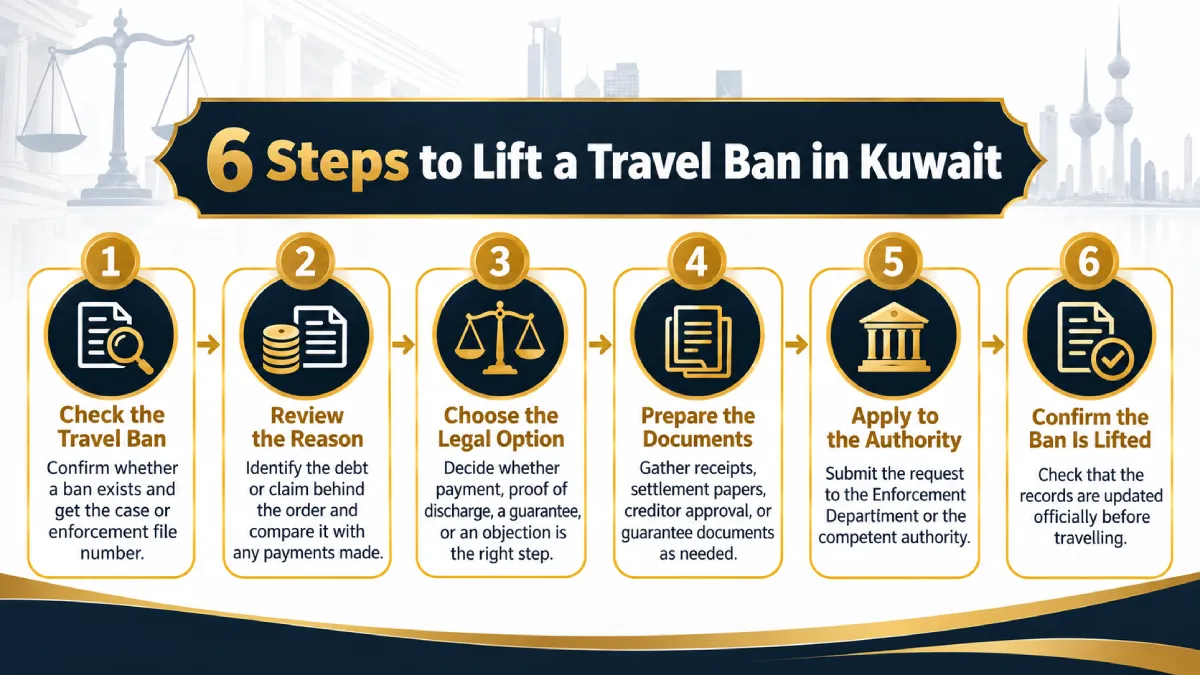
Lifting a Travel Ban in Kuwait involves several legal steps, depending on the grounds for the order and the details recorded in the enforcement file:
- Check the travel ban order: Verify whether an order exists through government services and obtain the associated case or enforcement file number.
- Review why it was issued: Identify the debt underlying the ban and compare the claimed amount with any payments already made.
- Choose the appropriate legal procedure: Determine whether the case requires proof of payment, notification that the debt has been discharged, provision of security, or an objection to the order.
- Prepare supporting documents: Gather payment receipts, debt settlement or discharge documents, the creditor’s written consent, or guarantee documents, depending on the grounds relied upon.
- Apply to the competent authority: Complete the procedure before the Enforcement Department or through the applicable judicial process, depending on the nature of the application.
- Follow up on the order’s status: Confirm that the ban has lapsed or that the appropriate decision has been issued, and verify that the official records have been updated before travelling.
The Kuwaiti Ministry of Justice provides a travel ban inquiry service through its service centres. You can also use the personal inquiry service on the Ministry’s Adl platform after registering and verifying your identity through the Kuwait Mobile ID (Hawiyti) app.
Because debt-related travel bans arise in the course of claims and debt recovery procedures, consulting a debt collection lawyer in Kuwait may help clarify how a settlement, payment, or guarantee affects the continued validity of the order.
Documents Required to Lift a Travel Ban
The documents required for Lifting a Travel Ban in Kuwait depend on the legal grounds supporting the request. Evidence that a debt has been discharged is not necessarily the same as the documentation required to have a guarantee accepted or to challenge the continuation of an order.
The table below outlines the main documents that may support each situation:
| Grounds for Lifting the Ban | Supporting Documents |
|---|---|
| Payment of the debt | An official payment receipt or a discharge document confirming payment |
| Creditor’s consent | Express written consent to cancel the ban |
| Provision of a bank guarantee | The guarantee document, to assess its sufficiency and acceptance |
| Provision of a financially capable guarantor | Documents needed to assess the guarantor’s financial capacity and suitability |
| Deposit of the debt amount | Evidence of depositing the debt and ancillary amounts with the Enforcement Department’s treasury |
| Failure of the ban’s legal conditions | Documents showing that a condition for issuing or maintaining the order is not satisfied |
| Failure to continue enforcement | Judgment details and dates of the steps recorded in the enforcement file |
It is also advisable to prepare the case or enforcement file number and the concerned person’s details, along with proof of authority if the application is submitted by a representative.
Can a Travel Ban Be Lifted After the Debt Is Paid?
Yes. Under Article 298 of the Procedures Law, the travel ban order lapses when the obligation it was intended to secure has been discharged. However, the method of proving payment varies depending on whether the amount was paid through the Enforcement Department or directly to the creditor.
If the debt is discharged outside the Enforcement Department, the Article requires the creditor to notify the Department within one week of the discharge date. It also gives the debtor the right to submit that notification personally at any time.
The Kuwaiti Ministry of Justice offers an online payment service for travel ban orders in certain types of cases, including:
- Full and partial payment orders.
- Acknowledgments of debt.
- Fee assessment orders.
- Orders assessing differences in expert fees.
To make a payment, enter your civil ID number, review the amount due, and complete the transaction by following the instructions displayed by the service.
If the amount is deducted from your bank account but no receipt is issued, the Ministry of Justice advises against paying again. It states that the amount will be credited to the case balance on the following day.
Therefore, if you have paid the debt but the travel ban still appears in the system, first check your payment receipt and case number to ensure that the amount was credited to the correct file. If payment was made directly to the creditor, you may need to prove that the obligation has been discharged and notify the Enforcement Department.
Can a Travel Ban Be Lifted Without Paying the Entire Debt?
Yes. The law provides for a travel ban order to lapse in circumstances that do not require immediate payment of the entire debt directly to the creditor. The creditor may agree in writing to cancel the order, or the debtor may provide a sufficient bank guarantee or a financially capable guarantor accepted by the competent authority.
The debtor may also deposit a sum equal to the debt and its ancillary amounts with the Enforcement Department’s treasury, earmarking it to satisfy the creditor’s claim in accordance with Article 298.
However, Lifting a Travel Ban in Kuwait does not necessarily mean that the underlying debt has been discharged. A guarantee may be accepted and the order may lapse while the financial obligation remains outstanding until it is paid or otherwise discharged under the law.
Grounds for Objecting to a Travel Ban Order
A travel ban order may be issued even where legal grounds exist to challenge it. The Procedures Law therefore allows an objection to the order when the requirements for issuing or maintaining it have not been met.
Under Article 297, a debt-related travel ban requires an established debt that is due and payable, together with serious grounds for believing that the debtor may evade payment by fleeing, despite having the means to pay.
Accordingly, the debtor’s need to travel or the existence of a dispute over the amount is not, by itself, a sufficient basis for an objection. The objection must identify a legal ground and be supported by relevant documents.
The dispute may also concern the underlying financial obligation itself. In that case, it may be necessary to consider the procedures for filing an action for a declaration of discharge from debt in Kuwait as a separate legal remedy. Filing such an action does not automatically cancel the travel ban order.
Can You Travel for Medical Treatment Despite a Travel Ban?
Article 297 of the Procedures Law allows permission for a debtor to travel for medical treatment in specified circumstances. This may concern the debtor’s illness or the illness of a parent, child, or spouse, as specified in the Article.
To qualify, an official medical certificate must establish that treatment is required outside Kuwait and cannot be provided within the country.
Permission to travel for medical treatment must be distinguished from the permanent lapse of the travel ban. Permission may be granted while the ban itself remains in force. You should therefore review the decision and its conditions and ensure that all required procedures have been completed before departure.
How Long Does It Take to Lift a Travel Ban in Kuwait?
There is no fixed timeframe that applies to every request to lift a travel ban. Some cases may be resolved through online payment, while others require notification that the debt has been discharged, acceptance of a guarantee, or a decision on an objection.
Official information available as of October 2026:
| Service or Procedure | Fee or Amount Payable | Published Processing Time |
|---|---|---|
| Travel ban inquiries at Ministry of Justice service centres | No fee | Approximately 10 minutes |
| Online payment for travel ban orders covered by the service | Amount due in the case | No single processing time published for all cases |
| Payment through the Travel Ban Office at border entry and exit points, for cases handled by that office | Amount payable under the order | The office’s instructions state that the restriction is removed from the computer system immediately after payment and the required procedure are completed |
It is important not to confuse the time needed to make an inquiry with the time required to lift a ban. The 10-minute period published for the official service applies to the inquiry only. It does not mean that every request to lift a travel ban will be completed within that time.
What Mistakes Can Delay the Lifting of a Travel Ban?
Lifting a Travel Ban in Kuwait may be delayed when the submitted documents do not match the enforcement records or when the chosen legal procedure fails to address the reason the restriction remains in force.
Common mistakes to avoid include:
- Relying solely on a verbal agreement with the creditor: An oral agreement does not replace the documents and notifications required by law to prove that an obligation has been discharged.
- Providing security without confirming its acceptance: The law requires the competent authority to accept the bank guarantee or proposed guarantor.
- Going to the airport before checking that the records have been updated: The travel ban may still appear in the system even if you have documents proving payment.
You should also not assume that lifting a travel ban brings every debt-related procedure to an end. Other measures, such as enforcement attachment, may continue depending on the nature of the obligation and the decisions issued in the enforcement file.
How Attorney Riyadh Matni Al-Fadhli Can Help Lift a Travel Ban
Attorney Riyadh Matni Al-Fadhli can help you understand your legal position by reviewing documents relating to the travel ban order and assessing the options available in light of the circumstances of your case. This review may include:
- Reviewing the travel ban order and identifying why it was issued.
- Examining payment receipts, discharge documents, and written consents.
- Assessing whether grounds exist for the order to lapse or be challenged.
- Identifying the documents and procedure appropriate to your situation.
- Explaining the next steps and any matters that require follow-up with the competent authority.
Frequently Asked Questions About Lifting a Travel Ban in Kuwait
Does a Kuwait travel ban disappear automatically once the debt is settled?
A travel ban order may lapse once the underlying debt has been discharged, but the official records must reflect that change. If payment was made directly to the creditor, the Enforcement Department may need to be notified. Always confirm the status of the order before making travel arrangements.
What should I do if my travel ban still appears after payment?
Start by checking the payment receipt, civil ID details, and enforcement case number. Confirm that the amount was credited to the correct case. If the debt was settled privately, provide evidence of discharge to the Enforcement Department. Do not assume that payment alone means the electronic restriction has been updated.
Can a creditor agree to cancel a travel ban in Kuwait?
Yes. Under Article 298 of the Kuwaiti Civil and Commercial Procedures Law, a travel ban order may lapse when the creditor provides written consent to its cancellation. The consent should be clear and properly documented. The relevant authority must also be notified so that the order's status can be addressed.
Will lifting a travel ban cancel other debt enforcement measures?
Not necessarily. Removing a travel ban does not automatically extinguish the underlying debt or terminate other enforcement measures. A creditor may still pursue legally available procedures, including enforcement attachment, depending on the case. Review the enforcement file to identify any remaining obligations or restrictions before assuming the matter is closed.
Lifting a travel ban in Kuwait depends on establishing a legal ground for the order to lapse and proving it before the competent authority. It is not limited to paying the debt. Consulting a lawyer in Kuwait may help you identify the necessary documents and avoid submitting an application unsupported by the facts.
If the travel ban order remains in effect, you can contact Attorney Riyadh Matni Al-Fadhli to discuss the next step based on the details of your case.
Related Legal Articles:
- Debt Demand Letter in Kuwait: Drafting and Practical Templates.
- Debt Recovery Lawsuit in Kuwait: When to File and How to Prove Your Claim.
- Bounced Cheque in Kuwait: What to Know Before Filing a Complaint or Reaching a Settlement.
Legal Disclaimer: This article provides general information about Kuwaiti law and does not constitute legal advice tailored to an individual case. Reading it does not create an attorney-client relationship. Procedures and outcomes vary depending on the facts, supporting documents, and decisions in effect in each case.

Lawyer in Kuwait, Registration No. 8342. Through this personal platform, he provides educational legal content covering contracts, companies and investment, arbitration, and commercial dispute resolution. The content is presented in a clear and precise manner to help individuals and businesses understand their legal options and reduce potential risks.