
Do you have a trust receipt but have not yet recovered your money? Or are you facing a demand for an amount stated in a receipt you previously signed? The evidentiary value of a trust receipt in Kuwait depends on the actual transaction between the parties and the evidence supporting it. A signature alone does not necessarily resolve every dispute concerning the receipt.
This article explains the requirements for a valid trust receipt, its evidentiary value before Kuwaiti courts, the distinction between a civil obligation and criminal breach of trust, and common mistakes that may affect the ability to prove a claim.
Are you confident that your trust receipt will support your claim? Even minor details in the document may affect your legal position. Attorney Riyadh Matni Al-Fadhli can help you assess the receipt and the supporting evidence, and clarify your legal position before you take action.
Contact Attorney Riyadh Al-Fadhli Now
Or continue reading to learn about the evidentiary value of trust receipts in Kuwait and what you should check before taking the next step.
Table of content
What Is a Trust Receipt in Kuwait?
A trust receipt is a private document recording that one person has received money or movable property from another for a specific purpose, with an obligation to safeguard, return, or use it as agreed by the parties. Its evidentiary value is governed by Kuwaiti rules of evidence. Liability for breach of trust, however, depends on the nature of the delivery and what the recipient did with the property, rather than merely on the title given to the document.
A dispute may arise when the recipient denies receiving the property or when either party disputes the amount stated or the reason the receipt was issued.
Where the receipt relates to a disputed financial obligation, consulting a debt collection lawyer in Kuwait can help clarify the document’s value as evidence and how it relates to other records, without assuming that every failure to fulfil an obligation constitutes a criminal offence.
Requirements for a Valid Trust Receipt in Kuwait
Clear information in a trust receipt helps identify the parties and the obligation involved, while reducing disputes over the amount or the purpose for which the property was delivered.
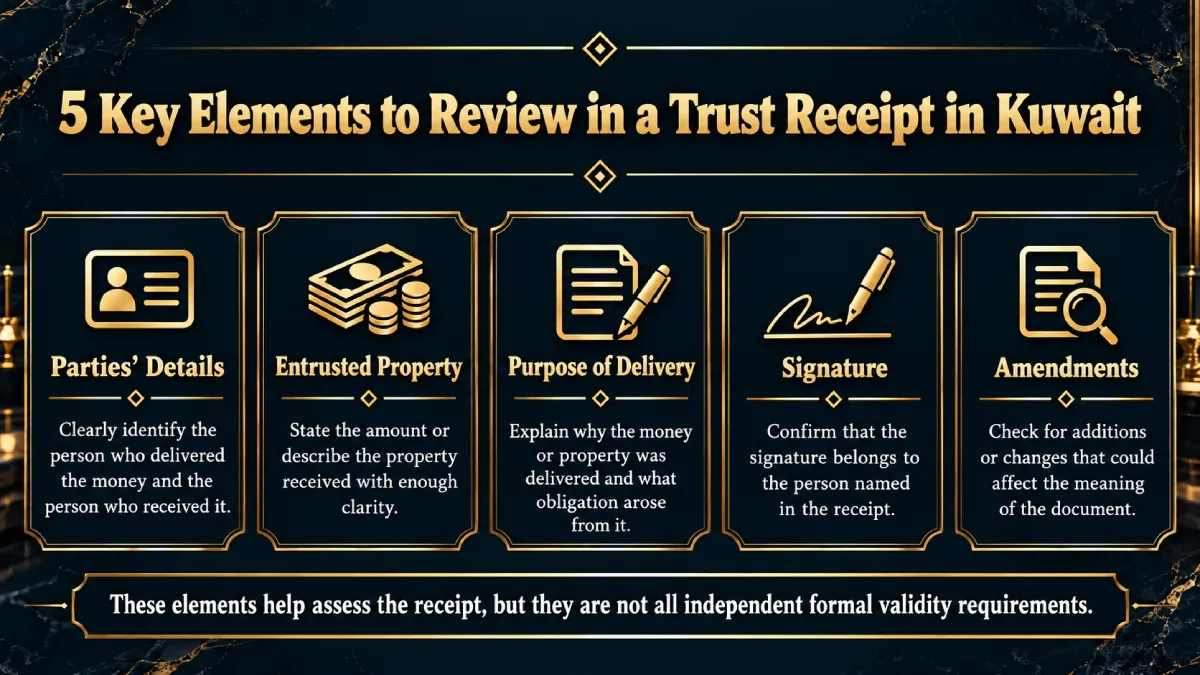
The following elements should therefore be checked when reviewing a trust receipt in Kuwait:
- Parties’ details: Clearly identify the person who delivered the money and the person who received it.
- Property entrusted: State the amount or describe the movable property received with sufficient clarity.
- Purpose of delivery: Explain why the recipient was given the property and what obligation arose from the transaction.
- Signature: Verify that the signature belongs to the person identified in the receipt.
- Amendments: Examine any additions or changes that may affect the document’s content or interpretation.
These elements are not all separate statutory formalities prescribed specifically for a document called a trust receipt. However, they help establish the true nature of the agreement and the obligations arising from it.
Missing information does not necessarily invalidate the receipt. Its effect depends on the nature of the omission and its importance in proving the obligation.
What Is the Evidentiary Value of a Trust Receipt Before Kuwaiti Courts?
A trust receipt in Kuwait may be relied upon as a private document, including when filing a financial claim, provided the legal requirements for its admissibility and evidentiary effect are met.
Article 13 of Decree-Law No. 39 of 1980 concerning Evidence in Civil and Commercial Matters provides that a private document is deemed to have been issued by the person who signed it unless that person expressly denies the handwriting, signature, seal, or fingerprint attributed to them, subject to the applicable legal provisions.
A signature establishes the attribution of a document to its signatory under the rules of evidence. However, the substance of the obligation and the reason for issuing the receipt may still be disputed in light of the facts of the case.
Article 27 of the Evidence Law also regulates allegations of forgery concerning official and private documents. This procedure is distinct from denying a signature, and each is subject to its own evidentiary rules.
For the relevant provisions, consult the Kuwaiti Evidence Law in the official collection of Kuwaiti legislation published by the Kuwait Institute for Judicial and Legal Studies.
Is a Trust Receipt Alone Sufficient to Prove Delivery of the Money?
A receipt may provide important evidence of delivery, but its weight depends on its contents and the evidence submitted by both parties. For example, a person may acknowledge signing the receipt while disputing why it was issued, or may claim to have already fulfilled the obligation. Depending on the nature of the dispute, this may require considering the procedures for filing a claim for discharge from liability.
Bank transfers, correspondence, and settlement receipts may help establish what actually occurred, particularly when the parties give conflicting accounts. Losing the original receipt or making unclear amendments to it may also complicate proof of the transaction.
The strength of a trust receipt does not depend on the signature alone, but on whether its contents reflect the actual transaction and are supported by the available evidence.
Can a Trust Receipt Lead to Imprisonment?
Failure to return the amount stated in a trust receipt in Kuwait does not automatically result in imprisonment. Criminal liability requires the elements prescribed by the Penal Code to be established. A mere delay in repaying money is not enough to prove criminal breach of trust.
Article 240 of Kuwaiti Penal Code No. 16 of 1960 addresses situations in which a person receives property belonging to another under one of the legally specified relationships of trust and subsequently appropriates it, uses it for personal benefit, or intentionally destroys it.
The article sets a penalty of imprisonment for up to three years, a fine not exceeding KWD 225, or either penalty. Its application nevertheless depends on proving the elements of the offence and does not automatically extend to cases involving difficulty repaying loans or debts.
The following table illustrates how the nature of a transaction can affect its legal assessment:
| Nature of the Situation | Possible Legal Assessment |
|---|---|
| A person receives money for safekeeping and deliberately appropriates it. | The elements of criminal breach of trust may be present. |
| A person borrows money and is unable to repay it. | This is generally a civil obligation and does not automatically amount to a criminal offence. |
| A person signs a receipt without receiving the money stated in it. | The actual delivery and supporting evidence must be examined. |
| The recipient returns the money and holds documentary proof of repayment. | Evidence of repayment affects the assessment of the claim. |
The Kuwait Institute for Judicial and Legal Studies discusses related issues in its official study, Crimes Against Property, which examines possession of property on trust and conduct that may constitute an unlawful interference with that property.
How Can You Protect Your Rights When Entrusted Money Is Not Returned?
A person may hold a signed trust receipt yet still struggle to recover the money because the other party denies receiving it or disputes the nature of the agreement. In such cases, it is important to review the documents before sending a formal demand for payment or deciding on the appropriate legal action.
To organize your trust receipt case in Kuwait, consider these steps:
- Review the original receipt: Check the parties’ details, signature, and amount, and make sure the wording concerning delivery and return is clear.
- Identify why the document was issued: Determine whether the money was genuinely delivered on trust or arose from a loan or another form of obligation.
- Collect proof of delivery: Keep bank transfer records, correspondence, and any documents showing how the money passed between the parties.
- Check whether the obligation was fulfilled: Review any repayments, settlement receipts, or later agreements that may affect the obligation.
- Assess the document legally: Identify what the existing records can prove and which aspects may require further evidence.
Mistakes That May Weaken the Evidentiary Value of a Trust Receipt
Certain mistakes in preparing or keeping a trust receipt may affect the ability to rely on it in a dispute. Their consequences often become apparent when the parties disagree about the amount or purpose of delivery.
Common mistakes to avoid include:
- Signing a receipt with significant blank spaces without clearly specifying the obligation.
- Recording an amount different from the sum actually delivered.
- Failing to document the purpose of delivery when the parties have several financial dealings.
- Changing information on the receipt without a documented agreement.
- Failing to retain documents proving that the money was returned or the amount repaid.
These mistakes do not necessarily invalidate the document, but some may weaken its evidentiary weight.
Article 26 of the Evidence Law allows the court to assess the effect of physical defects in a document, including erasures, alterations, and insertions, according to their impact on its evidentiary value.
If the receipt relates to several financial transactions, establishing the true nature of the obligation may require examining other records in the context of financial cases in Kuwait to clarify how each document relates to the disputed amount.
When Do You Need a Lawyer to Review a Trust Receipt?
You may need to consult a lawyer in Kuwait if a dispute arises concerning the validity of a trust receipt or the amount stated in it, especially when the available documents do not clearly establish the nature of the parties’ agreement.
A legal review is particularly important in the following situations:
- The other party denies receiving the money despite having signed the receipt.
- One party claims that the receipt was issued as security for a loan or another financial transaction.
- There is a dispute over the authenticity of the signature or information in the document.
- A demand for payment continues despite evidence that the amount has already been paid.
- The amount stated in the receipt does not match the related bank transfers.
Attorney Riyadh Matni Al-Fadhli can assess the receipt’s evidentiary value in light of the facts and available documents and explain the legal options appropriate to the dispute.
Frequently Asked Questions About Trust Receipts in Kuwait
Does a handwritten trust receipt have legal value in Kuwait?
A handwritten trust receipt may have evidentiary value in Kuwait if its authenticity and connection to the underlying transaction can be established. Under Article 13 of Kuwait's Evidence Law, a private document is generally attributed to its signatory unless the relevant signature or handwriting is expressly denied, subject to applicable evidentiary rules.
Can I challenge a trust receipt after signing it?
Yes. Signing a trust receipt does not necessarily prevent a person from disputing the underlying obligation or the circumstances in which the document was issued. Depending on the facts, the dispute may concern the actual delivery of money, the purpose of the transaction, repayment, or alleged alterations to the document.
What happens if the original trust receipt is lost?
Losing the original trust receipt may make it more difficult to establish the document's authenticity and evidentiary weight. The consequences depend on the available copies, supporting records, and applicable rules of evidence. Bank transfers, correspondence, and other documents may help establish the underlying transaction, but they do not automatically replace the original.
Can a trust receipt be used as security for a personal loan?
A trust receipt may be issued in connection with a loan, but describing a debt as entrusted money does not automatically make it a criminal breach of trust. Kuwaiti courts must consider the actual legal relationship, the purpose of delivery, and the relevant evidence when assessing whether the dispute concerns a civil debt or criminal conduct.
A trust receipt in Kuwait is one of the documents that may be used to prove financial obligations. However, its legal value varies according to the circumstances in which it was issued and the nature of the transaction between the parties. Reviewing its details and supporting evidence therefore helps identify the appropriate legal course for the dispute.
If you have a disputed trust receipt, you can contact Attorney Riyadh Matni Al-Fadhli to request an appointment to review your documents and understand the strengths and weaknesses of your position before deciding on the appropriate legal action.
Related Legal Articles:
- Enforcement Seizure in Kuwait: Requirements and procedures for seizing a debtor’s assets.
- Procedures for Enforcing a Judgment in Kuwait: What should you do after a judgment is issued?
- Payment Order Under Kuwaiti Law: When is it used, and what are the procedures?
- Bounced Cheque in Kuwait: What should you know before filing a complaint or reaching a settlement?
Legal Disclaimer: This article provides general legal information for educational purposes only. It does not constitute personalized legal advice, and reading it does not establish an attorney-client relationship. Legal assessments vary depending on the facts, evidence, and applicable legislation.

Lawyer in Kuwait, Registration No. 8342. Through this personal platform, he provides educational legal content covering contracts, companies and investment, arbitration, and commercial dispute resolution. The content is presented in a clear and precise manner to help individuals and businesses understand their legal options and reduce potential risks.