An embezzlement accusation may begin with a financial discrepancy in the accounts or a shortage in entrusted funds or inventory. However, an inventory report alone is not sufficient to establish liability. Financial transactions must be traced, and the actual authority and access rights of each person handling the funds must be identified.
An acquittal in embezzlement cases in Kuwait depends on proving how the money was entrusted, tracing its movement, and determining whether there is evidence that the accused disposed of it with the intent to appropriate it. This article explains the key defenses in embezzlement cases and the documents needed to identify the cause of the shortage and the person responsible for it.
Have you been accused of embezzlement because of a financial shortage and are concerned about detention or a travel ban? Attorney Riyadh Mutni Al-Fadhli can review the case documents, inventory report, and available defenses and determine the appropriate legal procedure based on the facts, without assuming any specific outcome.
Contact Us to Review Your Case NowOr read the article first to learn about the main defenses in embezzlement cases and what steps you should take
Table of content
What Should You Do If You Are Accused of Embezzlement in Kuwait?
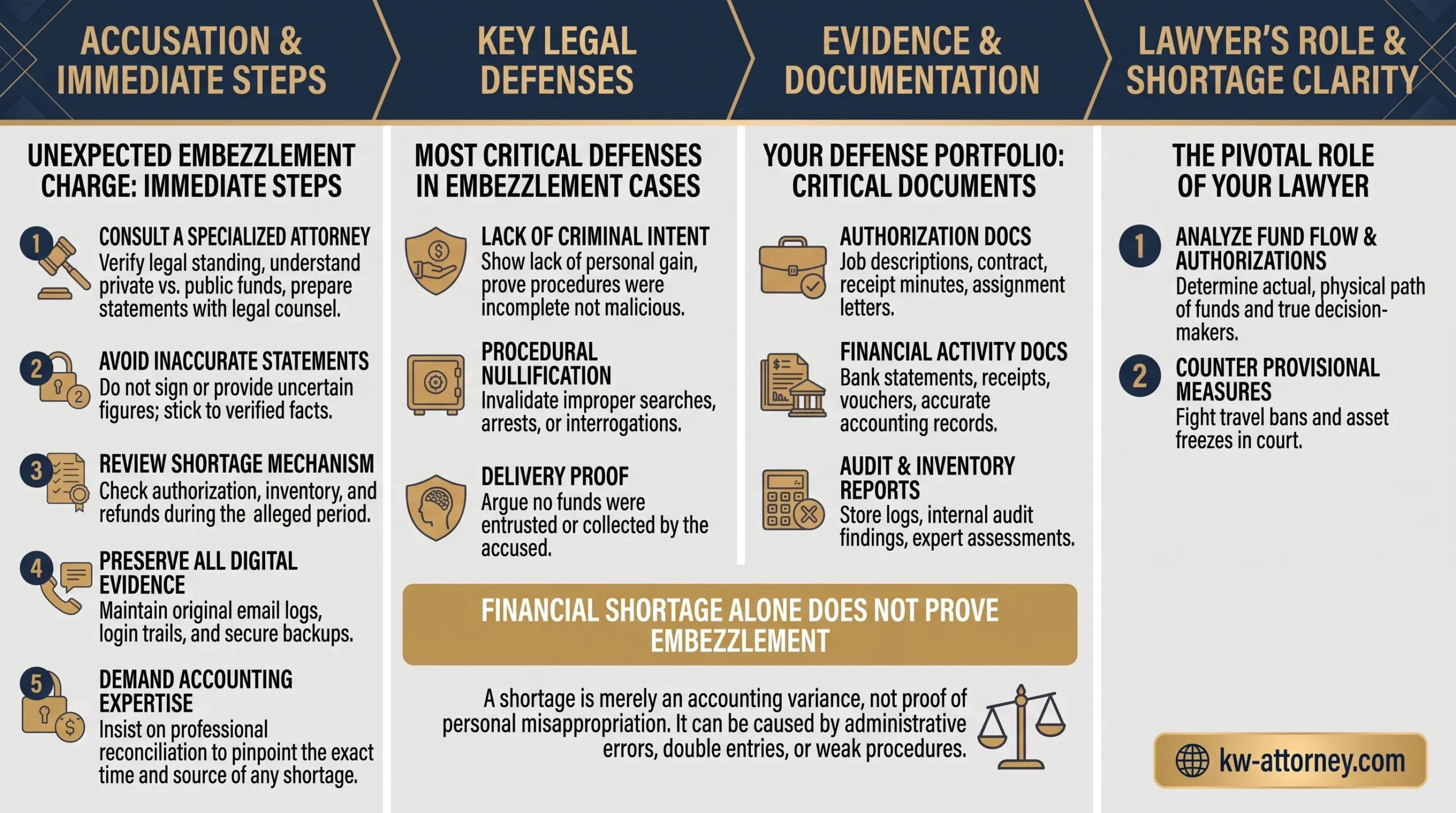
An embezzlement accusation requires careful and measured action from the beginning of the investigation. The most important steps include:
- Consult a lawyer in Kuwait before giving a detailed statement to determine the nature of the incident, the applicable law, and whether the matter involves public funds, private funds, or an accounting dispute.
- Avoid unverified statements: do not provide estimated explanations for amounts or accounting entries before reviewing the records, and do not sign a report containing inaccurate figures or facts.
- Examine how the shortage was calculated: review the audit or inventory period, the transactions included in the amount, the users who had access, and whether cancellations, returns, and adjustments were properly accounted for.
- Preserve electronic evidence: retain correspondence, access logs, reports, and backups in their original form without deleting or altering anything that may affect their evidentiary value.
- Request accounting expertise when necessary: an accounting expert may help match entries against supporting documents and bank accounts, identify when the shortage arose, trace the movement of funds, and determine its connection to the accused.
Key Defenses for Acquittal in Embezzlement Cases in Kuwait
There is no single defense that applies to every embezzlement case. Each defense should be supported by a specific fact, document, or technical piece of evidence.
The Public Funds Protection Law Does Not Apply
This defense may be raised in cases involving embezzlement of public funds where it is not established that the funds are owned by or subject to one of the entities specified in Article 2 of the law, or where the incident concerns funds belonging to a private company that falls outside the scope of the law.
This does not automatically eliminate potential liability, as the investigating authority may examine whether another criminal classification applies to the facts.
No Proof That the Funds Were Entrusted to the Accused Because of Their Position
The entrustment of money to the accused by reason of their employment or position is a key element in an embezzlement charge. This element may be disputed where one of the following circumstances is established:
- The accused did not sign a record acknowledging receipt of the entrusted funds or property.
- The money or goods were delivered to another person.
- The funds or property were jointly entrusted to several employees.
- The accused was not responsible for safeguarding, collecting, or disbursing the money.
- More than one person had access to the safe, account, or password.
- The shortage existed before the accused assumed responsibility.
- No inventory or reconciliation was conducted when responsibility began or ended.
No Act of Embezzlement Was Established
The fact that funds were under an employee’s control does not by itself mean that the employee embezzled them. The prosecution must identify conduct indicating that temporary possession connected to the employee’s duties was converted into possession for their own benefit.
For example, retention of funds may have resulted from an incomplete handover process, instructions to suspend payment, or a pending reconciliation of accounts. Such an explanation should be supported by the case documents.
By contrast, transferring the money to a personal account, selling property, concealing its destination, or providing false information about it may be used as evidence against this defense.
Lack of Criminal Intent and Intent to Appropriate the Funds
This defense arises when the evidence is insufficient to establish that the accused intended to appropriate the money or dispose of it for their personal benefit.
Indicators that may be examined include:
- The accused received no personal benefit.
- The transaction was recorded and no attempt was made to conceal it.
- Prior authorization or instructions existed.
- The accused took the initiative to report the discrepancy.
Merely claiming good faith is not sufficient. The circumstances of the case and supporting documents should substantiate that position.
Invalidity of a Material Procedure
The defense may challenge the validity of a search, seizure, interrogation, or expert examination where the procedural defect affects the legality of the evidence or the accused’s right to a defense, provided that the objection is raised at the appropriate legal stage.
Why Does a Financial Shortage Alone Not Prove Embezzlement?
A financial shortage does not by itself establish the offense of embezzlement. It merely indicates a difference between the recorded balance and the actual balance, without identifying the cause of the discrepancy or the person responsible for it.
A shortage may result from:
- An accounting error or duplicate entry.
- Failure to record a cancellation or refund.
- Recording an invoice under the wrong account.
- Weak inventory or reconciliation procedures.
- Insufficient controls over access to the system, funds, or entrusted property.
- Entries or transactions relating to a different accounting period.
- Loss or damage that was not recorded correctly.
For this reason, each transaction contributing to the alleged shortage should be identified and examined rather than attributing the entire amount to an employee solely because of their position.
What Documents Are Important for an Embezzlement Defense in Kuwait?
Collecting relevant documents at an early stage can help determine the scope of responsibility and build the defense on evidence that can be independently reviewed. Important documents may include:
| Document Type | Examples |
|---|---|
| Entrusted Property and Authority | Employment contract, job description, assignment decisions, and handover and receipt records |
| Financial Transactions | Bank statements, receipt and payment vouchers, accounting entries, invoices, and returns |
| Inventory and Stocktaking | Inventory reports, delivery orders, damage reports, and warehouse access logs |
| Electronic Evidence | Emails, correspondence, access and modification logs, and backups |
| Audit and Expert Evidence | Internal and external audit reports, expert reports, instructions, and approvals |
The importance of each document varies depending on the nature of the funds or property, how they were entrusted, and the period covered by the accusation.
Can a Person Accused of Embezzlement Be Banned From Traveling or Dealing With Their Assets?
Where the case involves public funds or an entity subject to Law No. 1 of 1993 concerning the Protection of Public Funds, the Public Funds Prosecution is responsible for investigating and handling the case.
Where sufficient evidence exists and the legally specified conditions are met, the law permits the Public Prosecutor to issue orders prohibiting the accused from traveling or from disposing of or managing their assets, in addition to taking other precautionary measures permitted by law.
The Lawyer’s Role in Building a Defense in Embezzlement Cases in Kuwait
The role of a financial crimes lawyer is not limited to denying the accusation. It also includes examining the elements of the alleged offense and connecting the accounting evidence with the accused’s actual responsibilities. Key tasks include:
- Determining the applicable law and the proper criminal classification of the incident.
- Analyzing the entrusted funds or property, access rights, authority, and movement of funds during the period covered by the accusation.
- Reviewing inventory and expert reports and challenging or discussing their findings where appropriate.
- Preparing legal defenses and submitting documents supporting the accused’s position.
- Challenging defective evidence or procedures and taking the appropriate legal action regarding travel bans, asset restrictions, or precautionary measures.
Frequently Asked Questions About Acquittal in Embezzlement Cases in Kuwait
What can lead to acquittal in an embezzlement case in Kuwait?
Acquittal may result when the prosecution cannot prove that the accused received the funds because of their position, committed an act of appropriation, or intended to use the money for personal benefit.
Is a financial shortage enough to prove embezzlement in Kuwait?
No. A financial shortage alone does not prove embezzlement because it only shows a difference between recorded and actual balances. The cause of the shortage and the person responsible must still be established through evidence.
Can accounting errors be used as a defense in an embezzlement case?
Yes. Accounting errors, duplicate entries, unrecorded refunds, incorrect invoices, or weaknesses in inventory procedures may help explain a financial shortage and challenge the allegation of embezzlement.
Does shared access to funds affect an embezzlement accusation?
It can. If several employees had access to the same cash, account, warehouse, password, or entrusted property, the prosecution must establish the specific connection between the accused and the missing funds.
What documents can support an embezzlement defense in Kuwait?
Relevant documents may include employment contracts, job descriptions, handover records, bank statements, payment vouchers, inventory reports, emails, access logs, audit reports, and accounting expert reports.
Is criminal intent required in an embezzlement case?
Yes. The evidence must establish the required criminal intent, including an intention to appropriate or dispose of the funds for the accused’s benefit. Good faith should be supported by the circumstances and documents of the case.
Can an accounting expert help in an embezzlement case?
Yes. An accounting expert may review financial records, reconcile transactions, identify when the shortage occurred, trace the movement of funds, and assess whether it can be linked to the accused.
Can a person accused of embezzlement be banned from traveling in Kuwait?
In cases involving public funds and where the statutory requirements are satisfied, the Public Prosecutor may issue a travel ban and impose restrictions on the accused’s ability to dispose of or manage assets.
Does Kuwait’s Public Funds Protection Law apply to every embezzlement case?
No. Its application depends on the nature and ownership of the funds and whether the entity involved falls within the scope of the law. A different criminal classification may apply to other cases.
How can a lawyer help with acquittal in embezzlement cases in Kuwait?
A lawyer can review the financial records, determine the applicable legal classification, examine inventory and expert reports, identify weaknesses in the evidence, prepare defenses, and challenge defective procedures where appropriate.
This concludes our discussion of acquittal in embezzlement cases in Kuwait. A financial shortage or missing inventory does not, by itself, establish the offense. A proper defense requires examining the nature of the funds, the circumstances under which they were entrusted, the accused’s authority and access, criminal intent, and the findings of inventory and expert reports.
If you receive a summons for investigation or face an accusation related to a financial shortage, you can contact Attorney Riyadh Mutni Al-Fadhli to review the complaint, entrusted-property records, and inventory report and determine the appropriate course of action based on the facts and documents without assuming a specific outcome for the case.
Disclaimer: This content is provided for general legal educational purposes only. It does not constitute legal advice or guarantee the outcome of any particular case. The appropriate legal approach varies depending on the facts, documents, and stage of the proceedings.

Lawyer in Kuwait, Registration No. 8342. Through this personal platform, he provides educational legal content covering contracts, companies and investment, arbitration, and commercial dispute resolution. The content is presented in a clear and precise manner to help individuals and businesses understand their legal options and reduce potential risks.