
The crime of money laundering in Kuwait is one of the sensitive financial offenses that may begin with a review of a banking transaction, a request to explain a financial transfer, a frozen account, or a summons for investigation. In such situations, it is important to understand the nature of the request and organize the financial and legal documents before submitting any response.
In this article, we explain the meaning of money laundering under Kuwaiti law, its penalties, suspicion and investigation procedures, the difference between suspicion and conviction, and the most important documents that may help prove the source of funds. We also explain when contacting a lawyer in Kuwait may be an important step before submitting any response or document.
Has your bank account suddenly been frozen, or have you been asked to prove the source of your funds and are worried about becoming involved in money laundering suspicions? Do not leave your financial position to uncertainty. Lawyer Riyadh Matni Al-Fadhli is ready to organize your documents and prepare accurate responses for the relevant regulatory authorities to help protect your funds and reputation.
Contact Lawyer Riyadh NowOr continue reading the article to learn the appropriate procedures.
Table of content
What Should You Do If You Are Asked to Prove the Source of Funds?
In money laundering cases, inconsistent statements or weak documentation may complicate the situation even when the funds are legitimate. Therefore, it is advisable to:
- Avoid giving a general verbal explanation without first reviewing the documents.
- Collect documents proving the source of income and movement of funds and arrange them chronologically.
- Build a clear timeline linking the funds entering the account to the purpose for which they were used.
- Avoid signing any statement that you do not understand or that does not accurately reflect the facts.
- Consult a lawyer before an investigation or before submitting a detailed response in a sensitive matter.
The objective is to provide a coherent explanation showing the source of the funds, why they entered the account, and how they were used, without gaps or contradictions.
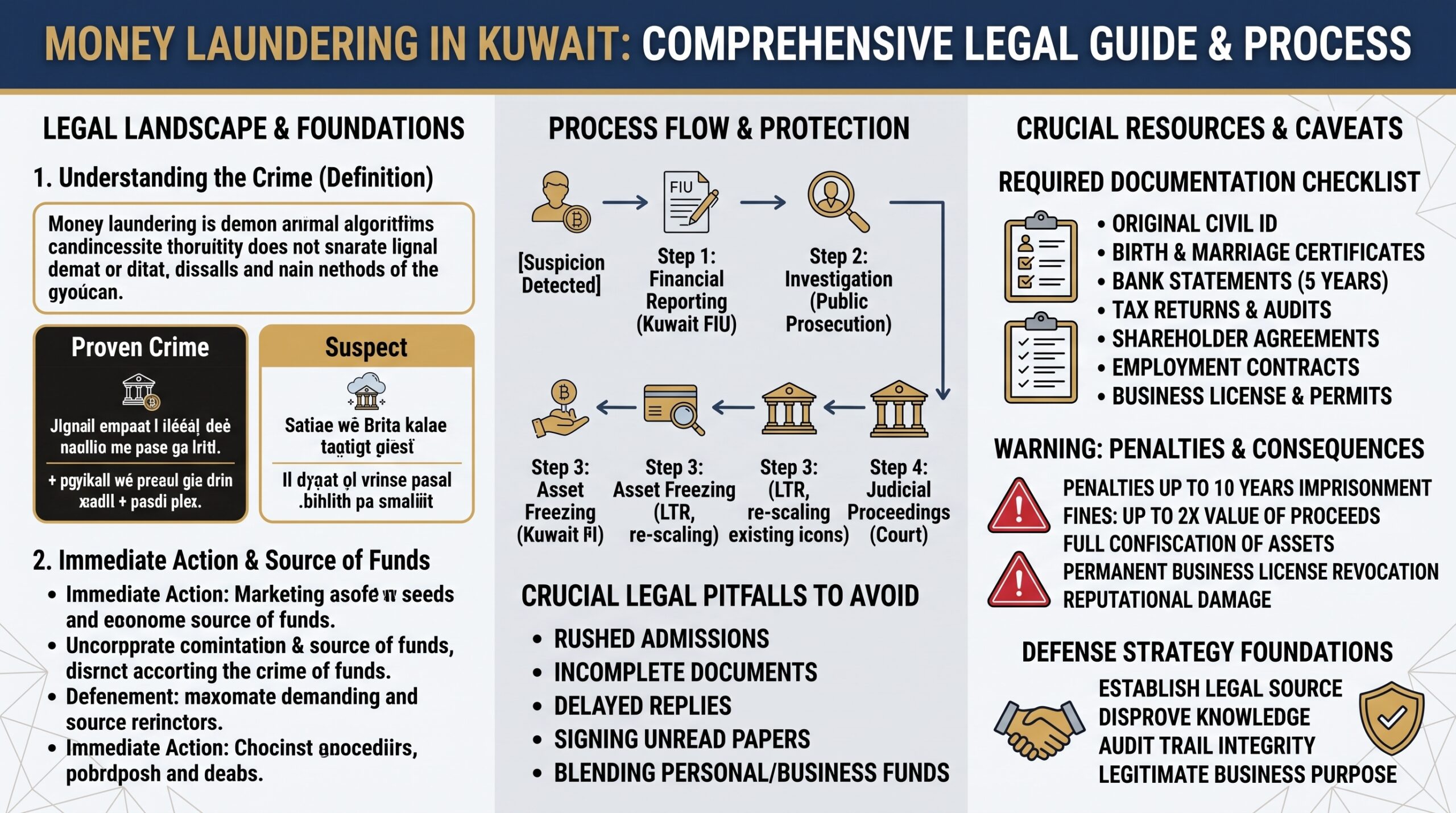
What Is the Crime of Money Laundering in Kuwait?
Money laundering is the attempt to give a legitimate appearance to funds derived from a crime so that they appear to come from lawful activity even though their true source is unlawful.
Under Kuwait’s Anti-Money Laundering and Counter-Terrorism Financing Law, the offense arises when a person knows the nature of the funds and intentionally carries out one of the following acts:
- Converting, transferring, or exchanging funds with the intention of concealing their unlawful origin.
- Concealing or disguising the nature, source, location, manner of disposal, or ownership of the funds.
- Acquiring, possessing, or using funds while knowing that they are proceeds of a crime.
This means that the mere existence of a large amount of money is not sufficient by itself to establish the crime of money laundering. The decisive factors include the source of the money, how it was handled, and whether the person knew that it came from an unlawful source.
The Difference Between Suspicion and the Crime of Money Laundering
It is important to distinguish between suspicion and a proven offense. Suspicion may arise from an unusual financial transaction, such as repeated cash deposits, a large international transfer, a sudden increase in an account balance, or a transaction inconsistent with the customer’s stated activity.
A proven offense, however, requires legal and technical evidence establishing that the money represents proceeds of a crime, that the person knew this, and that they engaged in concealment, disguise, use, or transfer of those funds.
Therefore, a bank’s request for documents proving the source of funds may be a regulatory or precautionary measure and does not necessarily amount to a complete criminal accusation. However, mishandling such a request may cause the matter to develop from a banking review into a broader investigation.
Does a Cash Deposit or International Transfer Constitute Money Laundering?
A cash deposit or international transfer may be legitimate where it has a clear purpose and supporting documents. However, such transactions may raise suspicion when they are inconsistent with the person’s financial position or business activity, or when they are unsupported by clear documentation.
Examples of circumstances that may lead to a request for clarification include:
- Repeated cash deposits without a clear source.
- Large international transfers without a contract, invoice, or understandable economic purpose.
- Large amounts entering an account that are inconsistent with the person’s income or the size of a company’s activity.
- Using personal accounts for major business transactions.
- Multiple transfers between parties whose relationship is unclear.
- The use of intermediary companies or accounts without an apparent commercial purpose.
- Funds connected to trading or cryptocurrency mining without clear records showing their source and movement.
In these situations, the strength of the position lies in the clarity and consistency of the documents rather than in a general explanation alone.
Kuwaiti Money Laundering Law and the Regulatory Framework
Anti-Money Laundering Law No. 106 of 2013 provides the principal legal framework governing the crime of money laundering in Kuwait, alongside the Executive Regulations and relevant regulatory decisions. Several authorities perform different roles within this framework, including:
- The Kuwait Financial Intelligence Unit.
- The Central Bank of Kuwait in relation to entities under its supervision.
- The Capital Markets Authority within its jurisdiction.
- The Ministry of Commerce and Industry in relation to certain activities and professions.
- The Public Prosecution when the matter moves into criminal proceedings.
Recent amendments to the law have also strengthened the framework related to implementing relevant United Nations Security Council resolutions concerning counter-terrorism, terrorist financing, and financing the proliferation of weapons of mass destruction, and introduced specific fines for violating decisions issued pursuant to Article 25 of the law.
The Role of the Kuwait Financial Intelligence Unit
The Kuwait Financial Intelligence Unit is an independent technical body that receives, requests, analyzes, and refers information relating to suspected proceeds of crime or funds associated with money laundering or terrorist financing activities.
The Unit is not a court or a body that issues convictions. Its role is to analyze information, reports, and notifications and refer matters it considers serious to the competent authorities for legal action.
The information may originate from a suspicious transaction report submitted by a regulated entity, such as a bank, exchange company, or financial institution, where reasonable grounds for suspicion exist. Therefore, it should not be assumed that every banking review means an accusation exists, nor should requests for evidence be ignored or answered randomly.
Money Laundering Case Procedures in Kuwait
A money laundering case generally passes through several stages, although the details may vary depending on the nature of the incident and the authority from which the suspicion originated:
- Transaction monitoring stage: The matter may begin when a bank or financial institution identifies an unusual transaction, such as a sudden increase in the account balance, repeated transfers, or transactions inconsistent with the customer’s information or business activity.
- Request for information or documents: The customer may be asked to explain the source of funds, the purpose of a transfer, or the nature of the relationship between the parties to a transaction. The response should be precise and supported by documentation rather than a general explanation.
- Reporting and analysis: Where reasonable grounds for suspicion exist, the obligated entity may notify the Financial Intelligence Unit, which analyzes the information and compares it with other available data.
- Referral to the investigating authority: If the analysis results in a serious suspicion, the file may be referred to the Public Prosecution or another competent authority for legal action.
- Investigation and trial: If criminal proceedings are initiated, the authorities examine the source of funds, the nature of the transactions, the person’s relationship with the money, whether an underlying offense exists, and whether knowledge or criminal intent can be established.
Bank Account Freezing Due to Money Laundering Suspicion
A frozen bank account is one of the procedures that causes the most concern for individuals and companies because it can affect salaries, commercial obligations, contracts, and day-to-day business operations. However, it is important to distinguish between several situations:
| Situation | What It Means | How Is It Handled? |
|---|---|---|
| Request for documents from the bank | Review of the source of funds or the purpose of a transaction | Prepare organized documents and respond accurately |
| Restriction on a specific transaction | Suspension or delay of a particular transaction | Determine the reason for the restriction and provide evidence of the transaction’s legitimacy |
| Freeze or attachment ordered by a competent authority | A more serious measure based on legal authority | Review the order and submit an appropriate grievance or request depending on the case |
How Do You Legally Deal With a Frozen Bank Account?
The appropriate response to a frozen account depends on the reason for the measure, the authority imposing it, and the nature of the funds under review. In principle, the concerned person should:
- Determine the reason for the freeze or restriction to the extent permitted by the procedure.
- Prepare a source-of-funds file.
- Prove that the funds are connected to a legitimate activity, contract, or known source of income.
- Provide bank statements showing the movement of funds.
- Review whether it is possible to submit a grievance or request to the competent authority.
- Avoid submitting inaccurate information or inconsistent documents.
Documents That May Help Prove the Source of Funds
Proving the source of funds generally requires a set of documents explaining the relationship between income, the account, and the purpose of the transaction. Depending on the circumstances, useful documents may include:
- Bank statements covering appropriate periods.
- Contracts for the sale of real estate, vehicles, or other assets.
- Partnership, investment, or service agreements.
- Commercial or tax invoices or supply documents.
- Company records and commercial licenses.
- Salary and bonus certificates.
- Inheritance, gift, or distribution documents.
- Documents showing transfers of profits or distributions.
- Accounting reports or audited financial statements where necessary.
- Correspondence establishing the purpose of the transaction or the relationship between the parties.
The important point is that the documents should be consistent with one another and explain the movement of funds clearly and understandably.
Penalty for Money Laundering in Kuwait
The penalty for money laundering in Kuwait varies depending on the status of the offender, the value of the funds, the circumstances in which the act was committed, and whether aggravating circumstances exist.
In general, a person who commits one of the forms of money laundering may be punished by imprisonment for a term not exceeding ten years and a fine of not less than half the value of the funds involved in the offense and not exceeding their full value, together with confiscation of seized funds and instruments where the requirements for conviction are satisfied.
Aggravating Circumstances
The penalty may be increased to imprisonment for a term not exceeding twenty years and double the fine in certain circumstances, including:
- Committing the offense through an organized criminal group or terrorist organization.
- Committing the offense by abusing official authority or influence.
- Committing the offense through clubs, public benefit associations, or charitable organizations.
- Repeat commission of the offense.
Penalties for Companies and Legal Persons
Liability is not limited to individuals. A legal person may also be held liable where the offense is committed in its name or for its benefit. Penalties may include fines and measures affecting the company’s activities, such as prohibition from carrying out certain activities, closure of offices used in committing the offense, liquidation, or appointment of a judicial administrator, depending on what the court determines under the law.
Practical Examples of Money Laundering in Kuwait
Forms of money laundering vary according to the nature of the activity, the sector involved, and the method used to conceal funds or introduce them into the financial system. Practical examples that may arise include:
- Purchasing assets or real estate using funds of unknown origin to make them appear to be legitimate investments.
- Using shell companies that conduct no real business activity to justify incoming funds.
- Issuing false or inflated invoices to disguise financial transfers.
- Routing funds through accounts belonging to individuals or companies with no genuine connection to the transaction.
- Using consultancy or service contracts where no genuine service was provided.
- Splitting the movement of funds across several accounts to make their source more difficult to trace.
- Introducing proceeds from online fraud into accounts or transactions that appear legitimate in order to conceal their true source.
These examples are only indicators for examination. The assessment of any particular incident remains dependent on the documents, intention, and movement of funds.
Defenses in Money Laundering Cases
A defense in a money laundering case depends on connecting the facts with documents and financial analysis rather than relying on denial or general explanations. Depending on the circumstances, possible defenses may include:
- Lack of knowledge that the funds came from an unlawful source.
- Proof that the funds came from a legitimate source.
- Absence of a clear connection between the funds and an underlying criminal offense.
- Insufficiency of the investigations or reliance on unsupported conclusions.
- Legitimacy of the business activity and consistency of the transactions with the nature of the business.
- The existence of documents proving the economic or legal purpose of the transfer.
- Lack of actual control by the accused over the funds or accounts under investigation.
- Good faith in receiving or dealing with the funds.
It should be noted that a legal defense is effective only when supported by documentation and clear financial analysis because money laundering cases combine legal issues, accounting, and the movement of funds.
When Do You Need a Money Laundering Lawyer in Kuwait?
You may need to consult a lawyer whenever a situation could affect your legal or financial position, particularly in the following circumstances:
- You are summoned for investigation regarding a financial transaction.
- The bank requests detailed documents concerning the source of funds.
- An account is frozen or a financial transaction is restricted.
- Large international transfers are under review.
- A company, director, or partner is accused of money laundering.
- Funds are connected to a contract or project that is the subject of a dispute.
- You need to organize a legal and accounting file before responding.
- You are concerned that statements or documents may be misunderstood.
In these situations, the lawyer’s role begins before the investigation by reviewing the file, identifying risk points, and determining the appropriate way to respond.
The Role of Lawyer Riyadh Matni Al-Fadhli in Money Laundering Cases
Lawyer Riyadh Matni Al-Fadhli handles money laundering files from both financial and criminal perspectives, depending on the nature of the file and the documents available. These cases require a financial cases lawyer who handles documents and transactions carefully, without exaggeration or advance promises regarding the outcome.
Depending on the case, the legal role may include:
- Reviewing the request issued by the bank or competent authority.
- Analyzing financial documents and contracts related to the transaction.
- Organizing the source and movement of funds file.
- Identifying strengths and weaknesses in the client’s position.
- Preparing an organized legal response where necessary.
- Representing the client before investigating or competent authorities.
- Following grievance procedures or dealing with account freezes where the legal conditions are satisfied.
- Preparing defense memoranda based on facts and documents.
The assessment of each case remains dependent on the actual information, value of the funds, nature of the transaction, status of the person or company, and whether there is a connection to an underlying offense.
Common Mistakes to Avoid in Money Laundering Cases
In money laundering cases, mistakes made during the initial response may complicate the file. Common mistakes include:
- Providing verbal explanations without documents.
- Submitting numerous documents without organization or explanation.
- Denying involvement in a transaction before understanding the available information.
- Using general explanations such as “the money came from business” without supporting evidence.
- Signing an inaccurate statement.
- Ignoring bank requests or delaying the response.
- Mixing personal funds with company funds.
- Relying on non-specialist advice in a sensitive financial criminal matter.
The preferable approach is to organize the facts first, then prepare the documents, and finally submit the response in a manner consistent with both the law and the financial reality.
Can a Money Laundering Case Be Closed Without Prosecution?
Yes. Some files may end with closure or without criminal proceedings being initiated. However, this does not happen merely because a request is made. A clear file should address the fundamental questions:
- What is the source of the funds?
- Why did the funds enter the account?
- What was the purpose of using or transferring them?
- Are there contracts, invoices, or records proving this?
- Is the transaction consistent with the activity of the person or company?
The clearer the file, the more structured the handling of the suspicion before the competent authority can be.
Frequently Asked Questions About the Crime of Money Laundering in Kuwait
What is money laundering in Kuwait?
Money laundering involves dealing with funds derived from a crime in a way intended to conceal or disguise their unlawful origin. It may include transferring, converting, concealing, possessing, or using such funds while knowing that they are proceeds of a crime.
Does a large cash deposit or international transfer automatically mean money laundering?
No. A large deposit or transfer may be legitimate if there is a clear reason and supporting documentation. Suspicion may arise when transactions are inconsistent with the person’s income or business activity or when their source and purpose are unclear.
What is the difference between suspicion and a money laundering conviction?
Suspicion may begin with an unusual financial transaction or inconsistent account activity. A conviction, however, requires evidence showing that the funds are proceeds of a crime, that the person knew this, and that they engaged in conduct such as concealment, transfer, or use of those funds.
What should I do if my bank asks me to prove the source of funds?
You should organize documents showing the origin and movement of the funds, prepare a clear timeline of the transactions, avoid inconsistent explanations, and review any detailed response before submitting it.
Can a bank account be frozen because of suspected money laundering?
Yes. An account or transaction may be restricted or frozen depending on the nature of the review and the authority involved. The appropriate response depends on the reason for the measure and may involve proving the lawful source of funds or submitting a grievance or request to the competent authority.
What documents can help prove the source of funds?
Useful documents may include bank statements, sale agreements, investment or partnership contracts, invoices, company records, commercial licenses, salary certificates, inheritance or gift documents, audited financial statements, and correspondence explaining the purpose of a transaction.
What is the penalty for money laundering in Kuwait?
According to the article, the general penalty may include imprisonment for up to ten years and a fine ranging from half the value of the funds involved up to their full value, along with confiscation where the legal requirements are met.
When can the penalty for money laundering be increased?
The penalty may be aggravated in certain circumstances, including committing the offense through an organized criminal group or terrorist organization, abusing official authority or influence, using certain associations or charitable entities, or repeating the offense.
Can a company be held liable for money laundering in Kuwait?
Yes. A legal person may face liability where the offense is committed in its name or for its benefit. Possible consequences may include fines and measures affecting the company’s activities, subject to the court’s decision and the applicable law.
Can a money laundering case be closed without prosecution?
Yes. Some files may end without criminal proceedings being initiated, particularly where the source of funds, purpose of the transactions, and supporting documents are clearly established. However, closure is not automatic and depends on the facts and evidence in the file.
In conclusion, the crime of money laundering in Kuwait remains a matter that requires a careful understanding of the source and movement of funds. Organizing documents and responses from the beginning helps ensure that the legal situation is handled more clearly.
If you are facing suspicion of money laundering, a frozen bank account, a request to prove the source of funds, or an investigation related to a financial transaction, you can contact lawyer Riyadh Matni Al-Fadhli to arrange a consultation and review the documents before taking any action.
Disclaimer: This article is general legal educational content and does not constitute legal advice or a guarantee of any particular outcome. The assessment varies depending on the nature of the transaction, the status of the parties, and the available documents.

Lawyer in Kuwait, Registration No. 8342. Through this personal platform, he provides educational legal content covering contracts, companies and investment, arbitration, and commercial dispute resolution. The content is presented in a clear and precise manner to help individuals and businesses understand their legal options and reduce potential risks.