
A social insurance dispute may arise when a person believes that a decision or settlement issued by the Public Institution for Social Security does not accurately reflect their insurance status or legal entitlements. In such cases, merely objecting to the outcome is not enough; the source of the dispute and the right being claimed must first be identified before choosing the appropriate procedure.
This guide provides a practical explanation of the procedures for filing a lawsuit against Social Security in Kuwait, starting with identifying the type of dispute and the claimant’s legal standing, through the initial claim and grievance process, and ending with the competent court, required documents, and the claims that may be submitted before the judiciary.
Has Social Security rejected your request, or have you discovered a reduction in your pension and are concerned about losing your rights because of complex legal deadlines? Do not let procedural requirements prevent you from pursuing what you may be entitled to. Attorney Riyadh Matni Al-Fadhli is ready to review the Social Security decision carefully and handle the grievance and litigation procedures based on the circumstances of your case.
Table of content
What Could Weaken Your Position Before Filing an Objection?
The problem does not always begin with the substance of the Social Security decision itself. The weakness may lie in the inability to prove or organize the relevant facts. Therefore, the case should be reviewed early if any of the following indicators are present:
- No written copy of the decision or settlement is available.
- There is no evidence showing the date on which the decision was received.
- It is unclear how the pension or the amount requested for repayment was calculated.
- There are previous communications or applications without proof that they were submitted.
- There are multiple decisions or account statements concerning the same matter.
Organizing these elements helps identify what is missing from the file and determine what information should be completed before choosing the next procedure.
What Is a Social Security Lawsuit in Kuwait?
A Social Security lawsuit is a judicial dispute concerning a right established under the Social Security Law or the laws and decisions supplementing it, in which the Public Institution for Social Security is a party.
Not all disputes follow the same format, because the legal characterization, claims, and required documents differ according to the type of decision, the legal standing of the claimant, and the right being sought.
Eligibility for Filing a Lawsuit Against Social Security in Kuwait
Any person who has legal standing and a legitimate interest may challenge a decision issued by the Institution and claim their right in accordance with the prescribed procedures. The main categories that may be involved in Social Security disputes include:
- Insured persons working in the government, private, or oil sectors.
- Pensioners.
- Business owners and self-employed persons.
- Beneficiaries entitled through an insured person or pensioner.
- Persons subject to special insurance schemes according to the law applicable to them.
- Employers disputing contributions, additional amounts, or employee registration.
The claimant’s legal standing must be verified before starting the proceedings, because the existence of a right alone is not sufficient if the lawsuit is filed by someone who is not legally entitled to claim it.
When Can a Lawsuit Be Filed Against Social Security in Kuwait?
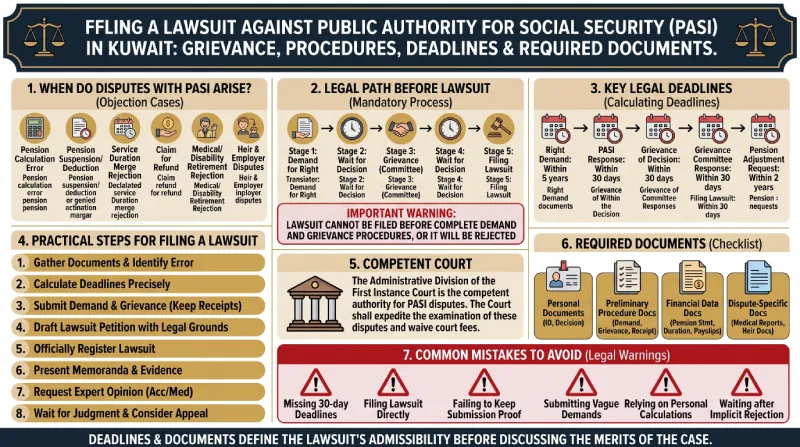
Social Security disputes vary according to the source of the issue. They may concern the method of calculation, the underlying entitlement, the period of service, or a debt claimed by the Institution. Common examples include:
- Error in calculating the retirement pension: Such as omitting a contribution period, applying an incorrect settlement salary, or failing to include certain salary components that should be taken into account under the law.
- Refusal to add a period of service: Where a previous period of service is not counted despite the conditions being met, a proven period is omitted, or there is an error in the cost or pension effect of adding that period.
- Suspension of the pension or deductions from it: Where the Institution suspends all or part of the pension or makes deductions that the person concerned considers unjustified or that continue after the underlying reason has ceased.
- Demand for repayment of amounts previously paid: The claimant may challenge the existence of the debt, its amount, the period it covers, or the method used by the Institution to calculate the amount to be repaid.
- Refusal of medical retirement or recognition of disability: Where a decision finds that disability has not been established or that entitlement conditions are not met despite medical reports or employment circumstances supporting the claim.
- Disputes concerning heirs and beneficiaries: Such as excluding a beneficiary from the pension, suspending their share, or disputing its distribution or the dates on which entitlement begins or ends.
- Employer and contribution disputes: Including disputes over employee registration, calculation of contributions and additional amounts, or differences relating to wages and periods of service.
The nature of the issue determines the type of claim that can be made and the appropriate method of proof. A calculation dispute is structured differently from a dispute concerning entitlement, debt, or a medical decision.
Must You File a Grievance Before Suing Social Security?
A person may not proceed directly to court to claim a right established under the Social Security Law without first following the pre-litigation procedure. Article 107 of the Social Security Law sets out the basic stages as follows:
- Submit a written claim to the Institution.
- Wait for the Institution’s decision or for the period allowed to decide the claim to expire.
- File a grievance against the decision before the Grievance Committee.
- Wait for the Committee’s decision or for the period allowed to decide the grievance to expire.
- File the lawsuit before the competent court within the applicable deadline.
Following these stages in the correct order is an independent procedural requirement regardless of the substantive strength of the right being claimed.
Deadlines for Claims, Grievances, and Lawsuits Against Social Security
Each deadline begins from a different event, such as the date on which the right became due, the date of notification of a decision, or the expiry of the period allowed to decide an application. Therefore, the starting point must be identified before calculating the deadline for objection or litigation.
| Procedure | Legal Deadline | Practical Note |
|---|---|---|
| Submitting a written claim to the Institution | Within 5 years from the date the right became payable | Keep proof of the date and contents of the submitted application |
| Institution’s decision on the claim | Within 30 days of submission | Expiry of the period without a decision is treated as a rejection of the application |
| Grievance against the Institution’s decision | Within 30 days from the date of notification of the decision | Proof of the notification date and the date of filing the grievance should be retained |
| Grievance Committee’s decision | Within 30 days from filing the grievance | Expiry of the period without a decision is treated as rejection of the grievance |
| Filing the lawsuit | Within 30 days from notification of the Committee’s decision or expiry of the period for deciding the grievance, whichever occurs first | The deadline is calculated according to the dates established by the documents |
The Social Security Grievance Committee
Decision No. 2 of 2025 regulated the formation of the Grievance Committee at the Public Institution for Social Security by amending certain provisions of Decision No. 7 of 1977 concerning the formation of the Committee and the rules for deciding grievances submitted to it.
The Committee consists of:
- The Head of the General Legal Affairs Sector, or the person acting in their place, as Chair of the Committee.
- The Director of the General Fatwa and Legal Consultation Department, or the person acting in their place, as a member.
- The Director of the department responsible for the subject of the grievance, or the person acting in their place, as a member.
- A legal researcher from the General Legal Affairs Sector who acts as the Committee’s rapporteur.
For the Committee’s meeting to be valid, all members must be present, and decisions are issued by majority vote. The complainant must also be notified of the decision issued on the grievance within no more than three days from the date of issuance, using any written or modern electronic means.
How to Submit a Grievance Against a Social Security Decision
The grievance should be clear and specific and should not be limited to a general statement that the claimant disagrees with the decision. It is preferable for the grievance to include:
- The complainant’s details, legal capacity, and civil ID number.
- The number and date of the decision being challenged.
- The date on which the decision was notified.
- A precise statement of the right being claimed.
- A chronological presentation of the facts.
- The legal or calculation grounds for the objection.
- An explanation of the alleged error in the decision.
- Documents supporting the grievance.
- Clear final requests.
Evidence showing the date on which the grievance was filed should also be obtained, whether it was submitted in paper form or through one of the approved electronic channels.
Which Court Has Jurisdiction Over Social Security Lawsuits?
When Filing a Lawsuit Against Social Security in Kuwait, identifying the competent court depends on the true nature of the claims and the legal basis of the dispute. As a general rule, the Administrative Circuit of the Court of First Instance has jurisdiction over disputes concerning the insurance rights referred to in Articles 107 and 108 of the Social Security Law.
However, the competent court must be identified according to the true nature of the claims and the legal basis of the dispute, rather than the description given to the lawsuit by the claimant. Appeals against judgments and the applicable deadlines are governed by the rules in force for administrative disputes at the time the judgment is issued.
Steps for Filing a Lawsuit Against Social Security in Kuwait
The process involves several interconnected stages, and following them in the correct order and within the applicable deadlines may affect the admissibility of the lawsuit and consideration of its merits.
1. Classify the Dispute and Define the Desired Outcome
Determine whether the dispute concerns pension calculation, entitlement, period of service, debt, or a medical decision, and then identify the legal outcome being sought.
2. Prepare a Timeline of the Case
Arrange chronologically the dates on which the right arose, the decision was issued and notified, previous claims and grievances were submitted, and any decisions were issued concerning them.
3. Verify Compliance With Pre-Litigation Procedures
Confirm that all procedures required before litigation were followed in the correct sequence and that there is evidence showing when each step was taken.
4. Prepare the Statement of Claim
The statement of claim should include the parties’ details and legal capacities, the facts of the dispute, the pre-litigation procedures followed, the legal basis, the specific claims, and the documents supporting them.
5. Register the Lawsuit and Serve the Institution
The lawsuit is registered with the competent court registry, and the Public Institution for Social Security is then served with the statement of claim and the relief sought in accordance with the prescribed procedures.
6. Submit Written Pleadings and Documents
The claimant presents their legal arguments and documents and responds to submissions made by the Institution. The claimant may also request that the Institution be ordered to provide the insurance file, settlement statements, or calculations necessary to decide the dispute.
7. Request Expert Evidence Where Necessary
The court may appoint an accounting expert to review pensions, contributions, and financial differences, or a medical expert in disability and medical retirement disputes, depending on the nature of the case and the court’s assessment.
8. Judgment and Assessment of Available Appeal Options
After pleadings and any investigation or expert procedures ordered by the court are completed, judgment is issued. The availability of grounds for appeal, the appropriate legal route, and the applicable deadline are then assessed.
Documents Required for Filing a Lawsuit Against Social Security in Kuwait
The documents required for Filing a Lawsuit Against Social Security in Kuwait vary according to the subject of the dispute. A complete file should generally include the challenged decision, proof of the pre-litigation procedures, and documents supporting the specific right being claimed.
Basic Documents
These include:
- A copy of the civil ID.
- A copy of the nationality certificate where required.
- The Institution’s decision being challenged.
- Evidence showing the date on which the decision was notified.
- A copy of the written claim and evidence of its submission.
- A copy of the grievance and evidence of the date on which it was filed.
- The Grievance Committee’s decision, if issued.
- Correspondence exchanged with the Institution.
Documents for Challenging Pension Calculations
These usually include:
- A detailed pension settlement statement.
- A certificate showing periods of contribution.
- A salary progression statement.
- Appointment, promotion, and termination decisions.
- Certificates of salaries and allowances relevant to the dispute.
- Contribution or deduction statements.
Documents for Adding a Period of Service
Key documents may include:
- Previous appointment decisions.
- Service or experience certificates.
- Official documents establishing the relevant period.
- A statement of any gratuity paid for that period, if applicable.
- Receipts showing payment of the cost of adding the period.
Documents for Disability and Medical Retirement
These usually include:
- The Medical Committee’s decision.
- Approved medical reports and examinations.
- Reports from hospitals and treatment providers.
- A statement describing the nature and requirements of the job.
- Recent reports showing the development of the medical condition.
Documents for Heirs and Beneficiaries
These may include:
- Death certificate.
- Inheritance certificate.
- Birth or marriage certificates.
- Proof of education or social status where required.
- The decision distributing or suspending the pension.
Documents for Employers
These include:
- The establishment file and licenses.
- Employee lists and employment contracts.
- Payroll records and bank transfers.
- Employee registration and deregistration records.
- Notices and claims issued by the Institution.
The court or Institution may request additional documents depending on the nature of the dispute and the claims made in each case.
How Can an Error in a Social Security Decision Be Proven?
An error is not proven by the number of documents submitted, but by their ability to show the difference between what the Institution applied and what should have been applied to the facts of the case. Evidence is generally built on three levels: the factual information established in the file, the basis on which the settlement or decision was made, and the financial or legal effect resulting from the difference between them.
If certain information is held by the Institution, a request may be made for the insurance file or settlement statements to be produced. The court may also rely on technical expertise where the dispute requires review of calculations or medical assessment.
What Claims Can Be Made in a Social Security Lawsuit?
The claims vary according to the nature of the dispute and may include:
- Annulment of the decision or a declaration that it should not be relied upon, depending on the legal characterization of the case.
- Recalculation of the pension on the correct basis.
- An order requiring the Institution to pay outstanding pension differences.
- Recognition or addition of a qualifying period of service.
- Recognition of entitlement to a pension, gratuity, or grant.
- Stopping a deduction or correcting its amount.
- A declaration that the claimant is not liable for a debt claimed by the Institution.
- Redistribution of the pension among beneficiaries.
- Implementation of the financial consequences resulting from the judgment.
The claims should not be drafted in general terms such as “grant me all my rights.” Instead, the specific right, period, amount, or method of calculation should be identified whenever possible.
What Are the Deadlines for Modifying a Pension and Other Insurance Rights?
In addition to the deadlines for claims and grievances, Article 108 establishes a special rule for requests to modify insurance rights. A lawsuit seeking modification of rights established under the law may not be filed after two years from the date of notification that the pension has been finally assessed, or from the date of payment in relation to other rights.
The law provides exceptions for:
- Upward recalculation resulting from a settlement made pursuant to a law.
- Recalculation based on a final judicial judgment.
- Material calculation errors occurring during the settlement process.
It is therefore important to distinguish between an original claim to a right, which is subject to the five-year period, and a request to modify a pension that has already been finally assessed, which is subject to the two-year rule and its statutory exceptions.
Do Social Security Claims Expire With Time?
Under Article 110 of the Social Security Law, the Institution’s claims against employers, insured persons, pensioners, and beneficiaries expire five years from the date on which they become due.
This period is interrupted if the Institution sends the person concerned a notice by registered letter stating the amount being claimed. In the case of an employer who failed to register all or some employees for insurance, the limitation period does not begin to run until the Institution becomes aware that they were employed by that employer.
An employer’s right to recover amounts paid in excess also expires if no claim is made within three years from the date of payment.
Determining whether a debt has become time-barred therefore requires reviewing the date on which it became due and any steps taken by the Institution that may have interrupted the limitation period.
Are Social Security Lawsuits Exempt From Court Fees?
Lawsuits concerning the application of the Social Security Law are exempt from court fees at all levels of litigation, whether filed by the Institution, insured persons, pensioners, or their beneficiaries.
These lawsuits are also heard on an expedited basis, and the court may order provisional enforcement without requiring security. However, if the lawsuit is dismissed, the court may order the claimant to pay all or part of the costs depending on the circumstances of the dispute.
Mistakes That May Affect the Admissibility of a Social Security Lawsuit
A person may have a valid substantive right but lose the opportunity to have it considered because of a procedural mistake. Common mistakes include:
- Filing the lawsuit directly without first submitting a claim to the Institution and challenging its decision through the grievance process.
- Missing the 30-day deadline.
- Failing to retain evidence of submitting the claim or grievance.
- Failing to establish the date on which the decision was notified.
- Naming the authority or its representative in an incorrect legal capacity.
- Submitting general or contradictory claims.
- Failing to attach the pension statement and contribution periods.
- Relying on personal calculations without an official document.
- Confusing a material calculation error with a dispute over the elements used in the settlement.
- Waiting for a formal response after an implied rejection has already occurred.
- Failing to take account of the special period applicable to modification of rights after the pension has been finally assessed.
The Role of a Lawyer in Social Security Disputes
The importance of a lawyer in these disputes lies in combining procedural accuracy with an understanding of the documents and calculations associated with the insurance right. Depending on the circumstances of the dispute, the lawyer may:
- Review the decision and determine its legal nature.
- Review the deadlines and confirm whether the right to file a grievance or lawsuit remains available.
- Identify missing documents.
- Draft the initial claim and grievance clearly.
- Identify the parties and claims in the statement of claim.
- Legally review the pension calculation or alleged debt.
- Request production of the insurance file or appointment of an expert where necessary.
- Prepare written submissions and respond to the Institution’s defense.
- Follow the judgment and determine the available appeal routes.
Consulting a lawyer in Kuwait does not guarantee a particular outcome, but it can help present the dispute through the correct procedure and avoid mistakes that may prevent the substantive right from being examined.
Frequently Asked Questions About Filing a Lawsuit Against Social Security in Kuwait
Can I file a lawsuit against Social Security in Kuwait?
Yes, if you have legal standing and a dispute concerning a Social Security right, decision, pension, contribution, or entitlement.
Must I file a grievance before suing Social Security in Kuwait?
Yes. The required pre-litigation procedures must be followed before bringing a Social Security claim before the competent court.
What is the deadline for filing a grievance against a Social Security decision?
The grievance must generally be filed within 30 days from the date you are notified of the Institution’s decision.
How long does the Grievance Committee have to decide a grievance?
The Committee has 30 days to decide the grievance; expiry of that period without a decision is treated as a rejection.
Which court handles Social Security lawsuits in Kuwait?
As a general rule, the Administrative Circuit of the Court of First Instance hears disputes concerning the relevant Social Security rights.
What documents are required to sue Social Security in Kuwait?
Key documents include the challenged decision, proof of notification, the written claim, grievance records, and documents supporting the entitlement.
In conclusion, filing a lawsuit against Social Security in Kuwait requires more than simply objecting to a decision issued by the Institution. A grievance and a statement of claim are not generic forms that can simply be copied and completed; each procedure should reflect the specific problem in the case and be supported by documents proving it.
For assistance in reviewing the decision and determining the appropriate legal procedure according to the circumstances of your case, contact Attorney Riyadh Matni Al-Fadhli.
Disclaimer: This article provides general legal information and does not constitute legal advice or a final assessment of any particular case. Procedures and claims vary depending on the facts, documents, and applicable deadlines.

Lawyer in Kuwait, Registration No. 8342. Through this personal platform, he provides educational legal content covering contracts, companies and investment, arbitration, and commercial dispute resolution. The content is presented in a clear and precise manner to help individuals and businesses understand their legal options and reduce potential risks.