

A patient may suffer harm after a medical intervention without knowing whether it resulted from professional negligence or from a possible complication. In such situations, understanding the correct legal route becomes essential, especially because the matter is connected to medical reports, deadlines, and procedures that may affect the validity of the claim.
This article explains the procedures for filing a medical malpractice lawsuit in Kuwait, the competent authority, the most important required documents, how to object to the report, and how to claim compensation according to the circumstances of each case.
Have you suffered harm after a medical procedure and feel uncertain whether it was a possible complication or professional negligence? Do not allow the claim deadline to expire and lose your right. Lawyer Riyadh Matni Al-Fadhli is ready to carefully review your medical reports, determine the correct legal route, and protect your right to full compensation.
Consult a Medical Malpractice Lawyer ImmediatelyOr you can first read the comprehensive guide below to learn the steps for filing the lawsuit.
Table of content
When Do You Need to Consult a Lawyer Urgently?
Urgent legal review becomes necessary in several situations, including:
- Receiving the Medical Liability Authority report while the objection period is still open.
- Approaching three years from the date of the medical act or procedure that is the subject of the complaint.
- Receiving a request to sign a waiver or settlement after the harm occurred.
- Being unable to obtain medical reports or test results.
- The harm resulting in additional treatment, disability, or inability to work.
- The existence of conflicting medical reports or a clear lack of documentation regarding the stages of diagnosis and treatment.
An appointment can be arranged with a lawyer in Kuwait to review the date of the incident and the available documents and determine the appropriate legal step before submitting a complaint, objection, or lawsuit.
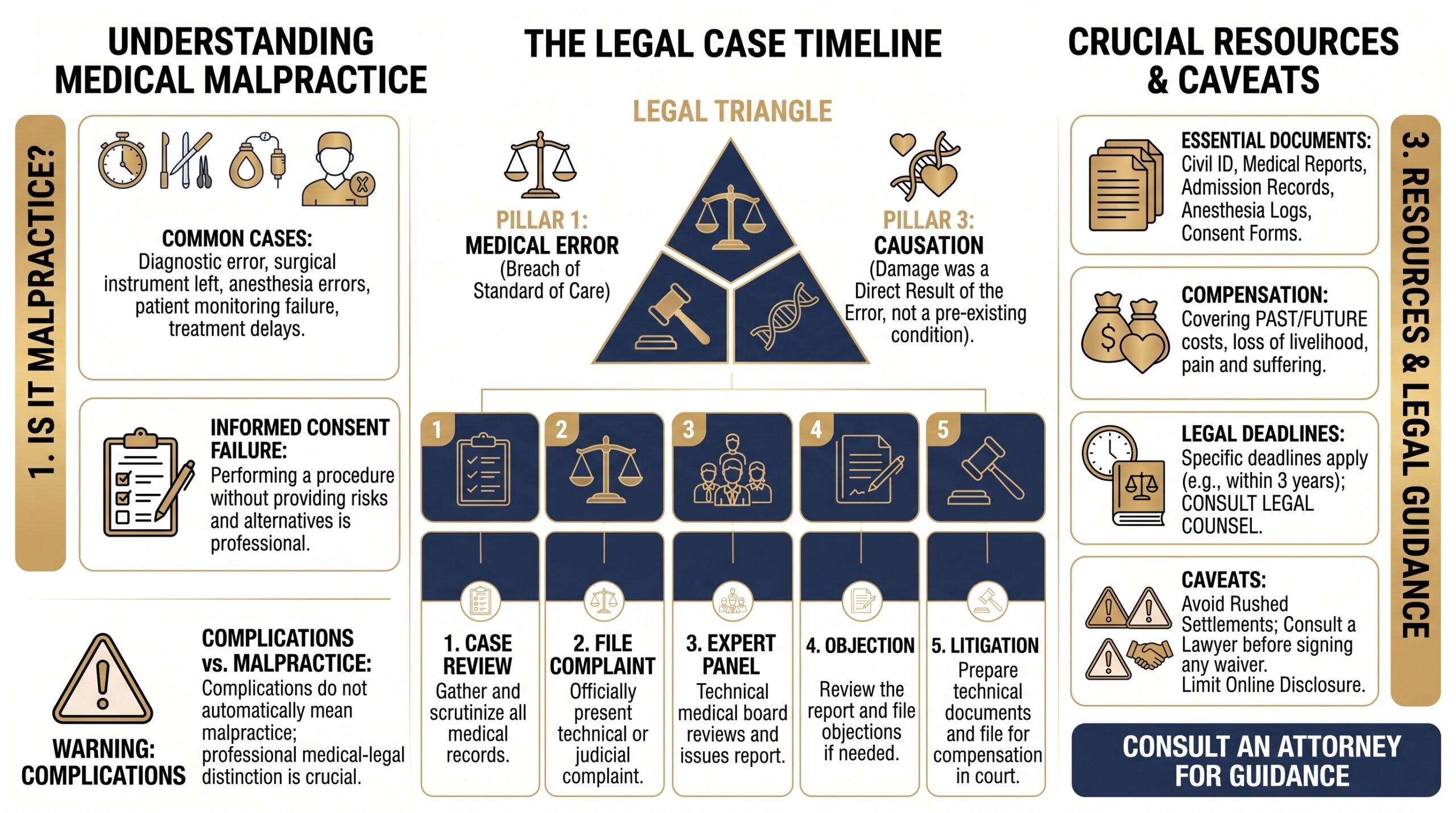
Procedures for Filing a Medical Malpractice Lawsuit in Kuwait
The procedures for filing a medical malpractice lawsuit in Kuwait pass through several stages, and their order may vary depending on the status of the case and the authority reviewing the incident. The main stages include:
- Reviewing the incident and the legal period: examining the date of the procedure, the harm, and any previous steps taken.
- Collecting medical documents: preparing reports, test results, invoices, and reports of subsequent treatment.
- Presenting the file to the Medical Liability Authority: through a direct complaint or referral from a competent judicial authority.
- Reviewing the technical report: studying the committee’s conclusion, reasoning, and the documents on which it relied.
- Objecting when grounds exist: submitting a reasoned objection within the prescribed legal period.
- Preparing the compensation lawsuit: identifying the defendants, damages, claims, and supporting documents.
- Registering and following up on the lawsuit: filing it before the competent court and submitting memoranda and defenses.
What Is Medical Malpractice Under Kuwaiti Law?
Medical malpractice means a physician or healthcare professional violating established technical medical standards or professional rules, or failing or neglecting to exercise the necessary care in treating the patient and following up on their condition, resulting in harm.
Article 34 of Law No. 70 of 2020 provides that a physician is not responsible for the outcome reached by the patient if the physician exercised the required care and used the methods expected of a practitioner in similar circumstances, specialization, and scientific and professional level.
What Situations May Constitute Medical Malpractice in Kuwait?
It is not possible to conclusively determine that medical malpractice occurred without reviewing the complete medical file and technical report. However, there are common situations that warrant careful review of the incident.
Delay in Diagnosing the Condition
A delay in diagnosis may form the basis of liability if symptoms or test results indicated that a specific action was required and the physician failed to take the appropriate diagnostic step at the proper time, resulting in deterioration of the patient’s condition.
The timing of the appearance of symptoms, the tests that were ordered, the results available to the physician, the time at which the disease was actually discovered, and the effect of the delay on treatment or chances of recovery should be reviewed.
Delay in Providing Treatment or Surgical Intervention
Liability may arise where the patient required urgent treatment or intervention and an unjustified delay was proven to have caused or aggravated the harm. It is not sufficient merely to prove that time passed between diagnosis and treatment. It must also be shown that the delay violated medical standards and actually affected the patient’s condition.
An Error During Surgery
Incidents that warrant examination include:
- Performing surgery on the wrong site.
- Causing injury to another organ without medical justification.
- Leaving an instrument or material inside the patient’s body.
- Using a surgical method that violates established medical standards.
- Failing to take the required precautions before or during surgery.
- Failing to properly manage bleeding or complications arising during surgery.
Anesthesia and Patient Monitoring Errors
The error may relate to the anesthesia dosage, failure to review the patient’s medical history, ignoring a known drug allergy, inadequate monitoring of vital signs, or delay in responding to anesthesia complications. Important documents in such cases include the anesthesia record, information about the medications and dosages used, and vital-sign readings during the operation.
Prescribing an Inappropriate Medication or Dosage
Liability may arise if a patient is prescribed a medication unsuitable for their condition, a documented allergy or obvious drug interaction is disregarded, or an improper dosage contrary to medical standards causes harm.
Failure to Follow Up With the Patient After Treatment or Surgery
Negligence in follow-up may constitute an independent medical error, especially if the patient reports symptoms requiring examination or intervention and those symptoms are not addressed in a timely manner. Examples include:
- Ignoring fever or severe pain.
- Failing to follow up on laboratory results.
- Delay in detecting bleeding or infection.
- Discharging the patient without clear follow-up instructions.
- Failing to respond to the patient’s post-operative consultations.
Errors During Childbirth
The incident may require review where there was delay in making a necessary medical decision, inadequate monitoring of the mother or fetus, or failure to respond to warning signs at the appropriate time. However, injury to the mother or child does not automatically mean that an error occurred. The technical report must establish a violation or failure and its connection to the harm.
Medical Procedure Without Informed Consent
Liability may arise when a medical intervention is performed without providing the patient with the essential information needed to make a decision, including the nature of the procedure, its alternatives, and potential risks. Liability depends on the extent to which the lack of information affected the patient’s decision, the resulting harm, and the relationship between them.
The Difference Between Medical Malpractice and Medical Complications
Distinguishing between malpractice and a complication is one of the most important issues on which the assessment of any case depends:
| Point of Comparison | Medical Malpractice | Medical Complications |
| Cause | Violation of medical standards, negligence, or failure | An outcome that may occur despite following medical standards |
| Possibility of Avoidance | Could have been avoided by exercising the required care | May occur despite appropriate medical care |
| Liability | May arise where harm and causation are proven | Does not by itself establish liability |
| Method of Assessment | Medical file and technical opinion | Nature of treatment, patient’s condition, and medical standards followed |
What Are the Requirements for Claiming Compensation for Medical Malpractice?
A compensation claim generally depends on the existence of three interconnected elements:
- Fault: It must be proven that medical standards were violated or that there was negligence or failure to provide the required care or follow-up.
- Damage: Physical, financial, or moral harm resulting from the medical incident must be proven, with its nature and effects established through supporting documents and reports.
- Causal relationship: It must be proven that the damage resulted from the alleged medical error rather than from the underlying disease, a pre-existing condition, or an independent cause. Therefore, it is important to compare the patient’s condition before and after the procedure and connect the timing of the harm with the treatment, surgery, or follow-up provided.
What Should You Do If You Suspect Medical Malpractice?
If you suspect medical malpractice, the following steps can help protect your rights and organize the file before taking legal action:
- Consult a lawyer to review the deadline and legal route: to determine the objection period, the time limit for filing the lawsuit, the appropriate procedure, and any missing documents.
- Obtain necessary treatment without delay: consult another healthcare facility when required and request a report documenting your condition and the treatment provided.
- Request medical reports and records: submit a written request for reports, test results, treatments, and invoices in accordance with Article 28 of Law No. 70 of 2020.
- Arrange the events chronologically: record dates of consultations, tests, diagnosis, treatment, appearance of harm, and subsequent medical procedures.
- Keep an organized electronic copy: convert reports and correspondence into digital files and arrange them by date and issuing authority while keeping original documents in a safe place.
What Documents Are Required to File a Medical Malpractice Lawsuit?
Completing the procedures for filing a medical malpractice lawsuit in Kuwait depends on preparing documents that establish the treatment process, the harm, and the resulting losses. It is preferable to prepare the following:
- The complainant’s civil ID.
- A power of attorney if the complaint is submitted through a representative.
- Admission and discharge report.
- Surgical operation report.
- Anesthesia report.
- Laboratory and test results.
- Radiology images and reports.
- Medication prescriptions.
- Follow-up reports.
- Informed consent form, if available.
- Reports of treatment for the harm at another facility.
- Medical invoices and expenses.
- Proof of absence from work or loss of income.
- Death certificate and inheritance certificate if the case concerns the patient’s death.
- A written chronological account of the incident.
It is preferable to organize the documents by date and prepare an index of the file contents rather than submitting a large number of unclassified documents without explanation.
What Is the Role of the Medical Liability Authority in Kuwait?
The Medical Liability Authority is an independent government entity established under Law No. 70 of 2020. Through the committees it forms, the Authority has exclusive jurisdiction to provide technical opinions on matters relating to medical errors and professional violations, whether referred through a complaint, report, official record, report, case, or lawsuit.
Its jurisdiction includes healthcare professionals, healthcare facilities, and their managers in both the public and private sectors. The Authority also examines whether an error or violation occurred, its nature, who bears technical responsibility for it, and the resulting health damage.
The Authority’s report is an important technical element in the file, but it is not a judicial judgment awarding compensation. Only the competent court determines legal and financial claims based on the evidence and defenses presented.
How Do You Submit a Medical Malpractice Complaint to the Medical Liability Authority?
The complaint is submitted by the concerned person or their representative by attending the Authority’s headquarters and completing the designated form, stating the details of the incident, and attaching the relevant medical reports and documents. The status of the complaint is also followed up through the personal attendance of the concerned person or their legal representative.
The complaint should preferably include:
- Details of the patient and complainant.
- Name of the healthcare facility.
- Name of the physician or healthcare professional, if known.
- Date of treatment or surgery.
- A brief and organized description of the incident.
- The harm that appeared after the procedure.
- Supporting tests and reports.
- The medical issues requested to be examined.
The complaint should focus on facts and dates rather than general accusations or emotional statements unsupported by the medical file.
How Does the Medical Liability Committee Review the Complaint?
The Medical Liability Committee is formed according to the nature of the matter and consists of persons with relevant expertise and specialization. The law specifies categories of members and requires that the committee consist of at least five members and that the total number be odd.
The committee may:
- Review the medical file and reports.
- Summon the patient or their representative.
- Hear statements from the persons complained against.
- Hear medical staff and witnesses.
- Conduct an examination or medical assessment.
- Request additional documents or information.
- Request a technical opinion from a public or private entity.
- Seek assistance from specialized medical or scientific bodies.
The committee’s report must include the procedures it carried out, the conclusion it reached, the reasons and evidence on which it relied, and responses to the requests and observations presented to it.
How Long Does the Medical Liability Committee Take to Issue Its Report?
The committee issues its detailed report within a period not exceeding 90 days from the date of its formation and may request an extension for an equal or shorter period.
This does not mean that the complaint will be fully concluded within 90 days. The period before the committee is formed may vary according to the priority system, particularly in cases involving death, referrals from courts or the Public Prosecution, and cases involving serious errors.
How Do You Object to a Medical Liability Authority Report?
If the committee’s report fails to address a material document, contains a contradiction, or incorrectly describes the incident or its sequence, interested parties may object to it. The objection must be submitted:
- In a written memorandum.
- With clear and specific grounds.
- Within 15 days from the date the report is received or notification of its issuance.
The report becomes final within the Authority’s procedures if no objection is submitted within the prescribed period. If an objection is submitted on time, the matter is reconsidered by another committee, whose report must respond to the grounds of objection presented.
What Should an Objection Memorandum Include?
Depending on the case, the memorandum may include:
- Identification of documents that the committee failed to discuss.
- Explanation of contradictions between the report’s reasoning and conclusion.
- Correction of the date or description of the medical procedure.
- Identification of a treatment stage omitted from the report.
- Discussion of the effect of delay in diagnosis or follow-up.
- Explanation of the failure to respond to a material medical report.
- Identification of an error in attributing the harm to a cause unsupported by the documents.
- Identification of the technical issue that should be reconsidered.
It is not sufficient for the memorandum to contain a general statement such as “I object to the conclusion.” The reason for the objection and its effect on the technical opinion must be explained.
What Happens After the Medical Liability Authority Report Is Issued?
The next step depends on the outcome of the report and the stage of the case and may include:
- Accepting the conclusion and proceeding with a compensation lawsuit: if the report finds that an error or violation occurred and caused related health damage, the possibility of filing a compensation lawsuit is examined, including identifying the defendants, claims, and supporting documents.
- Objecting to the report: if the objection period remains open and serious grounds exist, preparing a reasoned objection may be the first step before taking any other action.
- Continuing an existing judicial process: the case may already be before a court or the Public Prosecution, and the Authority’s report may have been issued following a referral from them. In that case, the report and defenses are submitted to the authority considering the case.
How Is Medical Malpractice Proven Before the Court?
The success of the procedures for filing a medical malpractice lawsuit in Kuwait depends on several elements, most importantly:
- The Medical Liability Authority report: it indicates whether an error or professional violation occurred, its nature, who is technically responsible for it, and the resulting health damage.
- The medical file: it reveals the patient’s condition, diagnoses, tests, treatments, consultations, and devices or tools used in treatment.
- The timeline: it helps establish the relationship between treatment and the timing of the harm and whether there was delay in diagnosis, treatment, or follow-up.
- Subsequent reports: reports issued by another healthcare provider may explain the nature of the harm, corrective treatment, degree of disability, or continuation of symptoms.
- Invoices and proof of losses: used to establish treatment costs, expenses, loss of income, or absence from work.
What Types of Compensation Are Available for Medical Malpractice?
There is no fixed amount of compensation applicable to all medical malpractice cases. The amount depends on the nature of the harm, how well it is established, and its relationship to the error. Depending on the circumstances of each case, the claim may include:
- Treatment costs: expenses incurred by the patient to treat the harm or reduce its effects, where proven by invoices and reports.
- Future treatment costs: if reports establish that the patient requires future surgery, treatment, or rehabilitation, these costs may be included among the claimed damages.
- Loss of income: salaries or profits lost because the patient stopped working or suffered reduced earning capacity, provided this is proven.
- Disability or loss of functional capacity: the type of injury, degree of disability, and duration affect the assessment of damages.
- Moral damage: compensation for an unlawful act may include moral damage, including pain, psychological suffering, and interference with normal life, subject to the court’s assessment and the evidence submitted.
- Damage resulting from death: where the patient dies, the legal standing of the claimants, inheritance documents, and the damages alleged by each claimant must be examined according to the circumstances of the case.
Who Are the Defendants in a Medical Malpractice Lawsuit?
The defendants cannot be identified in the same way in every case. Their legal status may vary according to:
- The type of healthcare facility.
- Whether the treatment was provided in the public or private sector.
- The physician’s relationship with the facility.
- The nature of the alleged error.
- The person responsible for management or supervision.
- The existence of an insurance company or guarantor.
- The documents and contracts governing the relationship.
The file may require examining the legal standing of the physician or healthcare professional, the healthcare facility, the government authority, or other parties before the lawsuit is registered. Naming a party with no legal standing or failing to include a necessary party may complicate the proceedings and delay resolution of the claims.
Does Informed Consent Prevent a Claim for Compensation?
Signing informed consent does not exempt a physician from liability for violating medical standards or negligence. Consent relates to accepting the procedure after its nature, benefits, risks, and possible complications have been explained. It does not mean accepting error or negligence.
Article 34 also provides that any agreement or condition limiting or restricting cases of medical liability or exempting a person from it is void. With respect to cosmetic surgeries and interventions, the law requires written informed consent accompanied by drawings, photographs, measurements, and documents relating to what was agreed upon and provides that the practitioner’s obligation is to exercise careful attention.
What Should You Do If You Cannot Obtain Medical Reports?
If you are unable to obtain medical reports, it is advisable to take the following steps to document the request and protect the right to pursue a claim:
- Document the request submitted to the healthcare facility and retain proof of the date and content of the request.
- Record any response from the facility or proof that it failed to respond within a reasonable period.
- Attach proof that the records were requested when submitting the complaint to the Medical Liability Authority, as the competent committee has the right to request the information and reports required to examine the incident.
- Distinguish between a delay in providing documents or a dispute over them and deliberate concealment or destruction of the medical file, because the legal characterization differs according to the facts and evidence.
When Does a Medical Malpractice Claim Become Time-Barred in Kuwait?
Article 84 of Law No. 70 of 2020 provides that claims arising from violations of the law become time-barred after three years from the date of the medical act or the violating procedure.
Therefore, a person should not wait or rely solely on the date the harm was discovered without legal review, because determining the applicable limitation period requires examination of:
- The date of the medical procedure.
- The type of lawsuit.
- The legal basis of the claim.
- The stage reached by the case.
- The procedures previously taken.
Errors to Avoid Before Filing a Medical Malpractice Lawsuit in Kuwait
Certain early actions may affect the strength of the case or result in the loss of important deadlines. Therefore, the following errors should be avoided before beginning the procedures for filing a medical malpractice lawsuit in Kuwait:
- Signing a waiver without review: do not sign a settlement, waiver, or release before understanding the rights covered by the document and its legal effects.
- Delaying the request for reports: the longer the patient delays collecting records, the more difficult it becomes to reconstruct the timeline and review medical decisions.
- Publishing accusations on social media: public posting does not prove a technical medical error and may create additional disputes. It is better to present the documents to the competent authority.
- Editing conversations or documents: original copies should be preserved and should not be cropped or altered in a way that affects their evidentiary value or context.
- Relying on a brief discharge report: assessment of the incident may require surgical, anesthesia, radiology, laboratory, and follow-up reports rather than a brief report alone.
- Failing to document receipt of the report: proof of the date on which the report was received or notification of its issuance should be retained because that date is used to calculate the objection period.
How Can Lawyer Riyadh Matni Al-Fadhli Help You in a Medical Malpractice Case?
The lawyer can provide legal support through:
- Assessing whether the file is suitable for a claim in light of the reports and legal deadlines.
- Identifying strengths and deficiencies in the available medical documents.
- Developing a legal strategy suited to the technical report’s conclusion and the stage of the case.
- Drafting complaints, objections, and memoranda clearly and with evidentiary support.
- Identifying the parties that should be named as defendants and the elements of compensation that may be claimed.
- Following up on procedures and representing the client before the competent authorities and courts.
Frequently Asked Questions About Filing a Medical Malpractice Lawsuit in Kuwait
What are the main procedures for filing a medical malpractice lawsuit in Kuwait?
The process generally includes reviewing the incident and legal deadlines, collecting medical records, presenting the case to the Medical Liability Authority, reviewing its technical report, filing an objection when appropriate, preparing the compensation claim, and registering the lawsuit before the competent court.
How can medical malpractice be proven in Kuwait?
Proof may rely on the Medical Liability Authority report, the patient’s medical file, the chronological sequence of treatment and harm, subsequent medical reports, invoices, and evidence of financial losses such as loss of income.
What is the difference between medical malpractice and a medical complication?
Medical malpractice involves negligence, failure, or violation of established medical standards. A medical complication may occur even when proper medical care has been provided and does not, by itself, establish liability.
What documents are needed to file a medical malpractice lawsuit in Kuwait?
Documents may include the civil ID, power of attorney where applicable, admission and discharge reports, surgical and anesthesia reports, test and radiology results, prescriptions, follow-up reports, informed consent forms, treatment invoices, proof of loss of income, and other relevant medical records.
What is the role of the Medical Liability Authority in Kuwait?
The Medical Liability Authority is responsible for providing the technical opinion on alleged medical errors and professional violations. Its committees examine whether an error occurred, who is technically responsible, and what health damage resulted. Its report is important evidence, but it is not itself a court judgment awarding compensation.
How long does the Medical Liability Committee take to issue its report?
The committee must issue its detailed report within no more than 90 days from the date of its formation. It may request an extension for an equal or shorter period.
Can I object to the Medical Liability Authority report?
Yes. An objection may be submitted in writing with clear and specific reasons within 15 days from receiving the report or being notified that it has been issued. If no objection is filed within the period, the report becomes final within the Authority’s procedures.
How long do I have to file a medical malpractice claim in Kuwait?
According to Article 84 of Law No. 70 of 2020, claims arising from violations of the law become time-barred after three years from the date of the medical act or violating procedure.
Does signing informed consent prevent a compensation claim?
No. Signing an informed consent form does not exempt a physician from liability for negligence or violation of medical standards. Consent relates to acceptance of the procedure and its known risks, not acceptance of medical error or professional negligence.
What types of compensation may be claimed for medical malpractice?
Depending on the case, compensation may include treatment costs, future treatment expenses, loss of income, disability or reduced earning capacity, moral damages, and damages arising from the patient’s death.
In conclusion, the procedures for filing a medical malpractice lawsuit in Kuwait require careful examination of the incident, organized evidence, and compliance with legal deadlines before taking any action. Acting at the appropriate time helps determine the correct route and protect the right to file a complaint, submit an objection, or claim compensation.
You can contact lawyer Riyadh Matni Al-Fadhli to review the facts and available documents, determine what the file requires, and identify the appropriate legal step before submitting a complaint, objection, or compensation lawsuit.
You may also be interested in: Recovering Financial Compensation for Damages
Legal Disclaimer: This article was prepared for general legal educational purposes and does not constitute legal advice or a determination that medical malpractice occurred in any specific case. The procedure, limitation period, defendants, and claims may vary depending on the date of the incident, the documents, and the legal characterization of the case.

Lawyer in Kuwait, Registration No. 8342. Through this personal platform, he provides educational legal content covering contracts, companies and investment, arbitration, and commercial dispute resolution. The content is presented in a clear and precise manner to help individuals and businesses understand their legal options and reduce potential risks.