
A person with a disability or their family may find themselves facing an administrative decision issued by the Public Authority for Disability Affairs that affects entitlement, medical assessment, continued payment of benefits, or financial obligations resulting from the decision.
In many cases, the problem is not the absence of a legal right, but rather a delay in filing an objection, missing documents, or choosing an inappropriate legal procedure. Understanding the correct legal route from the beginning may therefore help the family protect its rights and avoid steps that could weaken its position later.
This guide explains the key points you need to know about Kuwait Disability Affairs Lawsuits, including when the process begins with an administrative grievance, when it may develop into court proceedings, and which documents should be prepared before taking any action.
Have you or a family member received an unexpected decision suspending benefits, reducing the disability classification, or demanding repayment of money? Do not let delays or incorrect procedures affect your rights. Attorney Riyadh Matni Al-Fadhli is ready to review the decision promptly and assess the legal options available to protect your rights and entitlements.
Contact Us Now to Review Your Decision LegallyOr continue reading the guide below to understand the steps for protecting your rights.
Table of content
What Are Kuwait Disability Affairs Lawsuits?
These lawsuits are disputes that arise between a person concerned and the Public Authority for Disability Affairs because of a decision or procedure affecting a legal right granted to a person with a disability or their legal representative.
Such disputes may involve several matters, including establishing a disability or determining its degree, entitlement to financial allowances, obtaining a designated caregiver certificate, and other services or rights regulated by the Authority.
The purpose of a lawsuit may be to annul a decision issued by the Authority, require it to take a particular action, or claim amounts due under the law. These disputes relate to the powers of the Public Authority for Disability Affairs, established under Law No. 8 of 2010 Concerning the Rights of Persons with Disabilities, which regulates the rights, services, and benefits provided to persons with disabilities in Kuwait.
When Do You Need a Lawyer in a Dispute With the Disability Affairs Authority in Kuwait?
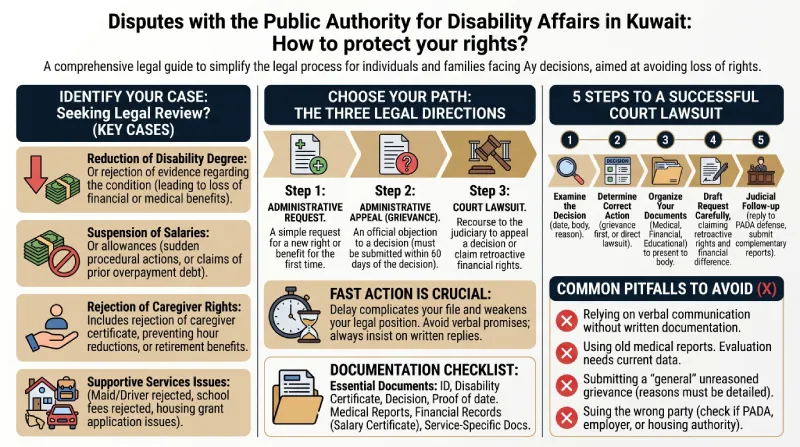
You may need a lawyer when a decision issued by the Authority affects a medical, financial, or employment-related right, or when delaying an objection may complicate the matter or result in the loss of an opportunity to take the appropriate legal action.
The situations that most commonly require prompt legal review include:
| Issue | Why It Matters | What Should Be Reviewed? |
|---|---|---|
| Reduction of the disability classification | Reduced allowances or loss of important benefits | The decision, medical reports, and assessment date |
| Suspension of salary or allowances | Unexpected financial pressure on the family | Reason for suspension, date of last payment, and required documents |
| Rejection of a caregiver certificate | Disruption of employment or retirement rights | Family relationship, medical condition, and Authority decisions |
| Debt claimed by the Disability Affairs Authority | Concern about a substantial financial claim | Basis of the debt, good faith, and previous payment decisions |
| Rejection of a domestic helper or driver allowance | Increased daily burden on the family | Type of disability, committee decision, and extent of need for assistance |
| Refusal to cover educational fees | Risk to the child’s educational stability | Educational Committee decision, school reports, and the student’s condition |
These cases should not be treated as one fixed procedure. Each matter must be reviewed according to the specific decision, supporting documents, and the authority that issued the refusal.
Why Should You Avoid Delaying After the Authority Issues a Decision?
A delay may turn a dispute that can still be reviewed and addressed into a more difficult procedural matter. In some cases, the person concerned may have the right to object, but delaying the grievance or failing to preserve documents may weaken their legal position later.
Many families do not act immediately because they are waiting for an oral response, hoping the matter will be resolved administratively, or unsure whether the decision can be challenged. In administrative disputes, however, timing is particularly important when the decision concerns suspension of entitlements, reduction of the disability classification, rejection of an official application, or a financial claim.
If you receive a written decision or payments are stopped without a clear reason, it is advisable to begin reviewing the decision and supporting documents promptly.
The Difference Between an Administrative Application, a Grievance, and a Lawsuit
One of the most common sources of confusion is the failure to distinguish between submitting an application to the Authority, filing a grievance against a decision, and bringing a lawsuit before the court.
| Stage | Meaning | Example |
|---|---|---|
| Administrative application | A request submitted to the Authority to obtain a right or service | Application to establish a disability or receive an allowance |
| Grievance | A formal objection to a decision involving rejection, reduction, or suspension | Grievance against a Medical Committee decision |
| Lawsuit | Resorting to the courts to challenge a decision or claim a right | Lawsuit seeking annulment of a decision reducing the disability classification or suspending allowances |
Choosing the correct stage is very important. Filing a lawsuit before completing the required procedures may create procedural problems, while relying only on oral communications may fail to preserve the right.
Which Decisions Can Be Challenged or Subject to a Grievance?
Any decision affecting the legal position of a person with a disability or a designated caregiver may need legal review. Examples include:
- Refusal to recognize a disability.
- Reduction of the disability classification from severe to moderate or mild.
- Suspension of allowances or salary.
- A demand for repayment of a debt.
- Refusal to issue a designated caregiver certificate.
- Refusal to reduce working hours.
- Refusal of a domestic helper or driver allowance.
- Refusal of an application related to education or school fees.
- Refusal of a housing benefit or a document required to obtain it.
The important question is not merely whether the decision is unsatisfactory, but whether it can be reviewed legally in terms of its reasons, timing, supporting documents, and the authority that issued it.
Filing a Grievance Against a Disability Affairs Decision in Kuwait
A grievance is a procedure submitted by the person concerned to the Public Authority for Disability Affairs requesting reconsideration of a decision before resorting to the courts. A grievance may be required for certain decisions or may be practically useful for formally recording the objection and explaining the alleged errors in the decision together with supporting documents.
According to the frequently asked questions published on the official website of the Public Authority for Disability Affairs, a grievance against a decision of the Educational and Technical Committee must be submitted within 60 days from the date of the decision at any branch of the Authority. The type and date of the decision should therefore be reviewed carefully to avoid delaying the appropriate action.
What Information and Documents Should Be Included in the Grievance?
It is preferable for the grievance to include the following information and documents:
- Details of the person concerned.
- The Authority file number, if available.
- The date of the decision or the date on which the person became aware of it.
- A description of the decision being challenged.
- The factual and legal grounds for the objection.
- Clear requests.
- Supporting documents, particularly recent medical reports, suspension notices, or financial documents.
A common mistake is submitting a general grievance stating only, “Please reconsider.” It is better for the grievance to identify a clear ground, such as an error in assessment, insufficient reasoning, failure to consider a medical report, an error in calculating entitlements, or failure to consider the circumstances of the designated caregiver.
Challenging a Medical Committee Decision and Reduction of the Disability Classification
Reducing the disability classification is one of the more sensitive situations because it may affect not only the medical description but also allowances, benefits, care arrangements, and other facilities connected to the condition.
A person or their family may feel that the decision is unfair where the medical condition is continuing or worsening while the classification is reduced or the condition is assessed as less serious than indicated by the medical reports.
This type of case is strengthened by a clear and organized set of documents including:
- Recent medical reports from recognized authorities.
- A medical history showing that the condition continues.
- Evidence that the condition has not actually improved.
- Information explaining the effect of the disability on daily life.
- A clear copy of the Committee’s decision.
- Any previous decisions confirming the former disability classification.
In this type of case, an emotional objection alone is not enough. The sense of unfairness should be translated into an organized documentary file showing where the alleged error occurred in the assessment or application of the relevant rules.
Suspension of Disability Allowances or Benefits in Kuwait
Suspension of allowances is one of the decisions that may place immediate pressure on a family because many families rely on these payments for treatment, transportation, daily care, or managing the affairs of the person with a disability.
The suspension may result from a data update, missing document, reassessment, change in disability classification, or a request by the Authority to review the file. Even where the Authority has an administrative reason, the person concerned remains entitled to understand the basis of the suspension and object if it is incorrect or disproportionate to their situation.
When payments are suspended, the person concerned should preferably begin with the following steps:
- Obtain the reason for the suspension in writing, where possible.
- Keep the most recent payment notice.
- Prepare the disability certificate and medical reports.
- Do not delay filing an objection or grievance.
- Do not sign any declaration or settlement before understanding its legal effect.
The purpose of legal review is not always escalation. It is to determine the most appropriate route: completing a missing document, filing a grievance, making a financial claim, or bringing a lawsuit seeking cancellation of the suspension and payment of outstanding amounts.
Challenging a Debt Claimed by the Disability Affairs Authority in Kuwait
A family may unexpectedly receive a financial demand or debt claim on the ground that amounts were paid by mistake or that the beneficiary was no longer entitled to receive them. This type of case requires careful review.
When challenging the debt, the basis of the claim should be examined from several perspectives, including:
- The date on which payments began.
- The reason for the claimed debt.
- Previous decisions authorizing payment.
- Whether the error was caused by the beneficiary or the administration.
- Whether reports or certificates supporting entitlement existed at the time of payment.
- Whether the beneficiary was properly notified.
Do not treat the debt as merely a figure. It should be examined as an administrative decision or financial claim requiring a legal basis and supporting documentation.
Claims for Retroactive Effect and Disability Allowance Differences
In some situations, the objective is not merely to restore a right for the future but also to claim amounts that were not paid previously because of an error in assessment, delay, or rejection.
For example, a person may initially have been classified at a lower disability level and later establish that they should have been classified at a higher level. Depending on the date of entitlement, the requests made, and the supporting documents, this may give rise to a claim for financial differences relating to the earlier period.
A retroactive claim may be important where an earlier error deprived the person of:
- Monthly allowances.
- A domestic helper or driver allowance.
- Differences linked to the disability classification.
- Entitlements connected with the designated caregiver.
- Educational amounts or other services due.
A common mistake is requesting only amendment of the decision while overlooking the financial consequences arising from it. The requested relief should therefore be drafted carefully from the beginning.
Domestic Helper or Driver Allowance for Persons With Disabilities in Kuwait
The Law Concerning the Rights of Persons with Disabilities provides that a person whose disability is determined by the competent committee to require assistance from a driver or domestic helper is entitled to a financial allowance determined by the Authority in accordance with the applicable conditions and rules, provided that it is not less than KWD 100.
This entitlement is not automatic in every case. It depends on the assessment of the competent committee, the type of disability, and the degree of need for assistance.
When Does a Dispute Arise Over the Domestic Helper or Driver Allowance?
A dispute commonly arises in situations such as:
- Refusal to pay the allowance despite an actual need.
- Payment of an amount lower than the person concerned believes is due.
- Suspension of the allowance after reassessment.
- Linking the allowance to updates or documents that are unclear to the claimant.
In these cases, the committee decision, medical reports, and the relationship between the disability and the need for a driver or domestic helper should be reviewed.
The Designated Caregiver and Reduced Working Hours in Kuwait
The designated caregiver is not merely a social description, but a legal status that may result in important rights, including certain employment or retirement benefits subject to applicable conditions and regulations.
A problem may arise when the Authority refuses to issue a caregiver certificate or when the employer refuses to apply the resulting entitlement, such as reduced working hours.
Common practical issues in designated caregiver cases include:
- Uncertainty over whether the father or mother is entitled to designated caregiver status.
- An employer requesting additional documents or refusing to apply reduced working hours.
- Uncertainty as to whether the dispute is with the Authority or the employer.
- Concern that requesting reduced working hours may affect the employee’s employment status.
- Insufficient medical documentation to demonstrate the extent to which the person with a disability depends on care.
In this type of case, it is important to identify precisely which authority issued the refusal. Sometimes the problem lies with the Public Authority for Disability Affairs, sometimes with the employer, and in some cases more than one authority may need to be involved depending on the nature of the dispute.
Retirement of a Designated Caregiver for a Person With a Disability
The Law Concerning the Rights of Persons with Disabilities regulates certain cases involving the retirement of a person with a disability or their designated caregiver according to specified periods of service, conditions, and regulations. Disputes may arise when an application is refused because a condition is considered unmet, because of disagreement over the disability classification, or because designated caregiver status is not recognized.
Documents that should be reviewed in this type of application include:
- Disability certificate.
- Designated caregiver certificate.
- Service records.
- Employer letter, if available.
- Medical documents establishing the nature of the condition.
- Any refusal or decision issued by the competent authority.
It is not enough simply to state that a person is actually providing care. What matters is proving that status within the applicable legal framework and through the required documents.
Education Cases for Persons With Disabilities and School Fees
Education disputes may arise when a child or person with a disability requires special educational arrangements or an appropriate school and an application is then refused, school fees are not covered, or the condition is not approved.
These cases may be particularly difficult for families because they concern not only financial costs but also the child’s future and psychological and educational stability. Issues that should be reviewed include:
- The Educational Committee’s decision.
- Educational or psychological reports.
- A diagnosis of learning difficulties, if applicable.
- Proof of the student’s enrollment.
- Invoices or claims for fees.
- Whether the educational institution is approved.
The more organized the file is and the more clearly it explains how the condition affects education, the easier it is to present the matter administratively or judicially.
Housing Cases and Housing Grants for Persons With Disabilities
A disability may be connected to housing rights, priorities, or grants intended to modify housing to suit the person’s condition. The Law Concerning the Rights of Persons with Disabilities includes provisions related to housing grants and priority in housing care subject to the applicable conditions and regulations. The relevant requirements and current forms should therefore be reviewed before submitting an application.
A family may need legal review in housing and housing grant cases where any of the following applies:
- Refusal of the grant or priority.
- A conflict between the Authority’s response and another housing authority.
- The reason for refusal is unclear.
- There is a delay in responding despite submission of the required documents.
- There is an actual need to modify the home to accommodate the disability.
Documents Required Before Filing a Lawsuit or Grievance
The more organized your file is from the beginning, the faster and more accurately your position can be assessed. The required documents vary according to the type of decision or dispute, but they can generally be organized as follows:
| Document Type | Examples of Required Documents |
|---|---|
| Basic documents | Civil ID of the person concerned, civil ID of the designated caregiver if applicable, disability certificate or disability ID, Authority file number, challenged decision, proof of the date on which the decision became known, proof of filing a grievance if one was submitted, and any correspondence or notices issued by the Authority. |
| Medical documents | Recent medical reports, government or approved medical reports where required, medical history, evidence showing continuation or deterioration of the condition, and reports explaining the effect of the disability on daily life. |
| Financial or employment documents | Notices suspending payments, statements of amounts paid or withheld where available, salary certificate, employer letter, service records, and any debt claim. |
| Educational or housing documents | Educational Committee decision, proof of student enrollment, fee invoices, learning difficulty or educational reports, and documents relating to a housing application or the response of the competent authority. |
Not all of these documents are required in every case. The documents needed depend on the nature of the decision and whether the dispute concerns medical assessment, financial entitlements, employment, education, or housing.
Steps in Kuwait Disability Affairs Lawsuits
Cases involving the Public Authority for Disability Affairs generally pass through several stages:
- Review the decision: Identify the date of the decision, the authority that issued it, and the reason for refusal or suspension, because these factors help determine whether the appropriate route begins with a grievance, claim, or lawsuit.
- Determine the appropriate procedure: Not every case begins with litigation. In some situations, the correct route may be a grievance, completion of missing documents, a financial claim, or an administrative lawsuit.
- Organize the documents according to the type of dispute: After collecting the documents, arrange them according to whether the dispute is medical, financial, employment-related, educational, or housing-related so that the matter can be presented clearly and systematically.
- Draft the requests precisely: Clearly identify the relief sought, such as annulment of the decision, restoration of payments, payment of financial differences, cancellation of a debt, recognition of designated caregiver status, or requiring an authority to apply a specific legal consequence.
- Follow the lawsuit and responses: After the lawsuit is filed, the administrative authority may submit a defense, and the case may require reports, expert evidence, or additional documents. Careful follow-up and organized responses are therefore important.
Common Mistakes That Weaken Disability Affairs Cases
Common mistakes include:
- Relying on oral statements: Oral communications are not enough to preserve a right. Always try to obtain a written decision or response or evidence showing that an application or grievance was submitted.
- Delaying the objection: Waiting too long may harm the legal position, particularly where there is a clear decision with a known date.
- Submitting a general and unspecific grievance: The grievance should explain the reason for the objection rather than simply requesting “reconsideration.”
- Using outdated medical reports: Old reports may not reflect the current condition. Recent and detailed reports are generally more useful.
- Failing to claim financial differences: If an incorrect decision caused financial loss, the possibility of claiming the resulting financial effect should be considered rather than seeking only future amendment of the decision.
- Naming the wrong authority as a defendant: In some cases the issue lies with the Authority, while in others it may involve an employer, educational institution, or housing authority. Correctly identifying the responsible party is important.
- Comparing the case with other cases: Similar problems do not necessarily require identical procedures. Each case should be assessed according to its decision, documents, dates, and the authority that issued the refusal.
The Role of a Lawyer in Kuwait Disability Affairs Lawsuits
A lawyer’s role is not limited to filing the lawsuit. Legal work begins earlier, with reviewing the decision and documents and identifying the most appropriate route. A lawyer may assist with:
- Reviewing the decision being challenged.
- Determining whether a grievance is required before litigation.
- Reviewing medical and financial documents.
- Drafting the grievance in clear legal language.
- Defining the judicial claims precisely.
- Filing the lawsuit and following responses.
- Claiming financial consequences where there is a legal basis.
- Avoiding formal and procedural mistakes.
A lawyer cannot guarantee a particular outcome because the decision ultimately belongs to the competent court, but legal representation may help build an organized file and present the claims more clearly within the applicable legal framework.
Frequently Asked Questions About Kuwait Disability Affairs Lawsuits
What are Kuwait Disability Affairs Lawsuits?
They are disputes involving decisions by the Public Authority for Disability Affairs that may affect disability rights, benefits, or other entitlements.
Can I challenge a Disability Affairs decision in Kuwait?
Yes. A decision affecting disability classification, allowances, caregiver rights, or other entitlements may be reviewed depending on its nature.
When can I file a grievance against a Disability Affairs decision?
The procedure depends on the type of decision. Certain Educational and Technical Committee decisions may be challenged within 60 days.
Can I challenge a reduction in my disability classification?
Yes. The decision, recent medical reports, previous classifications, and supporting evidence should be reviewed before taking action.
What should I do if my disability allowance is suspended?
Obtain the reason for suspension, preserve payment records, prepare supporting documents, and review the available grievance procedure promptly.
Can I challenge a debt claimed by the Disability Affairs Authority?
Yes. The basis of the debt, previous payment decisions, notification, and circumstances surrounding the payments should be reviewed.
In conclusion, Kuwait Disability Affairs Lawsuits require more than simply objecting to a decision. The reason for the decision, its date, the available documents, and the appropriate legal procedure should all be reviewed to determine whether the matter should begin with a grievance, financial claim, or court action.
If you have received a decision involving refusal, reduction of the disability classification, suspension of allowances, a debt claim, or refusal of a designated caregiver certificate, consulting a lawyer in Kuwait may help you understand the appropriate legal procedure before taking further action.
If you have received a decision from the Public Authority for Disability Affairs and need to understand the available legal route, you can contact Attorney Riyadh Matni Al-Fadhli and send a copy of the decision together with a brief summary of the case via WhatsApp for an initial review of the available procedure.
Legal Disclaimer: This article provides general educational legal information and does not constitute legal advice or a promise of a particular outcome. Available procedures and legal options vary according to the circumstances of each case, the date of the decision, supporting documents, applicable deadlines, and the authority that issued the refusal or suspension.

Lawyer in Kuwait, Registration No. 8342. Through this personal platform, he provides educational legal content covering contracts, companies and investment, arbitration, and commercial dispute resolution. The content is presented in a clear and precise manner to help individuals and businesses understand their legal options and reduce potential risks.