The withdrawal of nationality may result in complications affecting family members’ records, such as the inability to register a newborn, discrepancies in the father’s or grandfather’s name, or changes to the family surname due to a document that has been proven to be forged.
This article explains what you need to know about a lineage claim for a person whose nationality has been withdrawn, and when the situation requires consulting a lawyer to assess the documents and determine the most appropriate legal course, helping to avoid unsuitable procedures or delays in processing the application.
Are you facing complications in obtaining birth certificates or correcting family records after a decision to withdraw nationality? These cases require a precise legal approach to protect your family’s rights. Lawyer Riyadh Matni Al-Fadhli provides clear legal guidance to determine the correct procedure and address the issue through carefully considered steps.
Contact Lawyer Riyadh NowOr you can continue reading to learn about the procedures and documents required for your case step by step.
Table of content
When Does a Person Whose Nationality Has Been Withdrawn Need a Lineage Claim or a Name Correction Request?
The legal procedure is not determined merely by the issuance of a nationality withdrawal decision, but rather by the type of error or dispute found in birth certificates, records, and official documents. The following table shows the most appropriate preliminary procedure for each situation:
| Existing Issue | Preliminary Legal Procedure |
|---|---|
| The father denies the child’s lineage | Submit a direct lineage establishment request to the Lineage Claims Committee in preparation for referral to the competent court |
| A child is registered under an incorrect father | Submit a direct lineage denial request after determining the applicant’s legal capacity and the supporting evidence |
| A dispute concerning descent from the paternal grandfather | Submit a request to establish or deny indirect lineage before the competent committee |
| A discrepancy in the father’s or grandfather’s name without a dispute over paternity | Submit a request to correct the name or the name of the ancestor |
| The surname is affected by a document proven to be forged | Request correction of the name or surname based on the final judgment establishing the forgery |
| No birth certificate is issued for the child while a lineage dispute exists | Resolve the lineage issue first, then complete the procedures for registering the birth |
| A clerical error exists in the name | Submit a request to correct a material error, not a lineage establishment request |
| The marriage was not documented and the father denies the child | Examine the establishment of the marital relationship and lineage according to the facts of the case and the available documents |
What Is Meant by a Lineage Claim for a Person Whose Nationality Has Been Withdrawn in Kuwait?
The law does not use the term “lineage claim for a person whose nationality has been withdrawn” as an independent legal designation. Rather, it is an expression describing a situation in which the withdrawal of nationality is connected to the need to establish or deny lineage, or to correct name or surname information in official records.
The law distinguishes between two types of lineage:
- Direct lineage: descent from the parents, such as establishing a child’s lineage to the father or mother, or denying it.
- Indirect lineage: descent from the paternal grandfather and higher paternal ancestors, such as establishing a person’s connection to a grandfather or a higher ancestor in the lineage.
Name correction means modifying the existing name by adding to it, deleting from it, or both, whereas changing the name means replacing it with another name. The surname refers to the family name.
The legal course varies depending on the type of request. A request to establish or deny direct lineage is subject to investigation by the committee before being referred to the competent court, while the committee decides requests concerning indirect lineage, correction or change of name, and addition or deletion of a surname.
Does a Judgment Establishing Lineage Restore Withdrawn Kuwaiti Nationality?
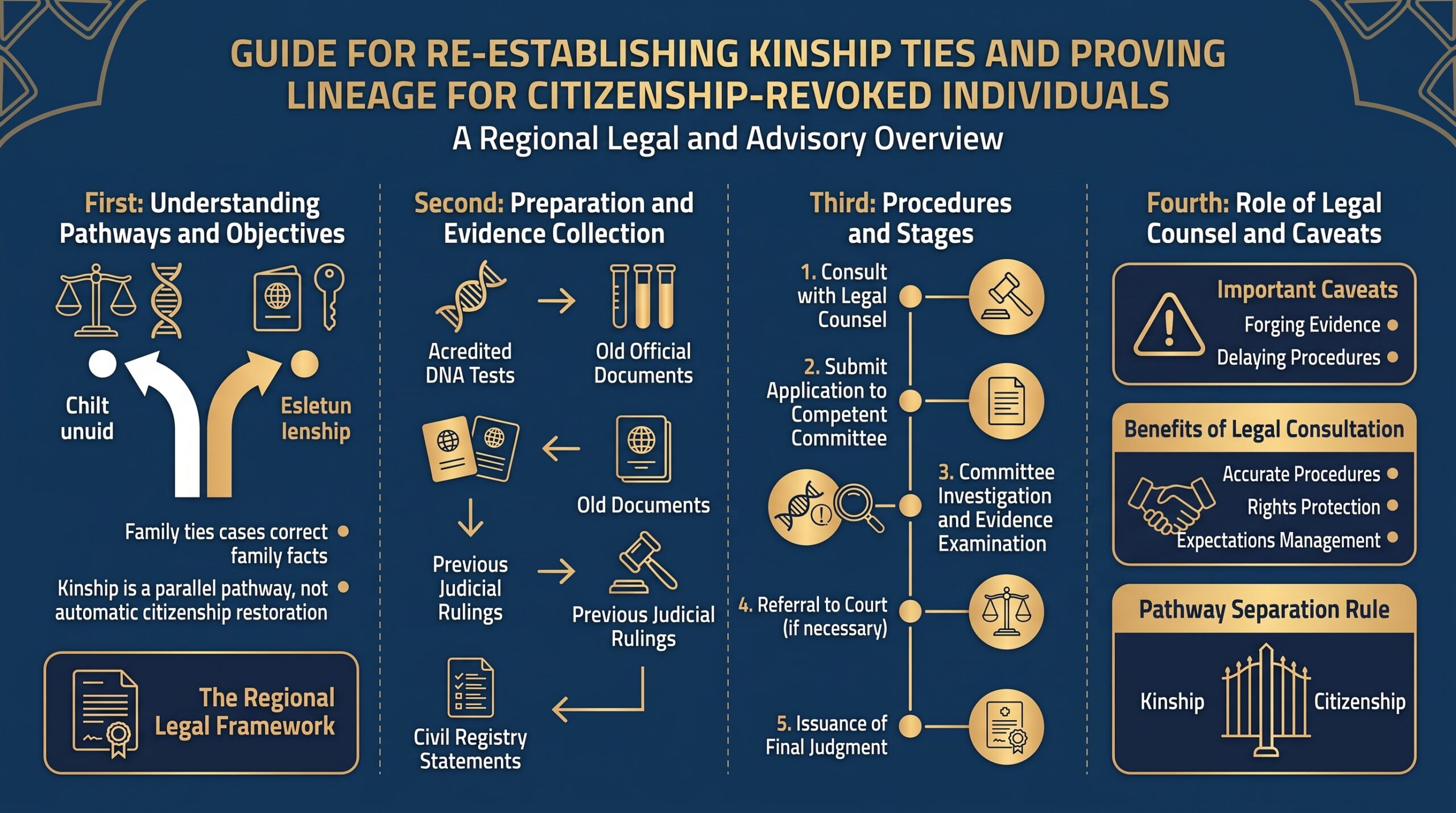
A judgment establishing lineage or a decision correcting a name does not, in itself, cancel or reverse a decision to withdraw Kuwaiti nationality; its effect may be limited to establishing paternity or amending the father’s or grandfather’s name in the birth certificate and official records.
With regard to the decisions of the Lineage Claims and Name Correction Committee and the Grievance Committee, Article 19 of Decree-Law No. 53 of 2026 requires ministries and administrative authorities to implement them, unless their implementation would affect nationality or residency matters.
Matters relating to the granting, loss, withdrawal, and revocation of nationality remain governed by Amiri Decree No. 15 of 1959 concerning the Kuwaiti Nationality Law, as amended by Decree-Law No. 52 of 2026.
Therefore, the case may require two separate legal courses:
- A course for establishing lineage or correcting official entries and records.
- A separate course relating to the decision to withdraw nationality and its consequences under the Kuwaiti Nationality Law.
Key Situations Requiring Lineage Establishment or Name Correction After Nationality Withdrawal
Choosing the appropriate legal procedure requires careful examination of the facts and documents, because situations that appear similar do not necessarily follow the same legal course.
Inability to Register a Newborn Due to a Paternity Dispute
The inability to issue a birth certificate does not always mean that a lineage establishment claim is required. It is first necessary to determine whether paternity is genuinely disputed or whether the problem is limited to discrepancies in the parents’ information or missing registration documents.
If the father denies the child’s lineage or there is no acceptable document proving paternity, a judgment establishing lineage may be required before the newborn can be registered. If lineage is not disputed, the appropriate procedure may instead be to complete the required documents or correct the official record.
Establishing the Lineage of a Person Whose Birth Was Not Registered After Reaching One Year of Age
The procedures for an unregistered birth apply to a person who was born outside a hospital and for whom no birth certificate was issued.
If the newborn is over one year old, a court judgment establishing lineage must be submitted. If the newborn is not Kuwaiti, the judgment must also establish that the birth occurred inside Kuwait.
Therefore, the need for a judgment establishing lineage is not determined solely by the absence of a birth certificate, but rather by the newborn’s age, the circumstances of the birth, the person’s registered status, and whether there is an actual dispute concerning paternity.
Correcting a Name or Surname After a Document Has Been Proven Forged
If the withdrawal of nationality is connected to a document that has been proven forged, this does not automatically result in changing the names or surnames of family members. It is first necessary to determine which information was based on the forged document and the extent to which it affected paternity, descent from the grandfather, or the registered name.
If the forgery affects the basis of lineage, the procedure would be directed toward establishing or denying lineage depending on the case. If lineage remains established and the effect is limited to the father’s or grandfather’s name or the family surname, the appropriate course may be a request to correct the name or surname.
Article 12 of Decree-Law No. 53 of 2026 generally prohibits correcting or changing the name of an ancestor or the surname, as well as adding or deleting a new surname, subject to specified exceptions, including the issuance of a final judgment establishing or denying lineage, or establishing the forgery of official documents proving the name or surname.
Therefore, the effect of the forged document on the official records must be determined before submitting the request, so that a name correction procedure is not pursued when the actual issue concerns the basis of lineage, or vice versa.
Procedures for Filing a Lineage Claim for a Person Whose Nationality Has Been Withdrawn in Kuwait
A lineage claim for a person whose nationality has been withdrawn goes through successive legal stages, and handling it requires compliance with the prescribed procedures according to the nature of each case, as follows:
- Reviewing the file: Examine the nationality withdrawal decision and compare the marriage, birth, father, and grandfather information to determine whether the required action is to establish or deny lineage, or to correct the name or surname.
- Submitting the request to the committee: The request is submitted by the concerned person or their legal representative, with a statement of the facts and the requested outcome. It may be submitted in person, through a representative holding a special power of attorney, or electronically after authentication through the “Hawiyti” application.
- Attaching supporting evidence: Documents and judgments supporting the lineage or the information to be corrected are attached according to the nature of the request and the legal capacity of its parties.
- Attending the investigation: The committee may summon the parties and witnesses and request any necessary information or documents. Failure to attend or to provide what is required within thirty days may result in rejection of the request or referral to the court, depending on the circumstances.
- Conducting DNA testing when necessary: The committee may order DNA testing or use modern scientific methods to verify lineage while maintaining the confidentiality of the results.
- Referring the request to the court: The committee refers a request to establish or deny direct lineage to the court together with its investigation report within six months from submission, or within three months if the matter concerns denial of lineage through li’an. If the period expires without a decision, the concerned person may resort to the courts.
- Hearing the case: After referral of the file and payment of the prescribed court fees, the Court Registry sets a hearing date, the parties are notified, and memoranda and evidence are submitted in accordance with the prescribed litigation procedures.
- Enforcing the judgment or decision: Once it becomes final and enforceable, the original record or birth certificate is corrected first, after which the procedures for amending the civil ID and related documents are completed.
Documents Required in a Lineage Establishment Claim
The required documents vary according to the nature of the case and the capacity of the parties, and the file may include the following:
- The decision or decree withdrawing nationality.
- The civil ID or an alternative official document.
- The birth certificate, if available.
- The marriage contract.
- The birth notification.
- The passport or security card, depending on the registered status.
- Birth certificates of children or siblings.
- Death certificates of the father or grandfather when necessary.
- Official documents bearing the father’s or grandfather’s name or the surname.
- Final judgments relating to lineage or forgery.
- Previous correspondence or transactions containing an acknowledgment of paternity.
- Details of witnesses who have direct knowledge of the marriage, birth, or lineage.
Not all of these documents are required in every case. The required documents are determined according to the type of lineage, the facts, and the information available to the official authorities.
Grievances and Objections Against Decisions of the Lineage Claims and Name Correction Committee
The method for reviewing a decision differs depending on whether the decision was issued as a rejection or an approval.
Grievance Against a Decision Rejecting a Lineage or Name Correction Request
A grievance may be filed against decisions declaring inadmissible or rejecting:
- A request to establish or deny indirect lineage.
- A request to correct or change a name.
- A request to add or delete a surname.
The grievance must be submitted within thirty days from the date the applicant is notified of the decision.
The Ministry of Justice explains that the grievance may be submitted by the concerned person or their representative, together with the rejection decision, the Investigation Committee’s report, and the required documents.
Objection to an Approval Decision in Lineage and Name Correction Requests
Any interested person may object to an approval decision within thirty days from the date the decision is published in the Official Gazette.
The outcome of another transaction should not be awaited once the objection period has begun, because expiry of the period may cause the decision to become final in the cases specified by law.
Fees for Lineage Establishment and Name Correction Requests in Kuwait
The law sets the basic fees as follows:
| Type of Request | Fee |
|---|---|
| Establishing or denying indirect lineage | 150 Kuwaiti dinars |
| Correcting or changing a name | 50 Kuwaiti dinars |
| Adding or deleting a surname | 50 Kuwaiti dinars |
| Grievance or objection | 50 Kuwaiti dinars |
| Correction of material errors | Exempt from the fee prescribed under Article 17 |
The concerned person may request exemption from the fee if they prove their inability to pay it through supporting documents, and the committee’s decision regarding the exemption is final.
As for a direct lineage claim referred to the court, proceedings continue after payment of the prescribed court fees when the hearing is scheduled.
Errors That May Lead to Rejection of the Request or Delay Its Determination
Any of the following errors may result in rejection of the request or prolongation of its procedures:
- Filing a direct lineage claim before the court prior to the investigation by the committee.
- Combining a request to establish lineage with a request to restore nationality despite the different competent authority and legal course applicable to each.
- Choosing a request that does not correspond to the subject of the dispute, such as using a direct lineage request to address a dispute concerning descent from the paternal grandfather.
- Submitting a lineage denial request to address a clerical error in the name.
- Requesting amendment of the civil ID before correcting the birth certificate or original record.
- Treating a person as belonging to the category of persons of undetermined nationality without an official document establishing their current status.
- Relying solely on a private DNA test.
- Concealing a previous judgment or document that conflicts with the stated facts.
- Missing the grievance or objection deadline.
- Providing unverified information to compensate for missing documents.
Article 18 provides for imprisonment for a term not exceeding five years, a fine not exceeding five thousand dinars, or either of these two penalties, for anyone who intentionally provides false information before the committee, the Grievance Committee, or the competent court while knowing that the information is incorrect.
The Lawyer’s Role in a Lineage Claim Related to the Withdrawal of Nationality
The importance of a lawyer lies in determining the effect of the nationality withdrawal decision on each individual’s records and choosing the course that corresponds to the actual nature of the dispute before submitting any request. A lawyer in Kuwait usually undertakes the following:
- Distinguishing between legal courses: differentiating between a dispute concerning the establishment of paternity, descent from the grandfather, correction of a name or surname, and the separate procedures connected with the nationality withdrawal decision.
- Assessing evidence before submission: reviewing the consistency between marriage contracts, birth certificates, birth notifications, and previous judgments, and identifying any contradiction that may weaken the request or cause delay.
- Determining the competent authority: identifying whether the request falls within the jurisdiction of the Lineage Claims Committee, the Name Correction Committee, or the competent court, thereby preventing submission of the procedure to an authority lacking jurisdiction.
- Protecting legal deadlines: monitoring deadlines for completing documents, filing a grievance against a rejection decision, and objecting to an approval decision so that the concerned person does not lose their right due to expiry of the deadline.
- Organizing enforcement of the judgment or decision: following up on correction of the original record or birth certificate first, then amendment of the civil ID and other documents according to the correct administrative sequence.
Frequently Asked Questions About a Lineage Claim for a Person Whose Nationality Has Been Withdrawn
Does establishing lineage restore withdrawn Kuwaiti nationality?
No. A judgment establishing lineage or correcting a name does not, by itself, cancel a nationality withdrawal decision. Nationality matters follow a separate legal framework and may require a separate procedure.
When is a lineage claim required after nationality withdrawal?
A lineage claim may be required when there is an actual dispute over paternity, descent from the paternal grandfather, or the correctness of lineage recorded in official documents. If the issue is only a clerical error, a correction request may be sufficient.
Where is a direct lineage request submitted in Kuwait?
A direct lineage establishment or denial request is first submitted to the competent Lineage Claims Committee for investigation before being referred to the competent court.
Can a name or family surname be corrected after nationality withdrawal?
Yes, in certain cases. The appropriate procedure depends on whether the issue concerns lineage itself or only the father’s name, grandfather’s name, or family surname in official records.
Is DNA testing required in every lineage case?
No. DNA testing is not automatically required in every case. The competent committee may order DNA testing or use other scientific methods when necessary to verify lineage.
What documents may be required for a lineage claim?
Documents may include the nationality withdrawal decision, civil ID, birth certificate, marriage contract, birth notification, passport or security card, relevant family birth certificates, previous judgments, and other official records supporting the claim.
Can I object to a decision of the Lineage Claims and Name Correction Committee?
Yes. Depending on the type of decision, a grievance or objection may generally be submitted within 30 days from notification of the rejection decision or publication of an approval decision.
What happens after a final judgment correcting lineage or a name?
The original record or birth certificate is generally corrected first. After that, related documents such as the civil ID and other official records can be updated accordingly.
This brings us to the conclusion of the article on a lineage claim for a person whose nationality has been withdrawn in Kuwait, the course of which is determined according to the nature of the dispute and the information that needs to be established or corrected. Since the documents and deadlines vary from one case to another, the file should be carefully reviewed before submitting the request or filing a grievance against the decision.
To review the nationality withdrawal decision and the marriage and birth documents, and to determine the appropriate legal course according to the facts of the case, you can contact lawyer Riyadh Matni Al-Fadhli.
You may also be interested in:
Legal Disclaimer: This article is general educational content and does not constitute legal advice or a guarantee of the outcome of any request or claim. The correct legal course is determined according to the reason for the withdrawal of nationality, the type of lineage, the applicable personal status law, and the documents available in each case.

Lawyer in Kuwait, Registration No. 8342. Through this personal platform, he provides educational legal content covering contracts, companies and investment, arbitration, and commercial dispute resolution. The content is presented in a clear and precise manner to help individuals and businesses understand their legal options and reduce potential risks.