
Decisions relating to nationality may result in legal and administrative consequences that vary according to the type of decision, its reason, and the scope of persons covered by it. Therefore, it is not sufficient to rely on the commonly used description of the decision; instead, its text and the legal basis on which it was issued must be reviewed.
This article explains the difference between withdrawal of Kuwaiti nationality, revocation, loss of nationality, and withdrawal of a nationality certificate, as well as the reasons for withdrawal, its effects on dependents, grievance procedures, and the options available after the decision is issued.
Has a decree withdrawing nationality been issued against you or a member of your family, and are you concerned about the legal deadline and the status of dependents? Do not let time pass; lawyer Riyadh Matni Al-Fadhli is available to carefully review the decree, determine your legal position, and prepare a well-founded grievance supported by strong legal grounds to protect your rights within the official deadline.
Contact Now to Review the Decree and Assess Your PositionOr continue reading first to clearly understand the procedures and steps.
Table of content
What Should You Do After a Decision to Withdraw Kuwaiti Nationality Is Issued?
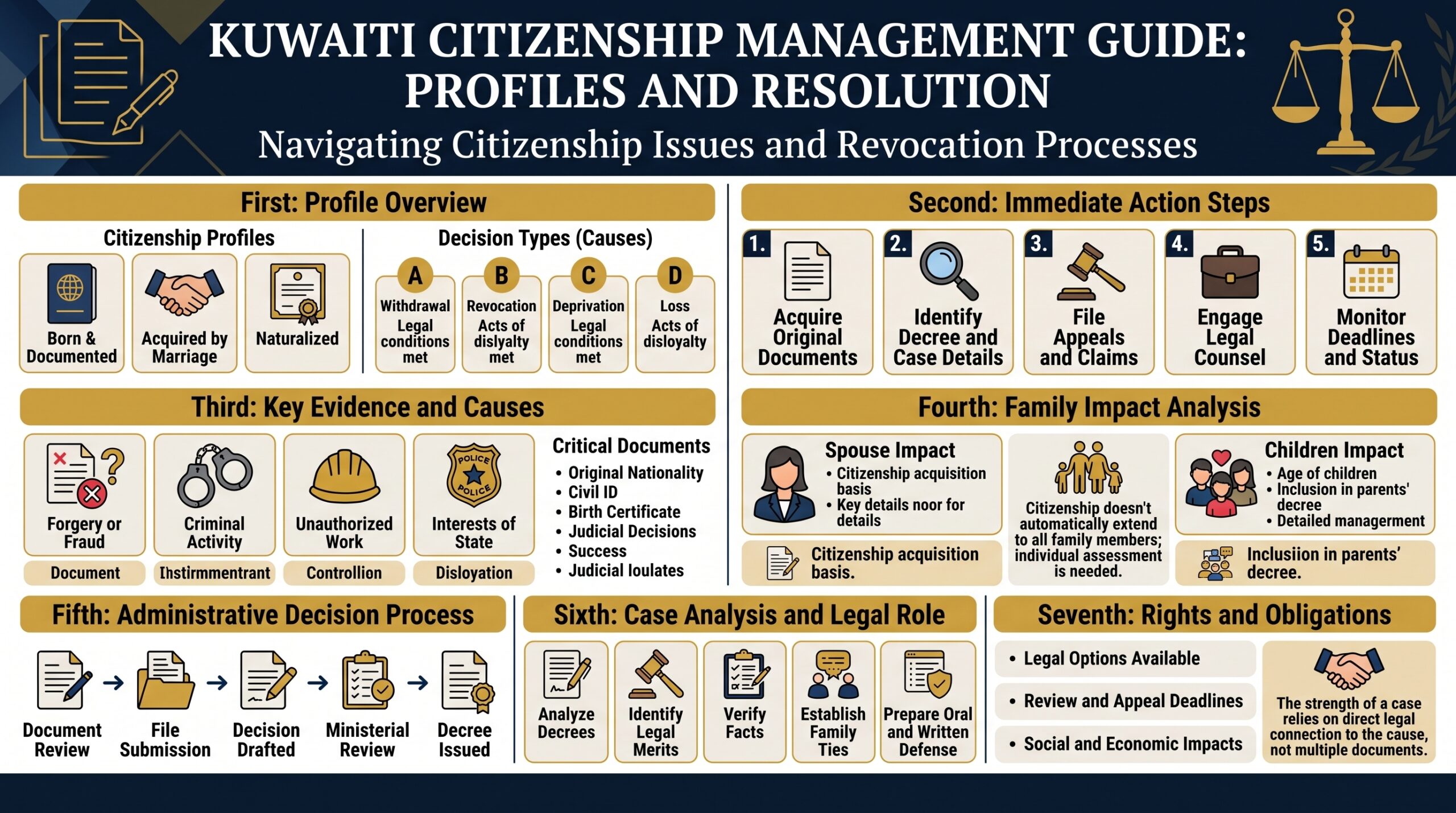
Start by referring to official information before submitting any request or document, because the appropriate procedure is determined by the text of the decision and its legal basis, not by the commonly circulated description of it. Take the following steps:
- Obtain the official decision: Review the “Kuwait Al-Youm” Official Gazette to determine the publication date and the persons covered by the decision.
- Determine the type and legal basis of the decision: Verify whether it concerns withdrawal, revocation, loss of nationality, or withdrawal of a nationality certificate, and review the cited article and paragraph.
- Examine the family’s status: Confirm how the wife and children acquired nationality and the extent to which the decision applies to them.
- Prepare the relevant documents: Focus on documents that directly address the reason for the decision rather than attaching numerous unrelated papers.
- Verify the deadline and official channel: Follow the instructions of the Grievance Committee and calculate the period from the date of official publication.
If the reason for the decision or the extent to which it applies to family members is unclear, lawyer Riyadh Matni Al-Fadhli can examine the decision and the essential documents and determine the legal priorities before any action is taken.
What Is Meant by Withdrawal of Kuwaiti Nationality?
Withdrawal of nationality means terminating a person’s enjoyment of Kuwaiti nationality that they previously acquired through naturalization when one of the cases stated in Article 13 of the Nationality Law applies. Withdrawal does not occur automatically merely because an accusation or information about the person is circulated. Rather, it is issued by decree upon the recommendation of the Minister of Interior and after approval by the Supreme Committee for the Investigation of Kuwaiti Nationality.
It must be distinguished from three other legal routes:
Legal Route | Who Does It Apply To? | General Legal Basis |
|---|---|---|
Revocation of Nationality | Anyone who holds Kuwaiti nationality | The cases stated in Article 14, such as serving in a foreign military without authorization, working for a state at war with Kuwait or with which relations have been severed, undermining the system or compromising loyalty, and deliberately adding an ineligible person to a nationality file |
Loss of Nationality | A person in respect of whom a circumstance occurs that the law makes a ground for loss of nationality | Such as voluntarily acquiring a foreign nationality |
| Withdrawal of a Nationality Certificate | A person who was issued a nationality certificate without entitlement | Fraud, false statements, or inaccurate testimony |
Key Amendments to the Kuwaiti Nationality Law in 2026
Decree-Law No. 52 of 2026 reorganized several fundamental provisions of the Nationality Law. Among the key changes relating to withdrawal are:
- Defining the cases in which nationality may be withdrawn from a naturalized person.
- Regulating the effect of certain cases of withdrawal on persons who acquired nationality by dependency.
- Adding a case involving the deliberate inclusion of an ineligible person in a nationality file.
- Permitting the use of DNA testing, biometric fingerprints, and other scientific methods in matters specified by law.
- Regulating penalties associated with providing inaccurate information in nationality matters.
- Providing that decrees and decisions relating to nationality are acts of sovereignty that are not subject to judicial review.
The explanation published on the official website of the judiciary confirmed that the amendment reorganized matters relating to the granting, loss, withdrawal, and revocation of nationality, permitted the use of scientific methods for verification, and classified nationality decisions as acts of sovereignty.
Reasons for Withdrawing Kuwaiti Nationality From a Naturalized Person
The Kuwaiti Nationality Law identifies six cases in which nationality may be withdrawn from a person who acquired it through naturalization. Each case differs in terms of its conditions, underlying facts, and the evidence required for examination.
Obtaining Nationality Through Fraud, Forgery, or False Statements
Nationality may be withdrawn if it was granted as a result of fraud, forgery, or false statements that affected the naturalization decision. The violation may relate to documents concerning lineage or birth, information about family members, witness statements, or other material information.
Applying this ground requires verifying the connection between the inaccurate information and the granting of nationality, because not every clerical error in a document constitutes fraud justifying withdrawal.
The effect of withdrawal extends to persons who acquired nationality together with the individual by dependency. Therefore, the basis on which each family member acquired nationality and their connection to the naturalized person’s file must be reviewed.
Issuance of a Final Judgment for One of the Specified Crimes
Nationality may be withdrawn if, after obtaining it, the naturalized person receives a final judgment for one of the following crimes:
- A crime involving dishonor or breach of trust.
- A crime against the internal or external security of the state.
- A crime involving an offense against the Divine Being or the Prophets.
- A crime involving an offense against the Amir.
A mere accusation, investigation, or judgment that remains subject to appeal is not sufficient. The judgment must be final and must have been issued after nationality was granted.
If the judgment was issued in absentia and the person is a fugitive outside Kuwait, nationality may be withdrawn after six months of the person remaining abroad. In this case, withdrawal does not automatically extend to the wife or children; the legal status of each must be examined independently.
Disciplinary Dismissal for Reasons Related to Honor or Integrity
Nationality may be withdrawn if a naturalized person is dismissed from a government position through disciplinary action for a reason related to honor or integrity, provided the dismissal occurred after the person acquired nationality.
This does not include termination of employment, resignation, or dismissal for ordinary administrative reasons. The dismissal decision and disciplinary investigation must be reviewed to determine the actual legal reason and whether the conditions for withdrawal apply.
This ground does not result in automatic extension of the withdrawal to persons who acquired nationality by dependency.
Withdrawal of Nationality in the Higher Interests of the State or Its External Security
Nationality may be withdrawn if required by the higher interests of the state or its external security. This ground is based on the competent authorities’ assessment of the facts and their impact on state interests and may rely on information or reports whose full details are not necessarily available to the person concerned.
Accordingly, legal review focuses on the wording of the decree, the person’s status when nationality was acquired, the sequence of events, and the available official documents.
Withdrawal may extend to persons who acquired nationality by dependency, with the decree specifying the persons covered by the decision.
Undermining the System or Belonging to a Foreign Political Organization
Nationality may be withdrawn where the competent authorities have serious evidence that a naturalized person promotes ideas intended to undermine Kuwait’s economic, social, or political system, or belongs to a foreign political organization.
A final criminal judgment is not required in this case. It is sufficient that serious evidence exists on which the competent authorities rely.
Such evidence may relate to the nature of the activity or membership, published materials, correspondence, or relevant documents. The effect of withdrawal may also extend to persons who acquired nationality together with the individual by dependency.
Adding an Ineligible Person to a Nationality File
Nationality may be withdrawn from a person who deliberately added to their own nationality file, or another person’s nationality file, an individual who is not their child or descendant.
The following conditions must be met for this ground to apply:
- An actual addition to the nationality file must have occurred.
- There must be no parent-child or descendant relationship with the person added.
- It must be established that the addition was made deliberately.
- An investigation must be conducted before the Supreme Committee for the Investigation of Kuwaiti Nationality.
The competent authorities may rely on birth certificates, civil records, and statements by parties to the file, in addition to DNA or biometric evidence in accordance with legal requirements.
Withdrawal may include persons who acquired nationality by dependency, with the decree specifying the scope of persons to whom the decision applies.
Can Kuwaiti Nationality Be Withdrawn From a Kuwaiti by Origin?
The withdrawal regulated under Article 13 does not apply to a Kuwaiti by origin because it concerns persons who acquired nationality through naturalization. However, another legal route may apply, such as loss or revocation of nationality, or withdrawal of the nationality certificate if it is established that the certificate was issued without entitlement.
The description of the decision must therefore be determined precisely. A person may be registered as a Kuwaiti by origin while the measure actually concerns withdrawal of the nationality certificate under Article 21 bis A, rather than withdrawal of nationality from a naturalized person.
Does Withdrawal of Nationality Extend to the Wife and Children?
Withdrawal of nationality from one person does not automatically extend the decision to all members of the family. Its effect depends on the reason for withdrawal, how each person acquired nationality, and the scope of persons covered by the decree.
The Wife’s Status After Withdrawal of Nationality
The wife’s status is determined by referring to the date on which she acquired nationality, the legal basis under which she acquired it, and the law in force at that time.
Article 10 regulates special cases relating to a woman who acquired nationality by reason of marriage to a Kuwaiti, including certain situations involving the husband’s death or termination of the marital relationship, the absence of children from him, marriage to a non-Kuwaiti, restoration of her original nationality, acquisition of another nationality, or possession of a foreign passport.
The Children’s Status After Withdrawal of Nationality
The status of each child must be reviewed separately according to the following factors:
- The child’s date of birth.
- The date on which the father was naturalized.
- Whether the child acquired nationality while a minor.
- Whether the child was born after the father’s naturalization.
- The action taken upon reaching the age of majority, where legally required.
- Whether the child’s name is included in the decree.
Reaching the age of majority alone does not automatically give the child an independent legal status. The manner in which nationality was acquired and the documents connected to the individual file must be examined independently.
Dual Nationality and Loss of Kuwaiti Nationality
A Kuwaiti loses their nationality if they voluntarily acquire the nationality of a foreign state. This requires that the person actually acquired foreign nationality by choice; foreign residence or possession of a travel document that does not establish acquisition of the foreign state’s nationality is insufficient.
A naturalized person who holds another nationality is required to renounce it and submit proof of doing so to the Ministry of Interior within three months from the date of obtaining Kuwaiti nationality.
If the period expires without proof of renunciation being submitted, the grant of Kuwaiti nationality is deemed never to have existed from the date of naturalization. This rule differs from withdrawal of nationality by decree under the cases stated in Article 13 of the Nationality Law.
How Is a Decision to Withdraw Kuwaiti Nationality Issued?
This process differs from the steps taken by a person after the decision has been issued. It explains the stages followed by the competent authorities when examining the file, issuing the withdrawal decree, and implementing it.
- Reviewing the nationality file: The competent authorities examine the information and documents and may use DNA or biometric evidence in matters relating to lineage or the addition of a person to the file.
- Investigating the incident: Evidence relating to the reason for withdrawal is examined, such as suspected documents, a criminal judgment, or a disciplinary dismissal decision.
- Referring the file to the Supreme Committee: The Supreme Committee for the Investigation of Kuwaiti Nationality reviews the case and conducts investigations falling within its jurisdiction.
- Committee approval and recommendation by the Minister of Interior: Issuance of the decree proceeds after approval by the Supreme Committee and upon the recommendation of the Minister of Interior.
- Issuance and publication of the decree: The withdrawal decree is published in the “Kuwait Al-Youm” Official Gazette, and the publication date is used to calculate deadlines associated with grievances.
- Implementation of the decision: The legal and administrative effects are applied to the persons covered by the decree according to the article and paragraph on which it was based.
If review of the file reveals suspected forgery or the submission of inaccurate information, a separate criminal investigation may be initiated before the Public Prosecution alongside the nationality withdrawal procedures.
Grievance Against a Decision to Withdraw Kuwaiti Nationality
The Grievance Committee for Withdrawal, Revocation, and Loss of Kuwaiti Nationality is responsible for receiving applications, examining their grounds and supporting documents, and submitting recommendations to the competent authorities. Filing a grievance does not suspend or cancel the decision, nor does registering it or referring it for review mean that the application has been accepted.
What Is the Deadline for Filing a Grievance Against a Nationality Withdrawal Decision?
The official platform sets a period of sixty days for grievances against decrees and decisions issued after April 30, 2025, beginning from the date on which the decree or decision is published in the “Kuwait Al-Youm” Official Gazette. Therefore, the period is not calculated from the date the person became aware of the decision or from its circulation in newspapers or on social media.
What Documents Are Required for a Grievance Against Withdrawal of Nationality?
The required documents vary according to the reason for the decision and the circumstances of the file and may include:
- A copy of the decree or decision with proof of its official publication date.
- The nationality certificate, civil ID, and available personal documents.
- The naturalization decree or evidence of the basis on which nationality was acquired.
- Birth, marriage, divorce, and death documents, and family records.
- Documents relating to the wife and children covered by the decision.
- The criminal judgment and a certificate confirming its finality if the decision is connected to a judgment.
- The dismissal decision and disciplinary investigation if the decision is based on disciplinary dismissal.
- Documents relating to foreign nationality or evidence of renunciation of it.
- Evidence directly responding to the specific reason stated in the decision.
- A legal memorandum explaining the facts, requests, and legal grounds supporting each argument.
The strength of the grievance does not depend on the number of attachments but on their direct connection to the reason for the decision and their ability to clearly support the facts and requests.
Is Filing a Grievance Against Withdrawal of Nationality Currently Available?
As of the review date of July 15, 2026, the official grievance submission page displays a message stating that the service is currently unavailable. Therefore, the platform and announcements issued by the committee should be monitored to determine when submissions resume, and no method that has not been officially announced should be used.
Can a Decision to Withdraw Nationality Be Challenged Before the Courts?
Article 22 of the Nationality Law, in its current wording, provides that decrees and decisions relating to nationality are acts of sovereignty and that the courts have no jurisdiction to review them. Accordingly, filing a case before the Administrative Court is not an available route for cancelling a nationality withdrawal decree under the current legal framework.
The available route is limited to filing a grievance before the competent committee or considering an application for restoration of nationality in accordance with the prescribed provisions and procedures. A grievance is an administrative procedure that ends with preparation of a recommendation for the competent authorities; it is not a judicial challenge resulting in a court judgment. Therefore, the expression “lawsuit to recover nationality” is not a legally precise description. The more accurate terminology is a grievance against the nationality withdrawal decision or an application for restoration of nationality, depending on the nature of the case.
Can Kuwaiti Nationality Be Restored After It Has Been Withdrawn?
Article 15 permits nationality to be restored by decree to a person from whom it was previously withdrawn or revoked, but submitting an application does not create an automatic right to restoration.
Before preparing the application, the reason for withdrawal, the outcome of any previous grievance, any new facts or documents, and whether the circumstances on which the decision was based have changed should be assessed. An application for restoration of nationality differs from a grievance because it is a new request subject to the discretion of the competent authorities and requires issuance of a decree.
How Can a Nationality Lawyer in Kuwait Help?
The role of a lawyer in Kuwait is not limited to collecting documents. It involves transforming the facts and documents into an organized legal file that directly addresses the reason for the decision. This includes:
- Building the legal framework of the file: Identifying the core issue that must be addressed instead of dispersing the request across irrelevant grounds.
- Connecting evidence to legal arguments: Identifying the document that supports each fact or request and detecting any deficiencies or inconsistencies in the papers.
- Assessing strengths and risks: Explaining what may be relied upon and what may weaken the request before it is submitted.
- Preparing the legal memorandum: Presenting the facts, requests, and legal grounds in a clear and coherent manner.
- Explaining the available options: Clarifying the difference between a grievance and an application for restoration of nationality and determining which is appropriate for the circumstances of the file according to the available official channels.
The decision and essential documents may be presented to lawyer Riyadh Matni Al-Fadhli for an initial assessment before preparing the application or legal memorandum.
Frequently Asked Questions About Withdrawal of Kuwaiti Nationality
What does withdrawal of Kuwaiti nationality mean?
Withdrawal of Kuwaiti nationality refers to ending the nationality of a person who previously acquired it through naturalization when one of the legal grounds stated in Article 13 of the Kuwaiti Nationality Law applies. The withdrawal is issued by decree after the prescribed procedures are followed.
What are the main grounds for withdrawal of Kuwaiti nationality?
The grounds include obtaining nationality through fraud, forgery, or false statements; certain final criminal convictions; disciplinary dismissal for reasons related to honor or integrity; considerations involving the higher interests or external security of the state; activities aimed at undermining the system or membership in a foreign political organization; and deliberately adding an ineligible person to a nationality file.
Can Kuwaiti nationality be withdrawn from a Kuwaiti by origin?
The withdrawal procedure under Article 13 applies to persons who acquired nationality through naturalization, not Kuwaitis by origin. However, other legal measures may apply, including loss or revocation of nationality or withdrawal of a nationality certificate where legally applicable.
Does withdrawal of nationality automatically affect the wife and children?
No. The effect does not automatically extend to every family member. The position of the wife and each child must be examined according to how and when they acquired Kuwaiti nationality and whether they are included within the relevant decree.
How long is the deadline for filing a grievance against withdrawal of Kuwaiti nationality?
For decrees and decisions issued after April 30, 2025, the stated grievance period is 60 days from the date of publication in the Kuwait Al-Youm Official Gazette, rather than from the date the person first becomes aware of the decision.
Does filing a grievance suspend the nationality withdrawal decision?
No. Filing or registering a grievance does not, by itself, suspend or cancel the decision, and referral of the grievance for review does not mean that it has been accepted.
Can a Kuwaiti nationality withdrawal decision be challenged before the courts?
Under the current wording described in the article, nationality decrees and decisions are treated as acts of sovereignty, and the courts do not have jurisdiction to review them. The available route is therefore the administrative grievance process or, where applicable, an application for restoration of nationality.
Can Kuwaiti nationality be restored after it has been withdrawn?
Yes. Article 15 allows nationality to be restored by decree to a person whose nationality was previously withdrawn or revoked. However, submitting an application does not create an automatic right to restoration, as the matter remains subject to the competent authorities’ assessment.
What documents may be needed for a grievance against nationality withdrawal?
Documents may include the decree or decision, proof of its publication date, nationality certificate, civil ID, naturalization documents, family records, relevant criminal or disciplinary judgments, foreign nationality documents, evidence addressing the specific reason for withdrawal, and a legal memorandum explaining the grounds and requests.
What is the difference between withdrawal, revocation, and loss of Kuwaiti nationality?
Withdrawal generally concerns nationality acquired through naturalization, while revocation and loss of nationality follow different legal grounds and apply in different circumstances. The correct classification depends on the wording and legal basis of the decree or decision.
Decisions to withdraw Kuwaiti nationality require careful handling that begins with understanding the content of the decree and its actual effects rather than relying solely on what is circulated about it. Any delay in examining the decision may affect the organization of documents, determination of deadlines, and understanding of the legal status of the wife and children.
You can contact lawyer Riyadh Matni Al-Fadhli and provide him with the decree and initial documents for assessment of the file, determination of the appropriate legal route, and clarification of whether a legal memorandum or grievance should be prepared through the available official channels.
You may also be interested in:
- Paternity Claim for a Person Whose Citizenship Has Been Revoked.
- Social Security Lawsuit for a Person Whose Citizenship Has Been Revoked in Kuwait.
Legal Disclaimer: The information contained in this article is for general educational purposes and does not constitute legal advice for any specific case. The legal outcome varies according to the wording of the decree, the applicable article and paragraph, the manner in which nationality was acquired, and the documents relating to each individual.

Lawyer in Kuwait, Registration No. 8342. Through this personal platform, he provides educational legal content covering contracts, companies and investment, arbitration, and commercial dispute resolution. The content is presented in a clear and precise manner to help individuals and businesses understand their legal options and reduce potential risks.