

An administrative deportation decision raises urgent questions for the person concerned about the reason for the decision, whether it can be reviewed, and what action should be taken before enforcement begins or after leaving Kuwait. The difficulty lies in the fact that using an inappropriate procedure, or submitting a general request that does not address the basis of the decision, may delay the case without achieving the desired outcome.
This article explains how to deal with cancellation of administrative deportation in Kuwait by identifying the nature of the decision, choosing the appropriate route for reviewing it, and preparing an organized legal file based on the facts and documents specific to each case.
Were you surprised by an administrative deportation decision affecting your stability and work in Kuwait? Rather than dealing with uncertainty, these cases require a careful legal assessment. Lawyer Riyadh Matni Al-Fadhli provides procedural guidance to review the reasons for the decision and examine grievance options based on sound legal grounds.
Request a Consultation to Assess Your CaseOr you can continue reading the article to learn about the available procedures.
Table of content
What Is Administrative Deportation in Kuwait?
Administrative deportation is a decision issued by the Minister of Interior requiring a foreign national to leave the State of Kuwait within a specified period, even if the person holds a valid residence permit.
Under Article 20 of Foreigners’ Residence Law No. 114 of 2024, the decision may be issued in the following cases:
- Having no lawful source of income.
- Violating the provisions of Article 19 relating to working for another employer without the required authorization, or committing the employment and residency violations stated therein.
- Where public interest, public security, or public morals require the foreign national’s deportation.
The residency system is currently governed by Decree-Law No. 114 of 2024, together with its Executive Regulations issued under Minister of Interior Decision No. 2249 of 2025, which entered into force on December 24, 2025.
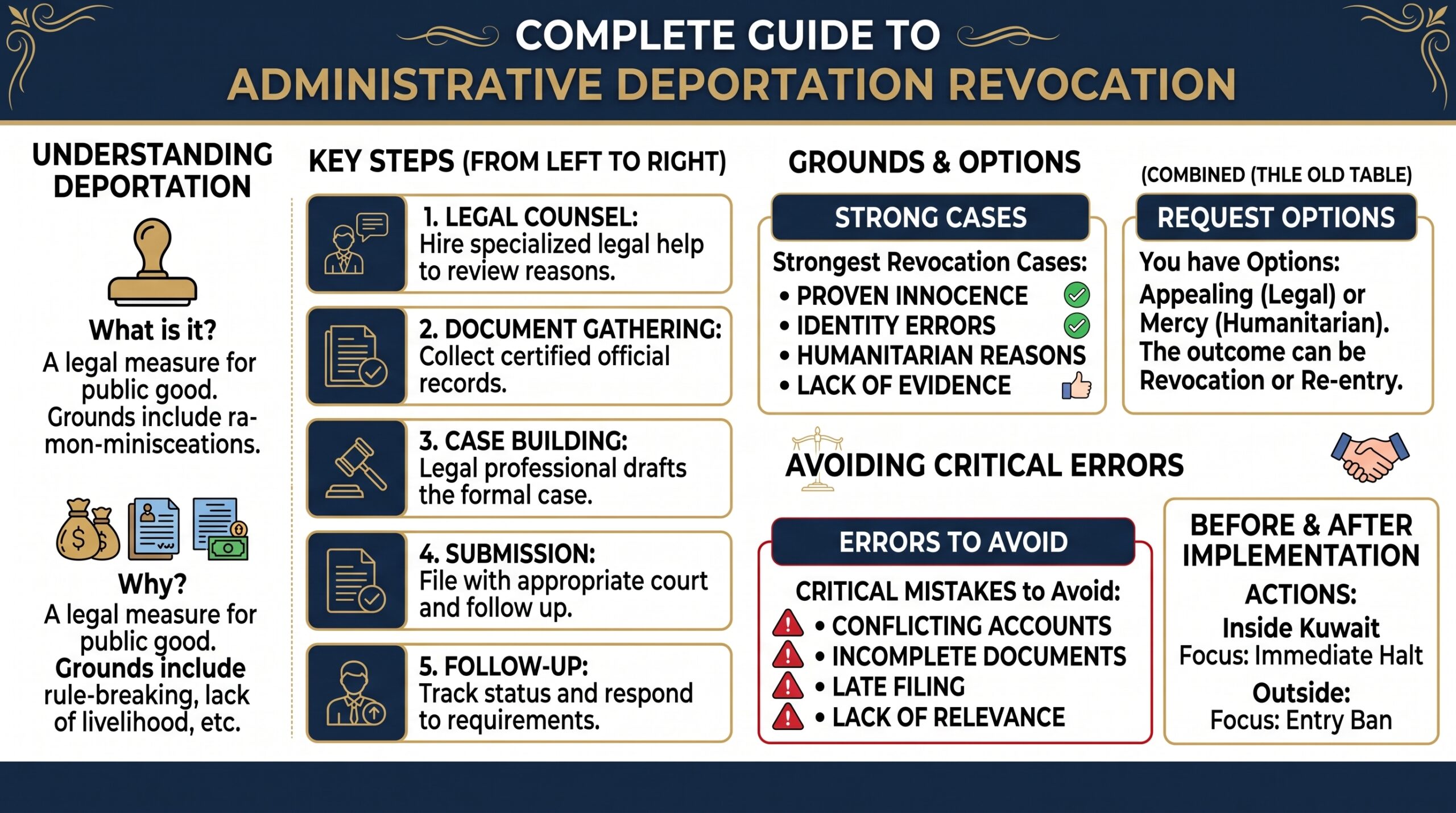
Can Administrative Deportation Be Cancelled in Kuwait?
A request may be submitted to reconsider an administrative deportation decision, but the appropriate procedure varies according to the person’s situation, the nature of the restriction recorded against them, and whether the decision has not yet been enforced or its effects remain after the person has left Kuwait.
Accordingly, the process begins by examining the reason for the decision and the related facts, then precisely determining what is required, whether this involves suspending enforcement, correcting records, or addressing the restriction in preparation for requesting permission to return. The request is assessed according to the official documents and the extent to which they relate to the reason for deportation.
The Difference Between Administrative Deportation and Removal from Kuwait
The type of procedure must be confirmed before submitting a request, because the law distinguishes between deporting a foreign national and removing a foreign national due to the absence of a valid residence permit.
| Point of Comparison | Administrative Deportation | Removal of a Foreign National |
|---|---|---|
| Reason for the procedure | One of the cases provided for under Article 20 | Absence or expiry of a residence permit |
| Residency status | May be issued despite a valid residence permit | Linked to the absence of a valid residence permit |
| Returning to Kuwait | Requires permission from the Minister of Interior | Permitted once entry requirements are satisfied |
| Required procedure | Request cancellation of deportation, removal of the restriction, or permission to return | Correct residency status and satisfy entry requirements |
Key Cases That May Support Cancellation of Administrative Deportation in Kuwait
The circumstances supporting a request to reconsider deportation vary according to the reason for the decision and the individual’s circumstances. The following are some of the most significant cases:
Cancellation of Deportation After an Acquittal
An acquittal may support a request to cancel deportation when the decision was issued because of the same accusation that ultimately resulted in no conviction.
It is preferable for the file to include:
- An official copy of the acquittal judgment.
- A certificate confirming that the judgment is final, when necessary.
- The case number and the authority that issued the judgment.
- A statement explaining the connection between the case and the deportation decision.
- Evidence that no other independent reasons exist for the decision.
An acquittal does not automatically remove the deportation decision. The judgment must be presented to the competent authority and a request made to reconsider the decision in light of the final outcome of the case.
Closure of the Case or Absence of a Connection Between the Person and the Incident
A grievance against deportation after a case has been closed may rely on the decision to close the investigation or a finding that there are no grounds to proceed with the case, particularly where the person’s connection to the complaint was not established or sufficient evidence was not available against them.
The request should not merely state that the case was closed. It should explain:
- The nature of the accusation.
- The date of the decision issued in the investigation.
- The outcome reached in the case.
- The extent to which the complaint is connected to the reason for deportation.
- Whether any other cases or violations exist.
Proof That the Accusation Was Malicious or the Case Was Fabricated
A malicious complaint should not be presented merely as a general allegation. It should be supported by indications revealing the motive behind filing it and the reliability of the incident on which it was based. Such indications may include previous correspondence, an established dispute with the complainant, repeated complaints connected to the same dispute, or a material contradiction in the complainant’s statements.
The memorandum should explain how these indications affected the basis of the deportation decision, rather than merely rearguing the accusation or describing it as fabricated without supporting documents.
Similar Names or Errors in Personal Data
A decision may be recorded against a person because of a similarity in names, an error in the passport number or civil ID number, or because case information was linked to the wrong identity.
A request to cancel deportation due to similar names requires documents proving the difference in identity, such as:
- The passport and civil ID.
- The unified number and fingerprint data, where available.
- Details of the case or the other person.
- Birth certificates or documents showing differences in personal data.
- A judgment or official certificate proving that the applicant has no connection to the incident.
The error should be corrected at its source, because submitting a humanitarian clemency petition does not resolve a restriction recorded against the wrong identity.
Cancellation of Deportation for Humanitarian Reasons and Family Reunification
A deportation clemency petition in Kuwait may include family and humanitarian circumstances worthy of consideration, including:
- Marriage to a Kuwaiti citizen.
- Having children who live and study in Kuwait.
- Responsibility for financially supporting the family.
- A medical condition affecting a family member.
- Stable residence in Kuwait for many years.
- A previous record free from serious violations.
These circumstances may support a request for reconsideration, but they do not by themselves eliminate the reason for the decision. Humanitarian documents should therefore be combined with measures addressing the basis on which the deportation decision was issued.
The impact of deportation on the family may be greater because Article 21 allows the decision to include foreign family members whom the person is legally responsible for supporting.
Cancellation of Deportation Due to Traffic Violations
When requesting cancellation of a deportation decision related to traffic matters in Kuwait, the nature of the recorded incident must first be determined, including whether it was merely an administrative violation, resulted in a criminal judgment, or was repeated in a way that influenced the decision.
A request for reconsideration may be stronger where there is:
- An acquittal.
- Cancellation or correction of the violation.
- Registration of the incident against another vehicle or person.
- An error in the license plate number or identity.
- Exceptional circumstances supported by documents.
- No other significant violations or cases.
Payment of the fine alone does not necessarily remove the deportation decision, because paying the violation and addressing the deportation decision are two separate procedures.
Deportation Due to Employment or Residency Violations
Deportation may be issued because the person worked for another employer without authorization or because of an incident related to the employer or source of income.
In such a case, the following should be reviewed:
- The work permit recorded at the time of the incident.
- The actual relationship with the employer.
- Complaints submitted by the employer.
- Official permits and approvals.
- Judgments or violation reports.
- Whether the legal status was subsequently corrected.
Correcting the status and submitting new documents may help support the request, but this does not automatically cancel the deportation decision unless the competent authority agrees to reconsider it.
Criteria for Assessing the Strength of a Request to Lift Administrative Deportation
The strength of a request is not measured by the number of attached documents, but by how directly they relate to the decision under review. The file can be assessed according to the following criteria:
- Connection to the decision: The request should explain the relationship between the new document and the reason that led to deportation.
- Legal value of the document: The judgment or decision should be final or issued in an official form that can be relied upon.
- Consistency of facts: The information stated in the memorandum should not conflict with judgments, investigation reports, or residency records.
- Accuracy of the timeline: The incident, decision, and subsequent developments should be arranged in a way that makes the file easy to understand.
- Suitability of the final request: The requested outcome should correspond to whether the person is inside or outside Kuwait and to the type of restriction recorded against them.
- Enforceability: It should be confirmed that the requested approval, if issued, will actually address the restriction preventing residency or return.
Steps for Cancelling Administrative Deportation in Kuwait
The procedures vary depending on whether the person is still in Kuwait or whether the deportation decision has been enforced and the person has left the country. However, preparing the request generally involves the following steps:
1. Seeking Assistance From an Administrative Deportation Lawyer
The procedures begin with a lawyer reviewing the person’s data, judgments, and available restrictions in order to determine the nature of the measure and the reason for its issuance.
The review also helps prevent confusion between administrative deportation, removal due to expiry of residence, a criminal judgment, an entry ban, or an error in personal data.
2. Reviewing the Case and the Decision
The incident that preceded the deportation is reviewed, including investigation reports, judgments, decisions closing the case, residency and employment records, and recorded violations.
The review may reveal that the problem is not limited to the deportation decision itself, but instead involves a judgment that has not yet become final, a complaint whose outcome has not been updated, or information recorded against another person.
3. Determining the Appropriate Procedure
Not all cases require the same type of request. The most appropriate option may be:
- A grievance against the reason for the decision.
- A clemency petition based on humanitarian circumstances.
- A request to correct personal data or address a case of similar names.
- A request for reconsideration after an acquittal.
- A request for permission to return after deportation has been enforced.
- A request to address the restriction after the case has ended.
4. Preparing the Documentary File
After determining the appropriate route, a list of required documents is prepared according to the reason for the decision. Official copies should be obtained, and the finality of judgments and accuracy of the information they contain should be verified. Documents issued outside Kuwait should also be reviewed to determine whether they require legalization or certified translation before being attached.
5. Building the Grounds for the Reconsideration Request
The memorandum should not rely on the number of attachments or emotional appeals, but on explaining the connection between the reason for deportation and the development that occurred afterward. Each ground should therefore be supported by a corresponding document, and the facts should be arranged chronologically until reaching a specific final request that suits the applicant’s situation.
This approach helps prevent the request from becoming scattered among multiple grounds that have no clear connection.
6. Submitting and Following Up on the Request
The request is submitted to the competent authority according to the type of decision and the status of the person concerned, while retaining the transaction number or other proof of submission where available.
The authority may request additional documents or updated judgments or information. The request should therefore be followed up and any deficiencies completed without delay.
7. Confirming Implementation of the Approval
If the request is approved, it is necessary to confirm that the restriction has been updated in the relevant systems, especially before booking a flight ticket or submitting a new visa application.
The existence of a letter or approval does not necessarily mean that all data connected to the restriction has been updated at the same time.
Documents Required to Cancel Administrative Deportation in Kuwait
There is no single list that applies to every case. However, the file may include the following documents:
- A copy of the passport.
- A copy of the civil ID.
- A copy of the deportation decision or the available details relating to it.
- An official copy of the acquittal judgment.
- A certificate confirming that the judgment is final, where necessary.
- A decision closing the investigation or stating that there are no grounds to bring criminal proceedings.
- Important case documents and reports.
- The work permit and employment contract.
- Residency and employer information.
- The marriage contract.
- Children’s birth certificates.
- Evidence of financial support or income.
- Official medical reports.
- Documents relating to the children’s education and residency.
- Documents proving a case of similar names.
- A traffic violations record or traffic judgment.
- The power of attorney issued to the lawyer.
The Difference Between a Grievance and a Clemency Petition Against Administrative Deportation
Although a grievance and a clemency petition may be submitted within one request, they differ in the basis on which each is founded and the objective sought, as shown in the following table:
| Point of Comparison | Grievance Against Deportation | Deportation Clemency Petition |
|---|---|---|
| Basis of the request | Challenging the incident or information on which the decision was based | Requesting reconsideration because of personal circumstances worthy of consideration |
| Focus of the request | Discussing the reason for deportation and whether it remains applicable | Explaining the effects of the decision on the applicant and their family |
| Nature of documents | Judgments, decisions, and official certificates connected to the reason for the decision | Family, medical, or living-condition documents supporting the circumstances presented |
| When is it more appropriate? | When there is an error or new development affecting the basis of the decision | When humanitarian circumstances exist without a document directly disproving the reason for the decision |
| Requested outcome | Reconsideration of the decision or correction of the restriction | The competent authority exercising its discretion to reconsider the matter |
Sample Administrative Deportation Clemency Request
Using a standard form without adapting it to the facts of the case is not recommended, but the request may be organized as follows:
Subject: Request for Reconsideration of an Administrative Deportation Decision.
Applicant Information:
Name, nationality, civil ID number, passport number, and contact information.
Decision Information:
Date of the decision, case or violation number, and reason for deportation according to the available documents.
Grounds for Reconsideration:
Explanation of the acquittal judgment, decision closing the case, error in personal data, or family and humanitarian circumstances.
Supporting Documents:
Prepare a numbered list of the attached judgments, certificates, and documents.
Final Request:
Cancellation of the decision, suspension of its enforcement, removal of the restriction, or permission to return to Kuwait, depending on the applicant’s situation.
The request should not contain inaccurate information or conceal the existence of other cases, because any inconsistency between the memorandum and official records may weaken the request.
Cancellation of Deportation Before and After Enforcement
The required procedures vary depending on whether the deportation decision has not yet been enforced or has already been enforced and the person has left Kuwait, as follows:
Before Enforcement of Deportation
When the person is still inside Kuwait and has not yet left, time is an important factor, especially if the person is detained in preparation for enforcement of the decision.
Article 22 permits the detention of a foreign national against whom a deportation decision has been issued for a period not exceeding thirty days, renewable if detention is necessary to enforce the decision. Therefore, relevant judgments and documents should be gathered and the appropriate request determined without delay.
There is nothing in the provisions referred to above that makes the mere submission of a clemency petition or grievance an automatic ground for suspending enforcement. The applicant should therefore not rely solely on filing the request without following up on the status of the decision.
After Enforcement of Deportation
After the decision has been enforced, suspending deportation is no longer the required objective. Instead, priority shifts to determining what effect remains recorded against the person’s entry into Kuwait. The restriction may result from the deportation decision itself, or it may be connected to an entry ban, case, or other violation requiring separate action.
The existing restriction must therefore first be identified, after which the request that directly addresses its effect should be selected. Having a new sponsor or satisfying visa requirements is not sufficient as long as the required permission to return has not been issued.
Errors That Weaken a Request to Lift Administrative Deportation
The file may be weakened by the way it is prepared or presented, even where significant supporting documents exist. Errors that should be avoided include:
- Providing more than one conflicting version of the same incident.
- Failing to explain the connection between the case and the deportation decision.
- Combining several main requests without arranging them according to priority.
- Using outdated documents after changes to residency or passport information.
- Attaching documents in a foreign language without a certified translation where required.
- Failing to state whether the person is inside or outside Kuwait at the time the request is submitted.
- Submitting the request without retaining proof of receipt or a tracking number.
- Failing to update contact information, which may result in the required documents not being completed.
The Role of an Administrative Deportation Lawyer in Kuwait
The importance of consulting a lawyer in Kuwait lies in transforming scattered facts and documents into a file that addresses the actual reason for deportation, rather than simply submitting a general form in the name of the person concerned.
The review begins by comparing what the person states with what appears in judgments, complaints, and residency records, then identifying the point on which the request should focus. This particularly includes:
- Building a clear chronological sequence of the incident and the decisions issued in relation to it.
- Checking whether more than one reason or restriction is affecting the case.
- Assessing how closely the judgment or new document is connected to the deportation decision.
- Determining the primary request and an alternative request where necessary.
- Anticipating deficiencies or inconsistencies that may appear during review of the file.
- Following up on the effect of any approval and ensuring that the intended restriction has been addressed.
A lawyer cannot guarantee acceptance of the request, but legal review reduces the likelihood of submitting a procedure that does not correspond to the nature of the decision or the situation of the person concerned.
Frequently Asked Questions About Cancellation of Administrative Deportation in Kuwait
Can administrative deportation be cancelled in Kuwait?
A request may be submitted to reconsider an administrative deportation decision. The appropriate procedure depends on the reason for the decision, the person’s current status, the restriction recorded against them, and whether deportation has already been enforced.
Does an acquittal automatically cancel an administrative deportation decision?
No. An acquittal may support a request to cancel administrative deportation when the deportation was based on the same accusation, but the acquittal does not automatically remove the deportation decision. The judgment must be submitted to the competent authority for reconsideration.
What documents are required for cancellation of administrative deportation in Kuwait?
The documents vary by case, but they may include the passport, civil ID, deportation decision, acquittal judgment, finality certificate, case documents, residency and employment records, family documents, medical reports, and a power of attorney issued to the lawyer.
What is the difference between a deportation grievance and a clemency petition?
A grievance generally challenges the facts, legal basis, or records on which the deportation decision was based. A clemency petition focuses on personal, family, or humanitarian circumstances that may justify reconsideration by the competent authority.
Can administrative deportation be cancelled after leaving Kuwait?
After deportation has been enforced, the main issue is usually no longer suspending the deportation itself, but identifying and addressing the restriction affecting the person’s return to Kuwait. A separate request for permission to return or removal of the relevant restriction may be required.
Does submitting a grievance or clemency petition automatically stop deportation?
No. The article states that merely submitting a grievance or clemency petition does not automatically suspend enforcement of the deportation decision. The status of the decision should therefore be followed up separately.
Can a deportation decision caused by incorrect personal data be reviewed?
Yes. Where the decision results from similar names, an incorrect passport or civil ID number, or information linked to the wrong person, a request may be supported by official documents proving the identity discrepancy and correcting the underlying records.
Can humanitarian circumstances help with cancellation of administrative deportation in Kuwait?
They may support a request for reconsideration. Relevant circumstances can include marriage to a Kuwaiti citizen, children living in Kuwait, family support obligations, medical circumstances, and long-term residence. However, these factors do not by themselves remove the original reason for deportation.
This brings us to the conclusion of this article on cancelling administrative deportation in Kuwait. The appropriate way to deal with the decision begins by determining the required outcome, whether this is suspending its enforcement, correcting the restriction, or requesting permission to return after deportation. Based on this, the appropriate procedure can be selected and the documents supporting the case can be prepared in a clear and organized manner.
You can contact lawyer Riyadh Matni Al-Fadhli to review the decision and the related facts and explain the procedural options available according to the details of each case, while taking into account that acceptance of the request is subject to the discretion of the competent authority.
You may also be interested in: Challenging Administrative Decisions for Abuse of Power
Disclaimer: The information contained in this article is for general educational purposes and does not constitute legal advice or a guarantee that a request to cancel deportation will be accepted. The outcome varies according to the facts, documents, and restrictions recorded in each case.

Lawyer in Kuwait, Registration No. 8342. Through this personal platform, he provides educational legal content covering contracts, companies and investment, arbitration, and commercial dispute resolution. The content is presented in a clear and precise manner to help individuals and businesses understand their legal options and reduce potential risks.