

An employee or concerned person may be surprised by an administrative decision that changes their legal or employment status, raising the question: Was the decision genuinely issued in the interest of work, or was the authority used to achieve another purpose?
This situation is known as abuse of authority or misuse of power, and it is one of the grounds for challenging administrative decisions when there are indications that the decision was not issued to serve the public interest.
In this article, we explain the meaning of abuse of authority under Kuwaiti law, when an administrative decision may be challenged, how misuse of power can be proven, and the role of an administrative grievance, annulment lawsuit, and compensation claim.
Were you surprised by an administrative decision that harmed your employment or legal status and feel that it was issued arbitrarily or for reasons unrelated to the interests of work? Do not delay reviewing your position, as grievance and challenge deadlines may affect the admissibility of your action. Lawyer Riyadh Matni Al-Fadhli can examine the decision, organize the documents, and prepare an appropriate grievance or lawsuit according to the facts of your case.
Contact Us to Assess the Administrative Decision Before Deadlines ExpireOr continue reading to learn when a decision may be considered defective and how to prove your right through supporting indications.
Table of content
What Is Meant by Abuse of Authority Under Kuwaiti Law?
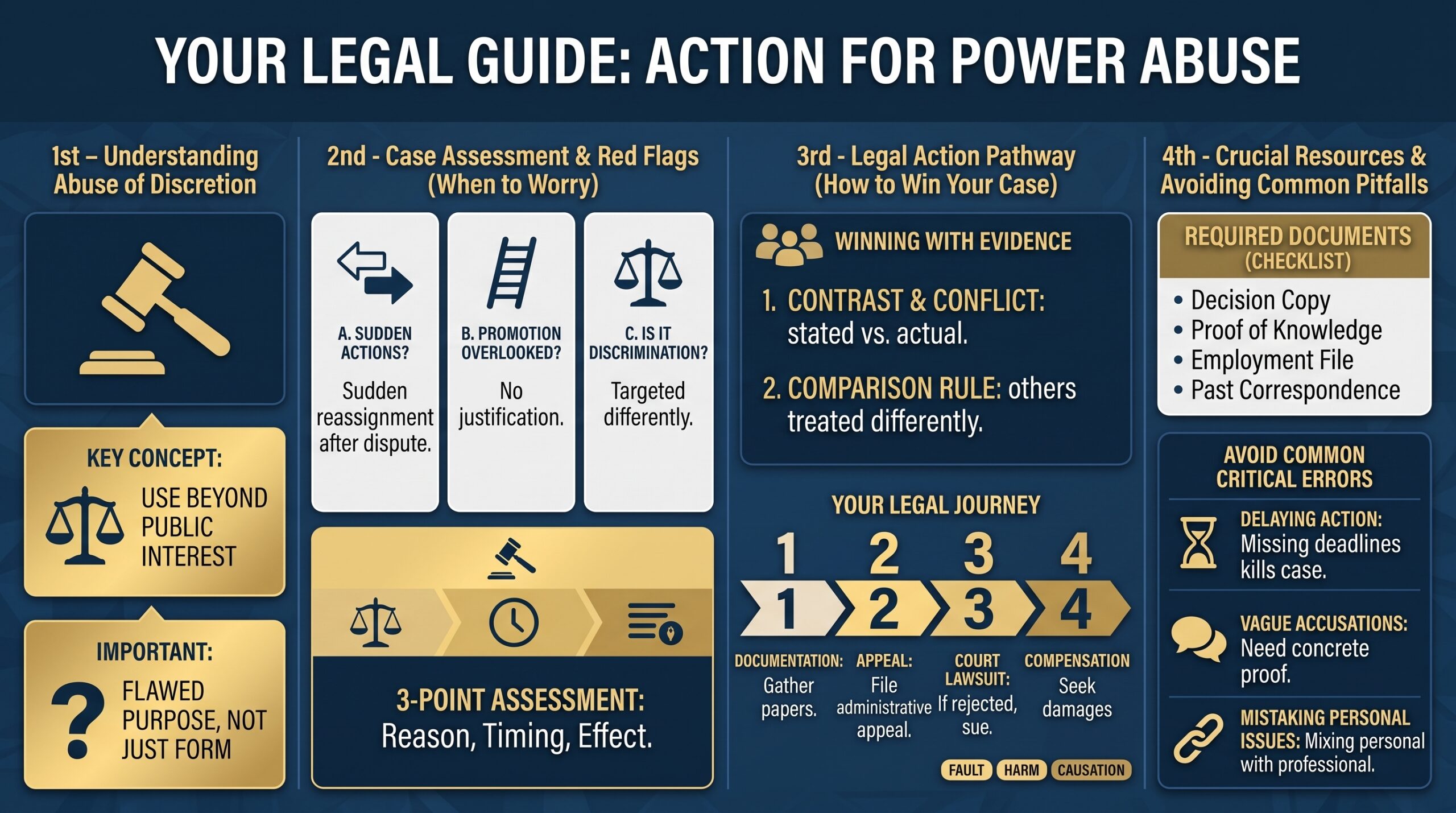
Abuse of authority is a legal defect connected to the purpose element of an administrative decision. The law does not grant an administrative authority its powers merely to issue decisions, but rather to achieve a specific objective related to the proper functioning of public services and the protection of the public interest.
Therefore, reviewing an administrative decision is not limited to identifying who issued it or whether its formal requirements were satisfied. The review also extends to the purpose for which the authority was exercised. If the authority was used to achieve a personal interest, favor one party, pressure the concerned person, or if the decision was connected to an unlawful benefit that may raise suspicion of the crime of bribery, the decision may be subject to review and challenge depending on the facts of each case.
The Difference Between Abuse of Authority and Abuse of Rights
Some people may confuse abuse of authority with abuse of rights, so it is important to distinguish between them.
| Point of Comparison | Abuse of Authority | Abuse of Rights |
|---|---|---|
| Field | Administrative law | Civil, family, or commercial law |
| Who carries out the act? | An administrative authority or public employee when issuing an administrative decision | A natural or legal person exercising a private right |
| Subject of the violation | The purpose of the administrative decision | The manner in which the right is exercised |
| Example | Transferring an employee with the intention of harming them | Using the right to litigate or property rights maliciously |
| Possible effect | Annulment of the decision and a compensation claim where its conditions are met | Stopping the harm or compensation depending on the case |
When May Your Case Constitute Abuse of Authority Under Kuwaiti Law?
It is not possible to conclusively determine that abuse of authority exists without examining the decision, documents, and facts. However, there are practical indicators that warrant attention, including:
| Situation | Could It Indicate Abuse of Authority? |
|---|---|
| Sudden transfer after a dispute with a supervisor | Yes, if supporting indications exist |
| Being passed over for promotion without a clear reason | Yes, if objective criteria are absent |
| Successive administrative penalties | May indicate targeting |
| Termination of service despite the existence of an excuse or document | The decision may be defective |
| Harmful decision without sufficient reasoning | Not conclusive evidence by itself |
| Harm caused by a private person | Usually not abuse of authority |
How Is Abuse of Authority Examined in Administrative Decisions?
The fact that a decision concerns transfer, promotion, or a penalty is not sufficient by itself to classify it as abuse of authority. The decision may be lawful if it is based on a genuine work requirement or a clear administrative reason. Therefore, legal examination is based on three elements: the reason for the decision, its timing, and the effect resulting from it.
Examining a Transfer or Secondment Decision
When examining a transfer or secondment decision, the question is not merely: Was the employee transferred? Rather, why was the decision issued at that particular time? Is there a genuine need at the entity to which the employee was transferred? Did the transfer result in an actual reduction in the employee’s employment status or an unjustified removal from the nature of their work?
From this perspective, the focus is on the complete context of the decision rather than on the transfer alone.
Examining a Decision to Pass Over an Employee for Promotion
In promotion decisions, the most important point is identifying the basis relied on by the administrative authority when comparing candidates. Therefore, performance reports, seniority, job requirements, and the authority’s previous treatment of similar cases are considered.
If the comparison criteria are unclear or inconsistent with the documents, the decision may require closer legal review.
Examining Administrative Penalties
In administrative penalties, the existence of an alleged violation by the employee is not sufficient. The validity of the investigation, whether the employee was given an opportunity to defend themselves, whether the penalty was proportionate to the act, and whether the penalty was used as an organized disciplinary measure or as a repeated means of pressure must all be examined.
Examining a Decision to Terminate Service or Treat an Employee as Absent From Work
When employment is terminated or an employee is treated as absent from work, the review focuses on whether the facts on which the administration based its decision were complete. If there were excuses, correspondence, documents, or relevant circumstances that were not examined, the decision may need to be reviewed in terms of both its reason and its purpose.
How Can Abuse of Authority in an Administrative Decision Be Proven?
Proving abuse of authority is not easy because the defect usually concerns the purpose and motive, matters that do not always appear in the wording of the decision. Therefore, proof usually depends on indications and documents rather than general statements.
Key Indications That Help Prove Misuse of Power
The most important indications that may help prove misuse of power include:
- Timing of the decision: such as a decision issued after a complaint, dispute, investigation, or demand for a right.
- Contradiction between the stated reason and reality: for example, where the administration states that the transfer was in the interest of work while no genuine need exists, or the position is filled by another person without clear justification.
- Different treatment of similar cases: where the concerned person is treated more strictly than others despite similar legal circumstances.
- A sequence of harmful decisions: such as a transfer followed by a penalty and then being passed over for promotion within a short period without strong reasons.
- Previous correspondence or documents: such as emails, official letters, meeting minutes, previous complaints, or any documents that may indicate a dispute or a prior position against the concerned person.
- Absence of a clear public interest: where the decision or its file does not show an administrative or employment justification for the action.
- Ignoring material documents: such as performance reports, medical excuses, official correspondence, or requests that were not seriously examined.
Who Bears the Burden of Proving Abuse of Authority Under Kuwaiti Law?
As a general rule, an administrative decision is presumed lawful until proven otherwise. Therefore, the concerned person bears the burden of submitting documents and indications supporting their objection.
Direct evidence of bad faith is not always required. A group of consistent indications may be sufficient if they reveal that the decision was not issued to achieve the public interest but instead pursued another purpose not recognized by law.
For this reason, organizing the documents and building a chronological sequence of events are among the most important steps in handling this type of case.
Administrative Grievance Before Filing a Lawsuit to Annul an Administrative Decision
For a number of administrative decisions, an administrative grievance is an important step before resorting to court. The grievance gives the administrative authority an opportunity to reconsider its decision, whether by withdrawing, amending, or confirming it.
Usually, three matters should be considered before submitting the grievance:
- The date on which the person became aware of the decision.
- The authority to which the grievance should properly be submitted.
- Drafting the grounds of the grievance clearly and specifically.
It is not advisable to submit a general grievance limited to statements such as “the decision is unfair” or “the decision is arbitrary.” Instead, the grievance should preferably explain:
- The decision number and date.
- The harm resulting from it.
- The ways in which the decision contradicts the facts or the law.
- The indications showing misuse of power or an improper purpose.
- The final request, such as withdrawing, amending, or reconsidering the decision.
Before submitting a general or rushed grievance, it is preferable to organize the facts and documents and connect them to the reason for the decision and the resulting harm.
Lawsuit to Annul an Administrative Decision Due to Abuse of Authority
If the grievance does not produce an appropriate outcome, the next step may be to file a lawsuit seeking annulment of the administrative decision before the competent court, depending on the nature of the decision and the legal deadlines. The purpose of an annulment lawsuit is to obtain a judgment declaring the administrative decision unlawful and to give effect to the legal consequences according to the circumstances.
The challenge may be based on more than one ground, including:
- Violation of the law.
- Lack of jurisdiction.
- Defect in form or procedure.
- Defect in the reason.
- Abuse of authority or deviation from the lawful purpose.
In abuse of authority cases specifically, the focus is not only on the apparent wording of the decision, but on the more important question: Was the decision issued to serve the public interest or to achieve another purpose not recognized by law?
When Can Compensation Be Claimed for Abuse of Authority Under Kuwaiti Law?
The concerned person may not be satisfied with merely seeking annulment of the administrative decision, particularly where it resulted in financial or moral consequences. In such a case, compensation may be considered where the elements of liability are present, which generally include:
| Element | Meaning |
|---|---|
| Fault | Issuance of an unlawful decision or one affected by a material defect |
| Harmful consequence | Actual harm to the financial or moral position of the concerned person |
| Causal relationship | A direct connection between that consequence and the challenged decision |
Annulment of an administrative decision does not necessarily result in compensation in every case. The resulting harm and its direct connection to the decision must also be proven.
Documents That Should Preferably Be Prepared Before a Grievance or Lawsuit
Before submitting a grievance or filing a lawsuit seeking annulment of an administrative decision, it is preferable to organize the file so that the strength of the objection and the most appropriate legal route can be assessed. The most important documents include:
- The disputed decision: such as a copy of the decision, the date of knowledge of it, and a copy of any notification or announcement if available.
- Employment or administrative records: such as employment history, performance reports, and promotion or transfer decisions.
- Previous correspondence: such as official letters, emails, and meeting minutes that explain the background of the dispute.
- Evidence of the effect resulting from the decision: such as financial documents, decisions depriving the person of a benefit or allowance, or documents showing the financial or moral impact.
- Previous grievances or requests: such as a copy of the grievance, its registration number, and proof of submission or response.
- Comparative indications involving similar cases: particularly in promotion, transfer, penalty, or unequal treatment decisions.
The concerned person does not need to be certain that the decision is unlawful. It is sufficient to present the facts and documents so that it can be determined whether the more appropriate route is a grievance, an annulment lawsuit, or a compensation claim.
Common Mistakes in Abuse of Authority Cases Under Kuwaiti Law
Certain mistakes may weaken the legal position even where the decision itself is questionable. The most notable include:
- Delaying action: deadlines in administrative disputes are extremely important, and missing them may make the challenge difficult to accept even where the concerned person has strong grounds.
- Submitting a general grievance without documents: general statements are not sufficient. The objection should be connected to documents, facts, and dates.
- Focusing only on the feeling of unfairness: courts do not base judgments on personal feelings, but on the decision, facts, and supporting indications.
- Confusing an administrative decision with a personal dispute: not every disagreement with a supervisor amounts to abuse of authority. What matters is proving that the dispute actually affected a harmful administrative decision.
- Forgetting to claim compensation where harm exists: in some cases, it may be appropriate to combine an annulment request with a compensation claim or seek compensation through the route suitable for the case.
When Do You Need a Lawyer in Kuwait to Challenge an Administrative Decision?
You may need a lawyer in Kuwait when an administrative decision harms your employment or legal status and there are indications of arbitrariness or use of authority for a purpose other than its lawful objective. A lawyer can assist with the following:
- Examining the administrative decision: reviewing the reason, timing, and effects of the decision to determine whether it may be challenged.
- Determining legal deadlines: confirming the deadlines for filing a grievance or lawsuit so that the concerned person does not lose the right to take action.
- Assessing whether a grievance is required: determining whether an administrative grievance is mandatory before going to court or appropriate according to the nature of the decision.
- Drafting the administrative grievance: preparing a clear grievance connecting the decision, resulting harm, and available indications.
- Considering suspension of enforcement: assessing whether suspension of the decision’s enforcement may be requested if it causes urgent harm.
- Preparing an annulment or compensation lawsuit: drafting the appropriate legal requests according to the documents and harm resulting from the decision.
- Organizing documents and supporting indications: arranging the file in a manner that clearly presents the facts before the competent authority.
Frequently Asked Questions About Abuse of Authority Under Kuwaiti Law
What is abuse of authority under Kuwaiti law?
Abuse of authority is a defect in the purpose of an administrative decision. It arises when administrative power is used for a purpose other than the public interest or the lawful objective for which that power was granted.
How can abuse of authority be proven?
It is usually proven through documents and supporting indications rather than direct evidence of bad faith. Relevant indications may include the timing of the decision, contradictions between the stated reason and the actual facts, unequal treatment, repeated harmful decisions, ignored documents, and prior correspondence.
Does every unfair administrative decision amount to abuse of authority?
No. A decision is not considered an abuse of authority merely because it causes harm or appears unfair. The surrounding facts must indicate that the authority was exercised for an improper purpose rather than a legitimate administrative objective.
Can an employee challenge a transfer decision for abuse of authority?
Yes, depending on the facts. A transfer may require legal review if its timing, lack of genuine work need, or resulting harm indicates that it was used to pressure or target the employee rather than serve an administrative purpose.
Can being passed over for promotion amount to abuse of authority?
It may, particularly where objective promotion criteria are absent or the authority’s decision is inconsistent with performance reports, seniority, job requirements, or its treatment of similar cases.
Is an administrative grievance required before filing an annulment lawsuit?
An administrative grievance is an important step for a number of administrative decisions and may be required or appropriate depending on the nature of the decision. The relevant authority, deadline, and grounds of grievance should be checked before filing.
What should an administrative grievance include?
It should generally identify the decision and its date, explain the resulting harm, state how the decision conflicts with the facts or law, present indications of misuse of power, and clearly specify the requested outcome.
Can an administrative decision be annulled because of abuse of authority?
Yes. Abuse of authority or deviation from the lawful purpose is one of the grounds that may support an annulment lawsuit against an administrative decision before the competent court, subject to the applicable procedures and deadlines.
Can compensation be claimed for abuse of authority?
Compensation may be claimed where the required elements of liability are established, including an unlawful or defective decision, actual financial or moral harm, and a direct causal link between the decision and the harm.
What documents are useful in an abuse of authority case?
Useful documents may include the disputed decision, employment or administrative records, performance reports, promotion or transfer decisions, previous correspondence, proof of resulting harm, previous grievances, and evidence showing different treatment of similar cases.
This brings us to the conclusion of our article on abuse of authority under Kuwaiti law, in which we explained that this defect does not arise merely because a person is dissatisfied with an administrative decision. Rather, it requires indications showing that the authority was used for a purpose other than the one prescribed by law.
If an administrative decision has been issued against you and you believe it involved abuse of authority, you can contact lawyer Riyadh Matni Al-Fadhli to request a consultation appointment and send a summary of the case and the essential documents via WhatsApp.
You may also be interested in: Cancellation of an Administrative Deportation Decision
Legal Disclaimer: This article is intended for general educational purposes and does not constitute legal advice or a promise of any particular outcome. Legal assessment varies depending on the facts, documents, deadlines, and procedures followed in each case.

Lawyer in Kuwait, Registration No. 8342. Through this personal platform, he provides educational legal content covering contracts, companies and investment, arbitration, and commercial dispute resolution. The content is presented in a clear and precise manner to help individuals and businesses understand their legal options and reduce potential risks.