
Company liquidation procedures in Kuwait are an important legal step for any company seeking to properly wind up its business without leaving outstanding obligations or unclear legal positions. Liquidation becomes particularly important when the company has debts, multiple partners, or ongoing contracts that require careful settlement.
In this article, we explain the practical aspects of company liquidation procedures in Kuwait and the key points that should be considered before starting, so you can make your decision on a clear legal basis and avoid mistakes that may delay deregistration or lead to future disputes.
Has your company stopped operating, and are you concerned about accumulating debts or legal liability arising from outstanding obligations? Do not leave your financial liability to uncertainty. Lawyer Riyadh Matni Al-Fadhli is ready to assess your company’s position and complete its closure through safe liquidation procedures that protect your rights and help you avoid future disputes.
Book a Consultation to Liquidate Your Company NowOr continue reading the article below to learn all the steps and requirements.
Table of content
Does Your Situation Require Voluntary Liquidation or a Liquidation Lawsuit?
Before starting any procedure, ask yourself: Has the company simply stopped operating? Does it have debts? Is there a partner who refuses the liquidation? Are there employment-related or banking claims? The answers determine the appropriate course of action.
| Company Situation | Most Appropriate Route |
|---|---|
| The partners agree and there are no substantial disputes | Voluntary liquidation |
| A partner refuses the dissolution or obstructs the procedures | Judicial liquidation lawsuit |
| The company has debts or claims from creditors | Organized liquidation after reviewing the financial position |
| The company has ceased operations and is intended to be deregistered | Review the license and outstanding obligations first |
| There are significant losses or mismanagement | Legal and accounting review before making the decision |
| There are assets, real estate, or continuing contracts | Liquidation requiring a legal and accounting plan |
Choosing the wrong route may delay the liquidation process or create a new dispute. Therefore, accurately determining the company’s position is an essential step before beginning company liquidation procedures in Kuwait.
What Does a Company in Liquidation Mean in Kuwait?
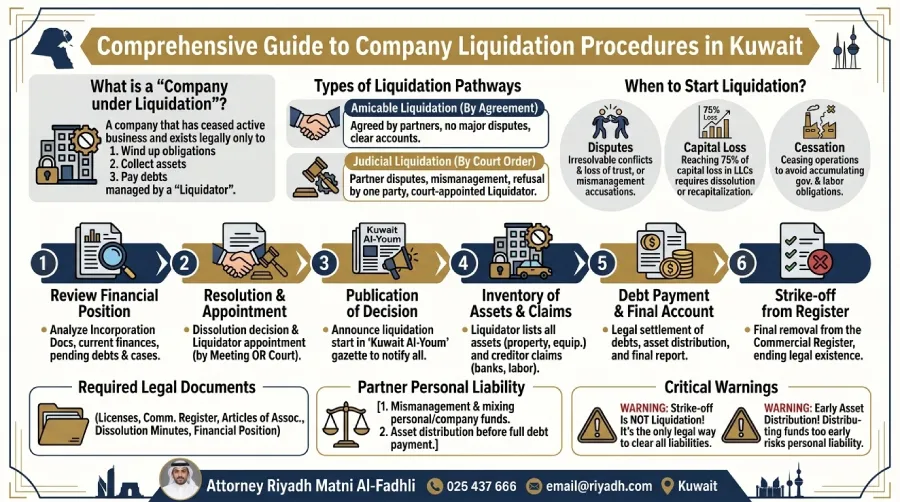
A company in liquidation is a company for which a resolution to dissolve it or a judgment ordering its liquidation has been issued, but it continues to legally exist until its obligations have been settled. During this stage, the liquidator manages the company’s affairs, identifies its assets, collects its receivables, pays its debts, and then distributes any remaining balance to the partners, if applicable. Once liquidation begins, the company may not conduct new business activities; its operations are limited to those necessary to complete the liquidation procedures.
Deregistration should not be treated as a substitute for liquidation. Deregistering a company or administratively terminating its license does not necessarily mean that all obligations have ended, particularly where there are debts, employees, or claims by partners or creditors.
The Ministry of Commerce and Industry explains, as part of its company dissolution and liquidation service, that the documents required for deregistering joint-stock companies include the minutes of the Extraordinary General Assembly meeting containing the decision to deregister the company, together with evidence that the official publication requirements have been fulfilled and a statement of financial position confirming that the liquidation procedures have been completed. This indicates that company deregistration generally takes place after the liquidation procedures and their requirements have been completed, rather than before.
When Is a Company Liquidated in Kuwait?
There are several situations that may lead to the commencement of company liquidation procedures in Kuwait, including:
1. The Company Ceases Operations
A company may actually stop operating while its commercial registration, license, and obligations remain active. In such cases, the company’s owners need an organized liquidation process instead of leaving the entity suspended, particularly where there are employees, bank accounts, lease agreements, or government obligations.
2. The Partners Agree to Dissolve the Company
If the partners agree to terminate the company, they may proceed with voluntary liquidation. The decision is generally issued by the Extraordinary General Assembly or the competent body within the company, depending on its legal form and memorandum of association.
3. The Existence of Debts or Claims
If the company owes money to banks, suppliers, employees, or partners, liquidation becomes more sensitive. In this situation, no funds should be distributed before the debts have been identified and repayment has been properly arranged. Rushing to distribute assets may lead to a subsequent dispute or liability depending on the circumstances of the case.
4. A Dispute Between the Partners
One partner may refuse the dissolution, accuse another partner of mismanagement, or a dispute may arise regarding the accounts and assets. In such cases, a company liquidation lawsuit may be the appropriate route for requesting court intervention and the appointment of a judicial liquidator.
5. Losses Significantly Affecting the Capital
When losses accumulate to a significant level, the matter must be taken seriously. In the case of a limited liability company, if losses reach three-quarters of the capital, the managers must refer the matter to the Extraordinary General Assembly of the partners to consider covering the capital, dissolving the company, or taking appropriate measures, in accordance with the Kuwaiti Companies Law.
Types of Company Liquidation in Kuwait
The types of company liquidation vary depending on the reason for liquidation and the authority overseeing it.
Voluntary Company Liquidation in Kuwait
Voluntary liquidation is generally the most appropriate route when the partners agree to terminate the company and there are no substantial disputes between them concerning management, assets, or debts. In this situation, the issue is not whether the company should be liquidated, but rather how to organize the liquidation properly so that no subsequent claims or liabilities arise after deregistration.
Voluntary liquidation generally begins with an agreement among the partners or a resolution by the competent assembly to dissolve and liquidate the company. The statutory procedures are then completed before the Ministry of Commerce and Industry and the relevant authorities according to the company’s type and its legal and financial position.
Voluntary liquidation is generally suitable if the company:
- Has ceased operations and there are no disputes.
- Does not have significant debts or complex claims.
- Has partners who agree on appointing the liquidator.
- Has available and clear accounts and documents.
- Has no pending cases that prevent completion of the procedures.
Judicial Company Liquidation in Kuwait
Judicial liquidation is required when the company cannot be terminated by agreement between the partners or when its continued operation leads to a dispute or harm. This route commonly arises where there is a substantial disagreement concerning management, accounts, assets, or debts, or where trust between the partners has broken down.
The importance of judicial liquidation is that it places the process of terminating the company under court supervision, helping protect the rights of partners and creditors and preventing the disposal of company assets or concealment of its documents during the dispute.
Company Liquidation Procedures in Kuwait Step by Step
The details vary from one company to another, but the general company liquidation process usually passes through the following stages:
1. Review the Memorandum of Association and Financial Position
Proper liquidation begins with reviewing the memorandum of association, the company’s latest amendments, the manager’s powers, the partners’ shares, the financial position, debts, pending cases, and obligations toward employees and government authorities.
This stage is important because it reveals whether the liquidation can be completed voluntarily or requires court intervention and whether there are risks affecting the manager or the partners before the decision is made.
2. Issue a Resolution to Dissolve and Liquidate the Company
If the process is voluntary, the dissolution and liquidation resolution is issued by the assembly or the partners in accordance with the company’s legal form. The resolution should generally include the appointment of the liquidator, define the liquidator’s powers, and specify the scope of the assignment.
If an agreement cannot be reached, the matter is brought before the court through a request to dissolve and liquidate the company and appoint a judicial liquidator.
3. Appoint the Liquidator
The liquidator is the person responsible for managing the liquidation stage. The liquidator’s duties include identifying the company’s assets, collecting its receivables, paying its debts, representing the company within the scope of the liquidation, and preparing the final account.
For joint-stock companies, the Ministry of Commerce provides a specific service for recording the liquidation and appointment of the liquidator in the Commercial Register. It requires the applicant to be the Chairman of the Board, the Vice Chairman, or a person delegated by the Board, together with submission of the required financial statements and approvals from regulatory authorities where applicable.
4. Publish the Liquidation Resolution
Publishing the liquidation resolution is an important step to notify third parties that the company has entered the liquidation stage. Ministry of Commerce services indicate that a publication letter in the Kuwait Al-Youm Official Gazette is required as part of certain deregistration procedures or when recording the liquidation.
The purpose of publication is to protect parties dealing with the company and give creditors and rights holders an opportunity to become aware of its legal status.
5. Notify Creditors and Identify Claims
After publication of the liquidation, the liquidator begins identifying the creditors and outstanding claims. This stage should not be treated as a mere formality, because overlooking a creditor or claim may lead to a later dispute even after the procedures have been completed.
6. Inventory the Assets and Liabilities
The liquidator identifies the company’s assets, such as bank accounts, real estate, equipment, goods, receivables from third parties, and unpaid capital contributions, if any. The liquidator also identifies liabilities such as loans, supplier invoices, employee entitlements, rent, fees, and legal claims.
7. Collect the Company’s Receivables and Pay Its Debts
Liquidation is not completed merely by appointing the liquidator. The company’s receivables must be collected and its obligations must be paid. This stage requires careful legal and accounting organization, particularly where there are multiple debts or insufficient assets to satisfy all claims.
8. Prepare the Final Liquidation Account
After the assets have been identified and the obligations paid, the liquidator prepares a final account showing the amounts collected, the amounts paid, and any balance remaining for distribution, if applicable.
9. Deregister the Company from the Commercial Register
After the final account has been approved and all requirements completed, an application is submitted to remove the company from the Commercial Register. Deregistration should not be treated as the first step, but rather as the final stage following completion of the liquidation and settlement of the obligations.
Documents Required for Company Liquidation Procedures in Kuwait
The required documents vary according to the type of company and whether the liquidation is voluntary or judicial. However, they can generally be organized as follows:
| Document Type | Examples |
|---|---|
| Company documents | License, Commercial Register, memorandum of association, amendments |
| Resolution documents | Minutes of the assembly or partners’ resolution to dissolve and liquidate the company |
| Liquidator documents | Letter appointing the liquidator or the liquidator’s acceptance of the assignment where required |
| Judicial liquidation documents | Court judgment where a judgment ordering liquidation has been issued |
| Financial documents | Statement of financial position, financial statements, lists of assets and liabilities |
| Documents from official authorities | Documents required by the Ministry of Commerce, social security authorities, the Execution Department, or regulatory authorities depending on the case |
The liquidation file may also require submission of a copy of the company’s license, the voluntary liquidation minutes or the judicial liquidation judgment, the liquidator’s details if the liquidator is not one of the partners, and the liquidator’s report upon completion of the liquidation work. In some voluntary liquidation cases, a certificate from the Execution Department confirming that there are no cases or claims may also be required.
Liquidation of a Limited Liability Company in Kuwait
The limited liability company is one of the most common corporate forms, and many questions therefore arise when it is liquidated, particularly regarding the partners’ liability for debts.
As a general rule, a partner’s liability in a limited liability company is connected to their share in the company. However, this does not mean that every action taken before or during liquidation is automatically protected. If there are acts involving fraud, commingling of company and personal funds, concealment of assets, or harm to creditors, liability may arise depending on the facts and evidence.
Therefore, when liquidating a limited liability company, attention should be paid to:
- The memorandum of association and its amendments.
- Previous resolutions of the partners.
- The company’s debts and obligations.
- The manager’s actions before liquidation.
- Claims by creditors or employees.
- How any surplus is distributed after payment of the debts.
Liquidating a Company with Debts in Kuwait
A company with debts can be liquidated. In fact, liquidation may sometimes be the legal process through which outstanding obligations are organized and paid. The risk arises when the partners treat liquidation as merely an administrative closure and distribute funds or sell assets without a clear legal arrangement.
When debts exist, attention should be focused on five questions:
- Who are the creditors?
- Are the debts supported by documents?
- Are there any lawsuits or enforcement orders?
- Are the company’s assets sufficient to pay the debts?
- Are there previous transactions that could be interpreted as harming creditors?
If the company has significant debts or disputed claims, merely preparing dissolution and liquidation minutes is not sufficient. A legal plan should be established to manage the claims and document every step.
Who Bears the Company’s Debts After Liquidation?
Determining who bears a company’s debts after liquidation depends on the type of company, the person’s capacity within it, and the nature of the actions taken before and during the liquidation.
In capital companies, such as limited liability companies and joint-stock companies, the general rule is that debts are paid from the company’s assets. However, liability may arise for the manager or the partners in certain circumstances, such as fraud, mismanagement, violation of the law, commingling of financial assets, or distribution of funds before obligations have been paid.
In partnerships, such as a general partnership, the liability of a general partner may be broader depending on the nature of the company and its obligations.
Therefore, it is not sufficient to ask, “Is the company a limited liability company?” Instead, the relevant question is, “What actually happened in relation to the management, accounts, and debts?”
Company Liquidation Lawsuit in Kuwait
A company liquidation lawsuit is the procedure used by a partner or interested party when an amicable solution cannot be reached, with the aim of requesting the dissolution and liquidation of the company in an organized manner that preserves rights and determines obligations.
Depending on the nature of the dispute, the lawsuit may include requests such as:
- A judgment ordering the dissolution and liquidation of the company.
- Appointment of a judicial liquidator.
- Appointment of an accounting expert to examine the documents and accounts.
- Identification of the company’s assets and liabilities.
- Taking urgent measures to protect the company’s funds where necessary.
- Requiring the manager or partner to submit the necessary documents and accounts.
Before filing the lawsuit, organizing the documents supporting the dispute or concerns regarding the company’s assets helps present the legal position more clearly and determine the appropriate requests to submit to the court.
How Long Does Company Liquidation Take in Kuwait?
There is no single fixed duration for company liquidation procedures in Kuwait. The process may be relatively short if the company has no complex debts, the partners agree, and the documents are ready. It may take longer if there are lawsuits, debts, or assets requiring valuation or sale.
Factors affecting the duration of liquidation include:
- The type of company.
- The existence of a dispute between the partners.
- The existence of debts or claims.
- The number of creditors.
- The clarity of the accounts.
- The existence of real estate assets, equipment, or inventory.
- How quickly the required documents are provided.
- Requirements of the Ministry of Commerce and regulatory authorities.
Therefore, the duration cannot be accurately estimated before reviewing the company’s documents and its financial and legal position.
Common Mistakes When Liquidating Companies in Kuwait
Company liquidation may appear to be a simple procedure, but small mistakes can lead to lengthy disputes. Some of the most common mistakes include:
- Leaving the company inactive without liquidating it: Cessation of business does not mean that the obligations have ended. The company may remain subject to renewal requirements, fees, employment obligations, or third-party claims.
- Distributing funds before paying debts: If funds or assets are distributed to the partners before debts are identified and outstanding amounts are paid, this may lead to disputes with creditors or create liability depending on the circumstances.
- Relying on a ready-made template: Every company has a different situation. A standard template may not address disputes between partners, debts, the liquidator’s powers, or the documents required.
- Ignoring employment-related or banking claims: Employees, banks, suppliers, and leases are among the matters most likely to delay liquidation if they are not reviewed from the outset.
- Failing to document the liquidation steps: Every stage should be documented, including the dissolution resolution, appointment of the liquidator, publication, inventory, payment, final account, and deregistration application.
The Role of a Company Liquidation Lawyer in Kuwait
The role of a lawyer in company liquidation is not limited to drafting an application or reviewing a template. It begins before the liquidation decision is made. A lawyer helps you understand your legal position, identify the route carrying the lowest risk, and prepare the documents in a way that reduces the likelihood of disputes.
A company liquidation lawyer can assist with:
- Reviewing the company’s memorandum of association and its amendments.
- Assessing whether the liquidation should be voluntary or judicial.
- Reviewing existing debts and claims.
- Drafting the dissolution and liquidation resolution.
- Preparing the statement of claim for liquidation where a dispute exists.
- Handling disputes between partners.
- Reviewing the liability of the manager or partner.
- Following up on deregistration procedures after the liquidation has been completed.
When Should You Contact Lawyer Riyadh Matni Al-Fadhli?
If your company has stopped operating, has debts, or there is a dispute between the partners, you may need a legal review before beginning the liquidation procedures. Lawyer Riyadh Matni Al-Fadhli can help you understand the company’s position and determine the most appropriate liquidation route based on the memorandum of association, financial position, debts, and available documents.
To make it easier to review the case, it is preferable to prepare the basic documents before making contact, including:
- A copy of the memorandum of association and its amendments.
- The latest license or Commercial Register extract.
- Details of the partners and their shares.
- The latest balance sheet or statement of financial position, if available.
- A list of debts or claims.
- Any lawsuits, notices, or enforcement orders.
- The reason for seeking liquidation.
Frequently Asked Questions About Company Liquidation Procedures in Kuwait
What are the company liquidation procedures in Kuwait?
They generally include a liquidation resolution, appointing a liquidator, settling debts and claims, preparing final accounts, and deregistering the company.
Can a company be deregistered without liquidation in Kuwait?
Deregistration does not necessarily end the company’s outstanding obligations. Liquidation requirements should generally be completed before final deregistration.
How long does company liquidation take in Kuwait?
There is no fixed duration. The timeframe depends on debts, partner disputes, company assets, pending claims, and the readiness of required documents.
Can a company with debts be liquidated in Kuwait?
Yes. The company’s debts and creditor claims must be identified and addressed before any remaining assets are distributed to the partners.
What is the difference between voluntary and judicial liquidation?
Voluntary liquidation applies when the partners agree, while judicial liquidation may be required when disputes prevent an agreed dissolution.
What documents are required for company liquidation in Kuwait?
Documents may include the commercial license, memorandum of association, liquidation resolution, financial statements, liquidator documents, and relevant court judgments.
Who pays the company’s debts after liquidation?
Company debts are generally paid from company assets, although managers or partners may face liability in certain cases depending on their conduct.
What does a liquidator do in Kuwait?
The liquidator identifies company assets and liabilities, collects receivables, pays debts, handles liquidation matters, and prepares the final liquidation account.
When is a company liquidation lawsuit necessary in Kuwait?
It may be necessary when partners cannot agree on dissolution or when disputes arise over management, debts, accounts, or company assets.
When should you consult a company liquidation lawyer in Kuwait?
Legal review is advisable when the company has debts, partner disputes, pending claims, ongoing contracts, or uncertainty about legal liabilities.
In conclusion, company liquidation procedures in Kuwait are not limited to closing the Commercial Register or ceasing business activities. Rather, liquidation is an organized legal process aimed at terminating the company, settling the rights of partners and creditors, and reducing the likelihood of disputes after deregistration.
Therefore, if your company has stopped operating, has debts, or there is a dispute between the partners, it is preferable to consult a lawyer in Kuwait before signing a liquidation resolution or distributing any funds, because the appropriate course of action varies according to the company’s circumstances and documents.
To arrange a consultation regarding company liquidation procedures in Kuwait, you can contact lawyer Riyadh Matni Al-Fadhli to review the company’s position and determine the appropriate course of action before beginning the process.
Legal Disclaimer: This content is provided for general legal awareness purposes only and does not constitute direct legal advice or a substitute for reviewing the company’s documents.

Lawyer in Kuwait, Registration No. 8342. Through this personal platform, he provides educational legal content covering contracts, companies and investment, arbitration, and commercial dispute resolution. The content is presented in a clear and precise manner to help individuals and businesses understand their legal options and reduce potential risks.