

Commercial arbitration in Kuwait is not merely an alternative to litigation before the courts; it can be an important decision for protecting corporate contracts and reducing the impact of disputes on liquidity and business reputation. When a dispute between the parties escalates, the key question becomes: Is arbitration the most appropriate route, or would going to court be more suitable?
In this article, we explain the meaning of commercial arbitration in Kuwait, when it may be appropriate, how an arbitration clause is reviewed, and what is required to enforce an arbitral award or challenge it when there is a serious legal ground.
Are you facing a complex commercial dispute or difficulties in a construction contract and worried about losing your financial rights? Do not leave your company’s future to the wrong legal route. Lawyer Riyadh Matni Al-Fadhli is ready to evaluate your case, review the arbitration clause, and determine the fastest and safest route to protect your money and business reputation.
Evaluate Your Arbitration Case with the Lawyer NowOr continue reading to learn when arbitration may be your best option.
Table of content
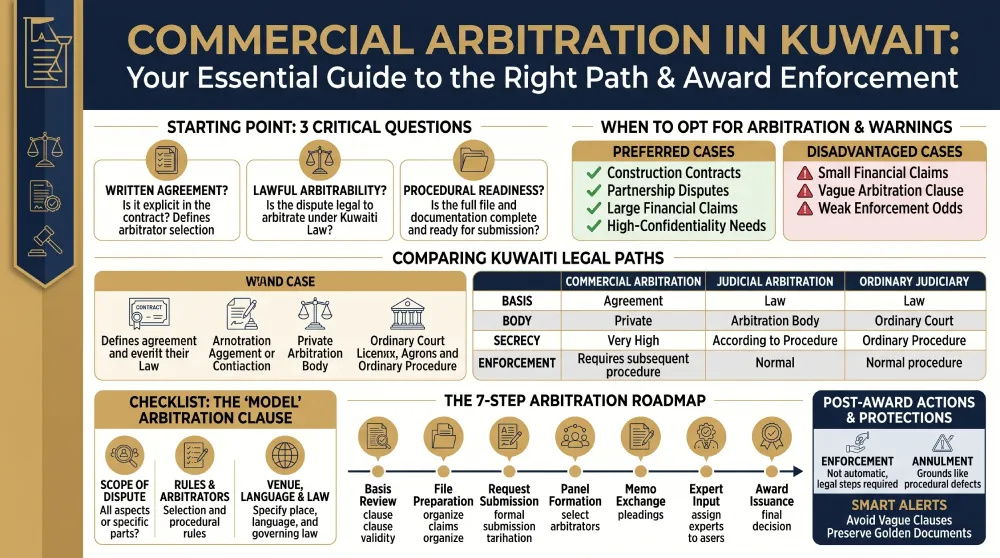
Before Starting Commercial Arbitration in Kuwait: 3 Factors That Determine the Strength of Your Position
Before deciding to pursue commercial arbitration in Kuwait, the existence of a dispute or an arbitration clause in the contract is not enough. Three essential matters should be reviewed:
- The existence of a clear written arbitration agreement.
- Whether the dispute is arbitrable and does not concern matters in which settlement is prohibited.
- The proper drafting of claims, documents, and the procedural route.
Arbitration may be suitable when the dispute is technically or commercially complex, but it can become a costly process if it is started without a legal review of the contract and supporting documents. Therefore, reviewing the case before escalation helps determine whether arbitration is the most appropriate route or whether another legal avenue would be more suitable.
What Is Commercial Arbitration in Kuwait?
Commercial arbitration in Kuwait is a legal method whereby the parties to a commercial relationship agree to submit their dispute to an arbitrator or arbitral tribunal instead of initially filing a lawsuit before the ordinary courts, provided that there is a valid arbitration agreement and the dispute concerns a matter that may legally be settled.
Arbitration is commonly used in disputes that require commercial or technical expertise, such as construction contracts, supply agreements, investments, commercial agencies, disputes between partners, service contracts, and complex financial claims.
However, arbitration does not mean complete separation from the judicial system. After an award is issued, the company may still need to take enforcement measures, and an application to annul the arbitral award may be raised if there is a substantial defect in the agreement, procedures, constitution of the arbitral tribunal, or if the award violates public policy.
The Legal Framework for Commercial Arbitration in Kuwait
The Kuwaiti Civil and Commercial Procedures Law regulates arbitration. One of the most important points to note is that arbitration must be established in writing, may not be used for matters in which settlement is prohibited, and the subject matter of the dispute must be specified in the arbitration agreement or during the proceedings; otherwise, the arbitration may be invalid.
This means that merely including a general phrase such as “the dispute shall be resolved amicably or through arbitration” may not be sufficient in every situation. The effectiveness of an arbitration clause depends not only on its existence, but also on how clearly it is drafted and whether it can actually be applied when a dispute arises.
Kuwait also has a judicial arbitration system under Law No. 11 of 1995. The Judicial Arbitration Department at the Ministry of Justice receives applications, undertakes the preparatory procedures for forming arbitral tribunals, and supervises the conduct of proceedings.
Therefore, it is important to distinguish between private or institutional commercial arbitration, judicial arbitration, and ordinary litigation, because choosing the wrong route may affect jurisdiction, procedures, and enforcement prospects.
When Is Commercial Arbitration Suitable for Your Dispute?
Not every commercial disagreement justifies starting arbitration. The correct decision depends on the contract, the value of the dispute, the nature of the relationship between the parties, the complexity of the dispute, and the prospects of enforcement after the award is issued.
A Clear and Enforceable Arbitration Clause
If the contract contains a clear clause referring disputes to arbitration, arbitration may be an appropriate route, provided that the clause is enforceable and covers the dispute in question. The key elements that should be reviewed in an arbitration clause before proceedings begin are explained below.
Technical Construction and Supply Disputes
Arbitration may be appropriate in construction and supply disputes involving complex technical or financial issues, such as percentages of completion, delay, variation orders, outstanding payments, or whether the work complies with contractual specifications.
In such cases, the mere existence of an arbitration clause is not enough. It is also necessary to ensure that the clause is clear and that the arbitral tribunal is capable of dealing with the technical aspects of the dispute.
Disputes Between Partners or Shareholders
When a disagreement arises between partners or shareholders, the objective may not simply be to recover money, but also to protect the continuity of the company and prevent deterioration of the business relationship or reputation with customers and suppliers.
Where arbitration has been agreed upon, it may help manage the dispute in a more organized manner, particularly in matters involving management, profits, accounts, exit arrangements, valuation of shares, or breach of a shareholders’ agreement.
High-Value Financial Disputes
The higher the value of the claim, the more important it becomes to choose the correct route from the outset. Errors relating to jurisdiction, notification, or the constitution of the arbitral tribunal may delay the claim, create grounds for challenge, or weaken enforcement prospects.
Therefore, it is not advisable to begin arbitration involving a substantial financial claim without first reviewing the contract, correspondence, and financial documents.
Disputes Requiring a Degree of Confidentiality
In some commercial disputes, confidentiality may be important because the dispute may involve pricing, customer information, operating models, trade secrets, or financial details that the company does not want publicly disclosed.
However, confidentiality alone is not sufficient reason to choose arbitration. It should also be supported by a clear arbitration clause, a strong evidentiary record, and a realistic prospect of enforcement.
When Is Arbitration Not the Most Appropriate Option?
Arbitration is not necessarily the best option in every commercial dispute. Ordinary court proceedings may be more suitable if the value of the dispute is limited and does not justify arbitration costs, if the case requires urgent or precautionary measures that must be sought before the competent judicial authority, or if the opposing party is practically unable to satisfy the award once issued.
Arbitration may also be unsuitable if the arbitration clause is not sufficiently clear to commence proceedings with confidence, if the dispute is simple in terms of facts and evidence, or if the competent court provides a faster and more effective route in the circumstances of the case.
Therefore, arbitration should be treated as a legal and commercial decision that requires prior assessment, rather than an automatic choice whenever a dispute arises.
The Difference Between Commercial Arbitration, Judicial Arbitration, and Ordinary Litigation
There is a common misunderstanding between commercial arbitration, judicial arbitration, and litigation before the courts. This confusion may result in choosing an inappropriate route from the outset.
| Comparison | Commercial Arbitration | Judicial Arbitration | Ordinary Litigation |
|---|---|---|---|
| Legal Basis | Agreement between the parties in the contract or a separate arbitration agreement | Judicial Arbitration Law No. 11 of 1995 | General judicial jurisdiction |
| Authority | Arbitration center or private tribunal according to the agreement | Arbitral tribunal under the system established by the Ministry of Justice and Court of Appeal | Competent courts |
| Nature of Dispute | Usually commercial, investment-related, or contractual | Civil or commercial within the scope of the law | Various disputes falling within judicial jurisdiction |
| Confidentiality | Often higher depending on the agreed rules | Depends on the nature of the proceedings | Court proceedings are generally public, subject to exceptions |
| Enforcement | Requires subsequent legal enforcement procedures | Subject to procedures specific to the judicial arbitration system | Judgments are enforced according to enforcement rules |
| Practical Risk | Invalidity of the clause or award, or difficulty with enforcement | Jurisdictional or procedural errors | Lengthy proceedings and multiple levels of litigation |
Choosing the appropriate route is not merely a procedural issue; it is a decision that determines how the dispute will be managed from the beginning through enforcement.
Arbitration Clauses in Commercial Contracts in Kuwait
An arbitration clause is a contractual provision in which the parties agree in advance to refer disputes arising from the contract to arbitration instead of directly resorting to ordinary courts. It is one of the most sensitive provisions in commercial contracts because its wording may determine the entire course of a future dispute.
An arbitration clause should clearly address the following elements:
- Defining the scope of disputes: The clause should clarify whether it covers all disputes arising from the contract or is limited to specific types of claims, such as financial claims, technical disagreements, or breach of performance obligations.
- Identifying the institution or procedural rules: It is preferable for the clause to specify whether arbitration will be conducted before a particular institution, under specific rules, or before a tribunal agreed upon by the parties. Failure to define this may create disagreement once a dispute begins.
- Specifying the number of arbitrators: Arbitration may be conducted by a sole arbitrator or a tribunal consisting of several arbitrators. Failure to determine the number of arbitrators and how they are appointed may delay commencement of proceedings or require intervention by the competent court.
- Specifying the language and seat of arbitration where necessary: In international contracts or contracts involving foreign parties, defining the language, seat of arbitration, and applicable law becomes important to avoid later procedural disputes.
What Is the Difference Between an Arbitration Clause and a Submission Agreement?
The difference between an arbitration clause and a submission agreement can be summarized as follows:
| Comparison | Arbitration Clause | Submission Agreement |
|---|---|---|
| Timing | Before the dispute, as part of the contract | After the dispute has arisen |
| Purpose | To establish how future disputes will be resolved | To refer an existing dispute to arbitration |
| Practical Risk | Ambiguity or failure to identify the institution | The other party may refuse to agree after the dispute arises |
| Lawyer’s Role | Drafting a clear clause before the contract is signed | Drafting an agreement defining the dispute, claims, and tribunal |
A submission agreement is often more sensitive because it is concluded after the dispute has already arisen, when the interests of the parties have become opposed. One party may refuse arbitration or attempt to narrow or expand its scope according to its own interests.
Commercial Arbitration Procedures in Kuwait Step by Step
Arbitration procedures vary according to the type of arbitration, the selected institution, and the agreed rules, but the practical process generally passes through the following stages:
Reviewing the Arbitration Clause or Submission Agreement
The first step is to examine the legal basis for resorting to arbitration: Is there a valid arbitration clause? Does it cover the current dispute? And is the dispute legally arbitrable?
This stage is important to avoid starting proceedings that may later result in an objection to jurisdiction or an application for annulment.
Preparing the Claim or Defense File
At this stage, the essential documents are collected and organized according to the nature of the claim or defense in preparation for clearly drafting the claims and submissions.
The better organized the file is from the outset, the stronger the ability to present the dispute before the arbitral tribunal accurately and persuasively.
Submitting the Request for Arbitration
The request for arbitration is submitted in accordance with the agreed rules and should include the details of the parties, the subject matter of the dispute, the claims, supporting documents, and details of the nominated arbitrator where required.
Constituting the Arbitral Tribunal
The arbitrator or arbitral tribunal is selected according to the agreement or applicable rules, with careful attention to impartiality, independence, and the absence of any reason preventing the arbitrator from hearing the dispute.
Exchange of Submissions and Documents
Each party presents its arguments and documents. The tribunal may schedule hearings, request additional documents, or hear and discuss expert evidence depending on the nature of the case.
Using Technical Expertise Where Necessary
In construction, supply, and technical claims, expert evidence may be necessary to assess liability, the value of the claim, the cause of delay, or whether the work complies with contractual specifications.
Issuance of the Arbitral Award
Once the proceedings are complete, the arbitral tribunal issues its award. The next stage is to review the award and determine the appropriate route for enforcement or whether there may be grounds to challenge it.
Enforcement of an Arbitral Award in Kuwait
Enforcement of an arbitral award in Kuwait requires reviewing the type of award, the authority that issued it, the arbitration agreement, and the validity of the procedures that preceded it. An award does not automatically result in financial recovery or compulsory enforcement merely because it has been issued; the necessary legal enforcement procedures must still be taken.
The approach differs depending on the type of award:
Enforcement of a Domestic Arbitral Award
A domestic award requires completion of the relevant enforcement procedures in Kuwait and a review of whether the award satisfies the applicable requirements and is free from defects that could give rise to a challenge.
Enforcement of a Foreign Arbitral Award
A foreign award requires additional review concerning recognition and enforceability, compliance with Kuwaiti public policy, and relevant international conventions, particularly in commercial disputes involving a foreign element.
Enforcement of an Award Issued Through Judicial Arbitration
Such an award is subject to the specific procedures governing the judicial arbitration system, taking into account the role of the Judicial Arbitration Department and the competent courts in challenges or enforcement.
When Can Annulment of an Arbitral Award Be Requested in Kuwait?
Annulment of an arbitral award does not mean reconsidering the merits of the dispute merely because one party is dissatisfied with the result. An annulment application generally focuses on substantial legal or procedural defects affecting the validity or enforceability of the award.
Situations that may be considered when examining potential annulment of an arbitral award include:
- Absence of a valid arbitration agreement: Where there is no valid arbitration clause or submission agreement, or where the agreement is ambiguous or does not apply to the dispute decided by the award.
- The arbitral tribunal exceeded the scope of the agreement: Where the tribunal decided matters that the parties did not agree to submit to arbitration or exceeded the claims presented to it.
- Defect in the constitution of the arbitral tribunal: Such as circumstances affecting an arbitrator’s impartiality or independence, or failure to follow the agreed procedure for appointing arbitrators.
- Violation of the right of defense: Where a party was not properly notified or was not given a meaningful opportunity to present its defense or documents.
- Violation of public policy: Where the award contains something contrary to public policy or decides a matter that cannot legally be submitted to arbitration.
How to Prepare an Arbitration File in Construction Disputes
Construction disputes require careful preparation before arbitration begins because the dispute usually depends not only on the contract, but also on the sequence of performance, correspondence, technical reports, payments, handover records, and variation orders.
In this type of case, it is necessary to examine the cause of the delay and determine whether it resulted from the contractor, owner, consultant, or circumstances beyond the parties’ control. The impact of variation orders on the completion period and contract value should also be reviewed, while ensuring that completed works, outstanding payments, and technical objections were properly documented at the relevant time.
The lawyer’s role is particularly important in connecting the legal and technical aspects of the dispute by organizing documents, accurately drafting claims, identifying breaches, and using technical reports where necessary so that the claim does not become a general allegation that is difficult to prove before the arbitral tribunal.
Documents Required to Review an Arbitration Case
Before contacting a lawyer, it is preferable to prepare the essential documents needed to evaluate the case accurately. These usually include:
- The original contract: Whether it is a construction, supply, agency, partnership, investment, or other commercial agreement.
- The arbitration clause or submission agreement: The arbitration provision or subsequent arbitration agreement should be highlighted because it forms the basis for determining the appropriate route.
- Correspondence between the parties: Such as emails, letters, messages, notices, meeting minutes, and any communications proving the claim or objection.
- Financial documents: Such as invoices, account statements, purchase orders, receipts, transfers, or financial claims.
- Technical reports: Particularly in construction and supply disputes, including progress reports, defect reports, handover records, or expert reports.
- The arbitral award, if one has already been issued: If the purpose is enforcement or annulment, the complete award should be provided together with evidence of notification, constitution of the tribunal, and the course of the proceedings.
Common Mistakes That Weaken a Company’s Position in Arbitration
Many companies lose valuable time or weaken their legal position because of mistakes that could have been avoided before or during arbitration, including:
- Signing a contract containing an ambiguous or incomplete arbitration clause.
- Starting arbitration without reviewing whether the arbitration clause applies to the dispute.
- Submitting general claims without accurately defining the claim or its legal basis.
- Poor documentation of correspondence, objections, or completed work.
- Ignoring deadlines, notification procedures, or document submission requirements.
- Failing to review the arbitral award immediately after issuance to determine the appropriate enforcement or challenge route.
How Can Lawyer Riyadh Matni Al-Fadhli Assist You in Commercial Arbitration Cases?
Lawyer Riyadh Matni Al-Fadhli assists companies and business owners in Kuwait with:
- Reviewing the arbitration clause before a dispute arises: examining the contractual provision and assessing its clarity, scope, and enforceability if a dispute occurs.
- Drafting a submission agreement: where there is no prior arbitration clause, a subsequent agreement can be prepared defining the dispute, claims, and the competent institution or tribunal.
- Preparing the claim or defense file: organizing documents, drafting claims, preparing submissions, and identifying the strengths and weaknesses of the case.
- Representing the company before the arbitral tribunal: following up on procedures, responding to the opposing party’s arguments, submitting documents, and discussing technical reports where necessary.
- Enforcing an arbitral award: reviewing the award and taking the legal steps required to make it enforceable through the appropriate route.
- Reviewing grounds for annulment of an arbitral award: evaluating the award and the preceding procedures to determine whether there is a legal ground for challenge or an application to stay enforcement.
When Should You Contact a Commercial Arbitration Lawyer?
It is preferable to contact a commercial arbitration lawyer in Kuwait in any of the following situations:
- Before signing a contract containing an arbitration clause.
- When a commercial dispute arises and you want to determine whether arbitration is appropriate.
- If you receive a notice that arbitration proceedings have been commenced against you.
- If you want to submit a request for arbitration.
- If an arbitral award has been issued in your favor and you want to enforce it.
- If an arbitral award has been issued against you and you want to review possible grounds for annulment.
- If the dispute concerns construction, partnership, supply, or a substantial financial claim.
The earlier the case is reviewed, the greater the ability to reduce risks and determine the most appropriate procedure.
Frequently Asked Questions About Commercial Arbitration in Kuwait
What is commercial arbitration in Kuwait?
Commercial arbitration allows parties to a commercial dispute to refer the matter to an arbitrator or arbitral tribunal instead of initially going to court.
When is commercial arbitration appropriate in Kuwait?
It may be suitable for complex commercial, construction, supply, partnership, investment, or high-value financial disputes where a valid arbitration agreement exists.
Is an arbitration agreement required to be in writing in Kuwait?
Yes. The arbitration agreement must be in writing, and the dispute must concern a matter that may legally be settled through arbitration.
What is the difference between an arbitration clause and a submission agreement?
An arbitration clause is agreed before a dispute arises, while a submission agreement is concluded after an existing dispute has already arisen.
How does commercial arbitration begin in Kuwait?
The process generally starts by reviewing the arbitration agreement, preparing the claim, submitting the arbitration request, and forming the arbitral tribunal.
Can an arbitral award be enforced in Kuwait?
Yes, but the award must go through the applicable legal enforcement procedures before compulsory enforcement can take place.
Can a foreign arbitral award be enforced in Kuwait?
A foreign award may be considered for recognition and enforcement subject to applicable legal requirements, public policy, and relevant international agreements.
When can an arbitral award be challenged in Kuwait?
A challenge may arise where there is a serious defect in the arbitration agreement, procedure, tribunal formation, right of defense, or compliance with public policy.
Is arbitration always better than going to court?
No. The appropriate route depends on the contract, dispute value, urgency, costs, evidence, and the practical prospects of enforcement.
When should you contact a commercial arbitration lawyer?
Legal review is advisable before signing an arbitration clause, starting arbitration, responding to a claim, enforcing an award, or examining possible grounds for annulment.
In conclusion, commercial arbitration in Kuwait can be an effective method for protecting companies and business owners, but it requires careful legal management from reviewing the contract through issuance and enforcement of the award. Therefore, consulting a lawyer in Kuwait can help you assess the strength of the case and determine the most appropriate legal route before escalation.
You can contact the lawyer Riyadh Matni Al-Fadhli using the WhatsApp button at the bottom of the screen to send the contract, arbitral award, and essential documents and request a legal review based on the facts and supporting materials.
Disclaimer: This content is provided for general educational purposes and does not constitute final legal advice. Legal assessment varies according to the facts, documents, nature of the contract, and competent authority.

Lawyer in Kuwait, Registration No. 8342. Through this personal platform, he provides educational legal content covering contracts, companies and investment, arbitration, and commercial dispute resolution. The content is presented in a clear and precise manner to help individuals and businesses understand their legal options and reduce potential risks.