
When a business owner discovers that another person is using their trade name, logo, or a mark similar to their trademark, the first question they often ask is: Can this be considered a trademark infringement case in Kuwait? And what procedures can be taken to protect their rights?
A trademark infringement case is based on the existence of an unauthorized use of a registered trademark or a similar mark in a way that may mislead the public or cause confusion between products or services. However, proving infringement does not depend only on visual similarity; it requires examining the registration status, the nature of use, the products or services involved, and the available evidence.
Therefore, dealing with such cases begins with understanding the legal status of the trademark before taking any action. This is also connected to the role of a trademark lawyer in reviewing documents, analyzing the trademark owner’s position, and explaining the available options according to the circumstances of each case.
Have you discovered that your trademark is being used without your permission, or are you facing a trademark infringement dispute? Do not leave your rights vulnerable. Contact Lawyer Riyadh Matni Al-Fadhli to review your legal position and take the appropriate steps to protect your trademark.
Contact Lawyer Riyadh Al-Fadhli Now
Or you can read the article to learn about the legal procedures before taking any step.
Table of content
What Should You Do When Facing a Trademark Infringement Case in Kuwait?
Discovering the use of a mark similar to yours may lead you to contact the other party directly or file an immediate objection. However, a structured approach begins with collecting information and preserving evidence before taking any action.
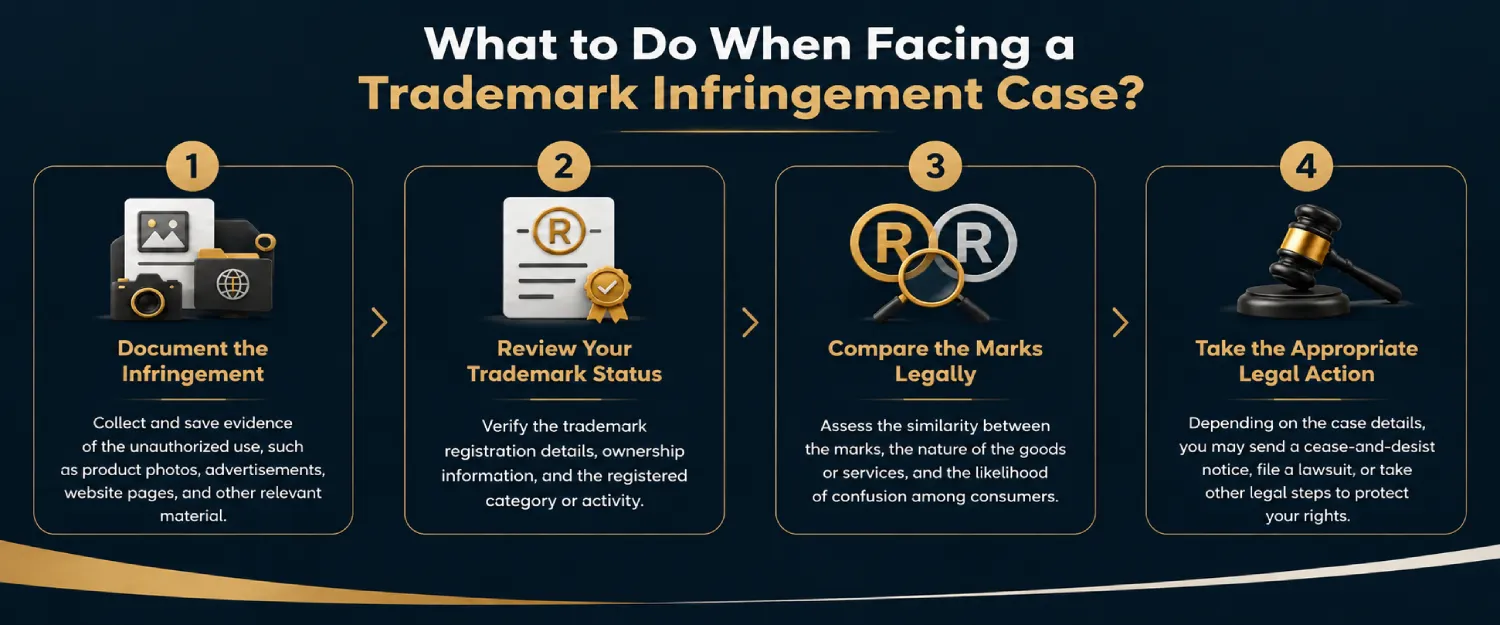
1. Document the Infringement Incident
The first step is to keep everything that proves how the other party is using the mark. Early documentation helps preserve the details of the incident, especially since online content or the way a product is displayed may later change or disappear.
2. Review the Status of the Trademark Before Taking Action
Before beginning any procedure, it is important to clearly verify the status of the trademark by reviewing:
- The existence of an official trademark registration.
- The trademark owner’s details.
- The category or activity registered for the trademark.
- The documents proving ownership and use of the trademark.
Verifying the trademark information and ownership helps create a clear understanding of the right subject to protection before proceeding with any action.
3. Compare the Two Marks from a Legal Perspective
Not every similarity between two marks necessarily means that trademark infringement has occurred. When examining a case, several factors are considered, including:
- The degree of similarity between the two marks.
- The nature of the goods or services associated with each mark.
- The possibility of confusion among the public.
- The way the mark is used in the market.
Therefore, determining whether infringement exists requires a comprehensive review of the circumstances surrounding the incident, not merely a separate comparison of the name or logo.
4. Determine the Appropriate Legal Action
After evaluating the nature of the disputed use and understanding the circumstances of the incident, the appropriate legal action is selected to address the case. Available options may include filing a trademark infringement lawsuit to protect the right and stop the unauthorized use of the trademark.
The steps taken may vary depending on the details of the dispute. Some cases may require requesting the other party to stop using the mark, while others may require referring the matter to the competent authorities or taking legal action to claim the rights established under the law.
Determining the appropriate procedure depends on the nature of the infringement, the status of the trademark, and the circumstances surrounding each case.
What Is the Penalty for Trademark Infringement in Kuwait?
The GCC Trademark Law applicable in Kuwait regulates the penalties related to trademark infringement, counterfeiting, or knowingly using a counterfeit or imitated trademark.
According to Article (42) of the Law, anyone who forges a registered trademark or imitates it in a way that may mislead the public, or knowingly uses a counterfeit or imitated trademark in bad faith, shall be subject to the following penalties:
- Imprisonment for a period of not less than one month and not exceeding three years.
- A fine of not less than five thousand Saudi Riyals or its equivalent in the currencies of the GCC states, and not exceeding one million Saudi Riyals or its equivalent in the currencies of the GCC states.
- Or either of these two penalties.
The penalties also cover certain acts related to selling, displaying, trading, or possessing products bearing a counterfeit or imitated trademark while knowing about it, in accordance with the provisions regulated under the Law.
Determining liability and the final penalty remains dependent on the proven facts, evidence, circumstances of each case, and the assessment of the competent judicial authorities.
What Evidence Helps in a Trademark Infringement Case?
When examining a trademark infringement case, attention is given to documents and evidence that help prove ownership of the trademark, clarify how it is being used by the other party, and determine whether there is similarity that may cause confusion among the public.
The following are among the most important elements that may help support the legal position:
| Evidence or Document | Its Role in the Case |
|---|---|
| Trademark Registration Certificate | Demonstrates the trademark owner’s right and official registration details |
| Trademark documents issued by the competent authority | Clarifies the trademark details and its legal status |
| Photos of products or advertisements used | Shows how the disputed trademark is being used |
| Website pages or online accounts | Documents the use of the trademark through digital platforms |
| Documents related to the commercial activity | Clarifies the connection between the trademark and the disputed products or services |
The trademark registration certificate and the related information are considered important documents for proving the status of the trademark, as the Ministry of Commerce and Industry in Kuwait provides trademark registration services, issues certificates, and processes trademark-related applications according to the applicable procedures.
The importance of each piece of evidence also varies depending on the nature of the incident, the method of trademark use, and the circumstances surrounding the dispute.
What Is the Role of a Lawyer in a Trademark Infringement Case?
The lawyer’s role involves organizing the legal file and analyzing the elements of the dispute, not merely taking action before the competent authorities. Trademark-related disputes may overlap with the commercial aspects of the business activity, making an understanding of the nature of the commercial relationship and the effects resulting from the infringement an important factor when assessing the legal position.
The legal review may include:
- Reviewing the trademark registration certificate.
- Evaluating the available evidence and documents.
- Identifying the relevant similarities.
- Reviewing the appropriate legal procedure.
- Preparing the documents required for the legal action.
In such disputes, the trademark owner may need the assistance of a commercial lawyer in Kuwait to understand the legal aspects related to the business activity and protect their interests according to the circumstances of the case. This helps the trademark owner take steps based on clear information rather than relying on initial impressions or non-legal assumptions.
Does Trademark Registration Help Prevent Infringement?
Trademark registration does not automatically prevent all cases of infringement, but it represents an important basis for proving rights and organizing trademark information when any dispute occurs.
Therefore, trademark registration is an important step for business owners who wish to protect their business identity and understand their legal position when any unauthorized use of the trademark appears.
Continuous market monitoring and attention to similar uses also help detect problems early and deal with them in a more organized manner.
Mistakes to Avoid When Discovering Trademark Infringement
There are some actions that may weaken the trademark owner’s position or complicate the dispute, including:
- Making accusations before reviewing the evidence.
- Ignoring the documentation of the incident immediately after discovering it.
- Assuming that every similarity constitutes infringement.
- Entering into negotiations or escalation without understanding the legal position.
Frequently Asked Questions About Trademark Infringement Cases in Kuwait
What is a trademark infringement case in Kuwait?
A trademark infringement case in Kuwait involves unauthorized use of a registered trademark or a similar mark that may confuse consumers or affect the rights of the trademark owner.
What should I do if someone uses my trademark without permission in Kuwait?
You should document the unauthorized use, collect available evidence, review the trademark registration status, and determine the appropriate legal procedure before taking action.
What are the penalties for trademark infringement in Kuwait?
Trademark infringement penalties in Kuwait may include imprisonment and fines according to the applicable GCC Trademark Law, depending on the facts and evidence of each case.
What evidence is needed for a trademark infringement case?
Evidence may include the trademark registration certificate, official trademark documents, product images, advertisements, online pages, and documents proving trademark ownership and use.
If you discover a similar use of your trademark or need to evaluate your position before taking any action, consulting a lawyer in Kuwait to review the documents and facts can help identify the available legal options according to the circumstances of each case.
A trademark infringement case requires careful examination of the evidence and the trademark status before choosing the appropriate legal path. Therefore, you can contact the lawyer Riyadh Matni Al-Fadhli to review the details of the case file and understand the possible legal steps based on the documents and specific circumstances of each case.
Disclaimer: This article is for general legal awareness purposes only and does not constitute specific legal advice. Reading this article does not create an attorney-client relationship. Legal procedures and outcomes vary depending on the facts of each case, the documents submitted, and the decisions issued by the competent authorities.
Sources:
- Ministry of Commerce and Industry of Kuwait, GCC Trademark Law, regarding the Trademark Law of the Cooperation Council for the Arab States of the Gulf applicable in Kuwait.
- Ministry of Commerce and Industry of Kuwait, Official Trademark Registration Services, for procedures and services related to trademark registration.

Lawyer in Kuwait, Registration No. 8342. Through this personal platform, he provides educational legal content covering contracts, companies and investment, arbitration, and commercial dispute resolution. The content is presented in a clear and precise manner to help individuals and businesses understand their legal options and reduce potential risks.