

The crime of embezzlement of public funds in Kuwait is considered one of the serious offenses associated with public office because it does not concern money alone, but also affects the assets of the State, public authorities, and entities whose funds fall within the scope of legal protection. The Protection of Public Funds Law regulates this offense through specific provisions.
In this article, we explain the meaning of embezzlement of public funds, its elements, the difference between embezzlement, unlawful acquisition, and facilitating unlawful acquisition, the prescribed penalties, when an administrative error may raise criminal suspicion, and what should be considered when there is a summons, audit report, or inventory record relating to public funds.
Are you facing a summons or audit report that raises suspicion of embezzlement and are concerned that an administrative error may turn into a criminal charge? Do not leave your future to accounting interpretations. Lawyer Riyadh Matni Al-Fadhli is ready to assess your legal position and guide you through the appropriate steps to protect your rights and professional career.
Book Your Consultation With the Lawyer NowOr continue reading the article first to understand the dimensions of the case.
Table of content
When Do You Need Urgent Legal Review in a Public Funds Case?
You may need urgent legal review if you are facing a situation that could develop from an administrative or financial observation into criminal liability involving public funds, particularly in the following circumstances:
- A summons from an investigative or regulatory authority regarding suspected embezzlement or unlawful acquisition of public funds.
- A shortage appearing in a financial or inventory custody account that could be interpreted as embezzlement.
- A request for an official response to an audit report containing sensitive financial observations.
- An inventory record or internal review indicating a shortage or unclear disposal of funds or documents.
- Pressure to sign an acknowledgment or repay an amount before understanding its legal implications.
- The conduct being connected to a request for a benefit or unlawful consideration, which may raise the issue of the crime of bribery alongside an offense against public funds.
- The existence of forgery or alteration in documents connected to custody, payment, or financial transfers.
Therefore, before making any statement, signing any acknowledgment, or submitting an official response, it is preferable to consult a lawyer in Kuwait to present a summary of the case and the documents and determine the available legal options calmly and clearly.
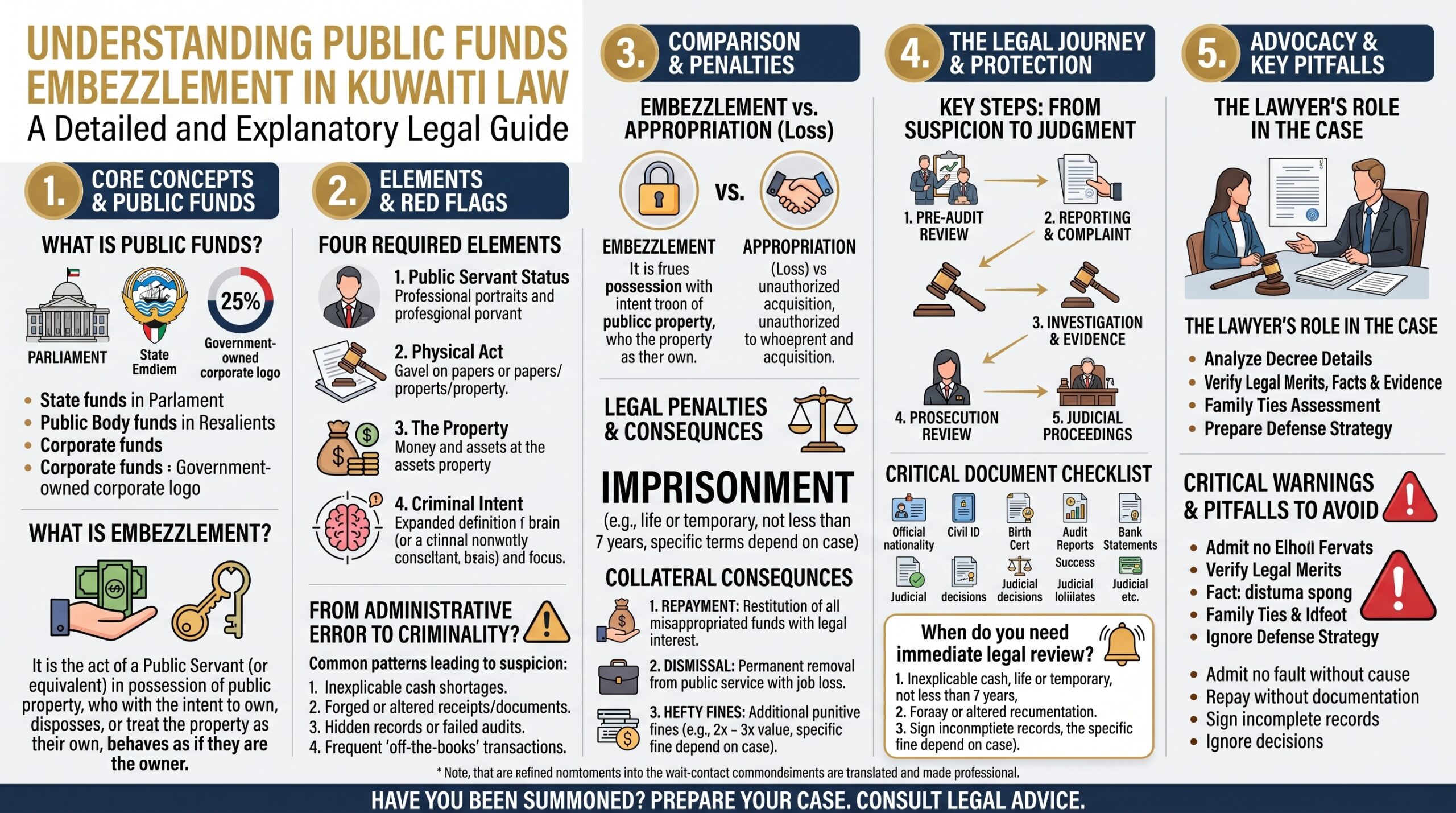
What Is Embezzlement of Public Funds in Kuwait?
Embezzlement of public funds occurs when a public employee, or a person treated as such, disposes of money, documents, or property delivered to them by reason of their position with the intention of treating it as their own, provided the remaining elements of the offense are established.
The essence of embezzlement lies in the transformation of possession from official custody or trust into possession exercised as an owner. Therefore, a financial shortage alone is not always sufficient. The reason the funds were received, the nature of the custody, the employee’s conduct, the documents, and the criminal intent must all be examined.
Judicial explanations also confirm that the decisive factor is not merely the existence of a financial shortage, but the nature of possession of the funds and the employee’s intention when dealing with them.
What Funds Are Considered Public Funds Under Kuwaiti Law?
Public funds in this context refer to assets owned by the State or public authorities, or funds that are legally protected within the scope defined by law. This includes:
- State funds.
- Funds of public authorities and public institutions.
- Funds of companies and establishments in which the State, public authorities, or public institutions hold at least 25% of the capital, directly or indirectly.
This is particularly important in cases involving companies in which the State holds an interest, because determining the percentage of State ownership and the way it is calculated may affect whether the funds are legally classified as public funds. This point is based on Article 2 of the Protection of Public Funds Law, which defines the scope of funds and entities covered by the law’s protection.
Elements of the Crime of Embezzlement of Public Funds in Kuwait
Not every financial violation is classified as embezzlement. The elements of the offense and whether they are present in the specific incident must be examined. The main elements include:
- Status of the offender: The perpetrator must be a public employee, a person treated as a public employee, or another person falling within the scope of the Protection of Public Funds Law according to the entity, position, and nature of the funds.
- Subject matter of the offense: The act must concern money, documents, goods, or other property that was delivered to the person because of their position or placed under their official custody.
- Act of embezzlement: This occurs when the employee deals with the money or property entrusted to them as though they were its owner, or their conduct reveals a change in the intention of possession from official trust to full possession.
- Criminal intent: It must be established that the offender knew the nature of the funds and that they held them in trust, while intentionally dealing with them without legal right.
For this reason, reviewing the documents and the employee’s official powers is necessary before determining the legal characterization of the incident.
The Difference Between Embezzlement and Unlawful Acquisition of Public Funds
The difference between embezzlement and unlawful acquisition can be summarized as follows:
| Point of Comparison | Embezzlement of Public Funds | Unlawful Acquisition of Public Funds |
|---|---|---|
| Employee’s relationship with the funds | The funds are under the employee’s custody or were delivered to them because of their position | The funds are not necessarily under the employee’s custody |
| Essence of the act | Breach of official trust | Obtaining public funds without legal right |
| Simple example | A cashier disposes of amounts under their custody | An employee obtains funds from an entity even though those funds were not under their custody |
When Does Facilitating the Unlawful Acquisition of Public Funds Constitute a Crime?
The offense may occur even if the employee does not obtain the money for themselves. Liability may arise if the employee uses their authority or official position to enable another person to obtain public funds without legal right.
This may occur in situations such as allowing money, goods, or documents to leave without a proper basis, or disabling internal controls in a manner that allows another person to obtain an unlawful benefit.
Therefore, the legal risk is not limited to the person who actually takes the money. It may extend to anyone who facilitates, enables, or deliberately conceals the violation where the legal conditions are satisfied.
When Can Professional Negligence Raise Suspicion of Embezzlement?
Not every financial shortage or administrative error amounts to embezzlement. The incident may merely involve negligence, an accounting error, or poor internal organization. However, the risk increases when indicators of criminal intent or concealment appear.
Among the most important indicators requiring careful legal examination are:
- Repeated shortages in custody occurring systematically or without justification.
- Missing, altered, or inconsistent documents.
- Suspicious signatures or payment orders.
- The employee dealing with the funds as though they were personal property.
- Transfers of money to unjustified accounts.
- Obstruction of accounting reviews or concealment of certain entries.
- A direct or indirect benefit received by the employee or another person.
Unintentional harm to public funds differs from embezzlement because it is based on error, negligence, or breach of official duties resulting in serious damage, without requiring an intention to appropriate the funds or deal with them as an owner.
Penalty for Embezzlement of Public Funds in Kuwait
The penalty for embezzlement of public funds in Kuwait is life imprisonment or temporary imprisonment for a term of not less than five years. The penalty becomes life imprisonment or temporary imprisonment for a term of not less than seven years if the offense is inseparably connected with another felony.
In addition to the principal penalty, conviction for embezzlement, unlawful acquisition, or facilitation may result in supplementary penalties, including:
- Dismissal from employment.
- Restitution of the funds involved in the offense.
- A proportional fine equal to twice the value of the money, benefit, or profit involved in the offense.
A travel ban or prohibition on disposing of assets, however, are precautionary measures that may be imposed in accordance with legal requirements where sufficient evidence exists. They are not among the supplementary penalties resulting from conviction.
Does Returning Embezzled Funds Exempt a Person From Punishment?
Returning the funds does not automatically exempt a person from punishment. It may be a factor considered by the court or investigating authority as part of the circumstances of the incident, but it does not by itself erase the offense or eliminate the need to examine its legal elements.
Therefore, this action should be approached carefully because its timing, reason, method of documentation, source of the funds, and stage of the case may all affect the legal assessment.
It is more appropriate for the accused or concerned person to consult a lawyer before taking any financial action or making any acknowledgment so that an unconsidered step does not become evidence against them.
Is the Crime of Embezzlement of Public Funds in Kuwait Subject to a Limitation Period?
Public funds offenses have a special status under the Protection of Public Funds Law. Article 21 bis provides that criminal proceedings for offenses stipulated in this law do not lapse with the passage of time, and the limitation periods for enforcement of the imposed penalty do not apply.
Accordingly, embezzlement of public funds is not treated like ordinary offenses in terms of limitation periods when it falls within the scope of the Protection of Public Funds Law.
Reporting and Investigation Procedures in Public Funds Embezzlement Cases
Public funds cases generally pass through stages beginning with gathering information, followed by examination and inquiries, investigation, and potentially trial or precautionary measures depending on the circumstances of each case. The principal steps include:
- Preparing the documents: such as a description of the incident, the entity involved, the names of the concerned persons, and the manner in which the damage or suspected offense occurred.
- Submitting the report to the competent authority: depending on the nature of the incident, this may be before regulatory authorities, investigative authorities, or the Kuwait Anti-Corruption Authority “Nazaha” where the matter falls within corruption offenses.
- Reviewing reports and financial records: including inventory reports, audit reports, financial entries, payment orders, contracts, correspondence, and account statements. The review may extend to transfers or the source of funds where suspicion involving money laundering arises.
- Investigation before the Public Funds Prosecution: the authority competent to investigate and take action concerning offenses violating the Protection of Public Funds Law.
- Taking precautionary measures where necessary: such as a travel ban or prohibition on disposing of assets where sufficient evidence exists in accordance with legal requirements.
Can a Travel Ban or Asset Freeze Be Imposed in Public Funds Cases?
The law may permit precautionary measures in public funds cases where sufficient evidence exists and the applicable legal requirements are satisfied. These measures may include a travel ban, restrictions on disposing of or managing assets, or tracing funds inside or outside Kuwait.
These measures fall within the powers of the Public Prosecutor in cases specified by law, while the concerned person retains the right to challenge a decision prohibiting disposal or management of assets within the prescribed deadlines and procedures.
What Documents Should You Prepare Before Consulting a Public Funds Lawyer?
Before requesting legal advice in a case involving embezzlement or unlawful acquisition of public funds, it is preferable to prepare the following:
- The summons letter or official notification, if available.
- Inventory or custody records.
- Internal or external audit reports.
- Payment, transfer, or delivery orders.
- Relevant account statements.
- Contracts, purchase orders, or invoices.
- Administrative correspondence and emails.
- Assignment decisions or job descriptions.
- Any document explaining why the funds were received or how they were handled.
- Names of witnesses or persons who participated in the financial or administrative procedures.
Preparing these documents helps identify the most appropriate legal characterization of the incident and distinguish between administrative and criminal liability.
The Lawyer’s Role in Public Funds Embezzlement Cases
The role of a financial cases lawyer in public funds embezzlement cases is not limited to attending investigations or presenting arguments in court. It begins with an initial legal and accounting review of the facts and documents. The lawyer’s practical role includes:
- Determining the legal characterization of the incident: Is it embezzlement, unlawful acquisition, facilitation of unlawful acquisition, unintentional harm, an administrative violation, or an accounting dispute?
- Examining the status of the person and entity: because the legal characterization of the funds depends on the nature of the entity, the percentage of State ownership, and the reason the funds were under the concerned person’s control.
- Reviewing expert and audit reports: a financial report may reveal an accounting error or a lack of connection between the alleged conduct and the result.
- Examining criminal intent: to determine whether the incident involved an error, negligence, or poor organization, or an intention to appropriate and dispose of funds without legal right.
- Dealing with precautionary measures: such as challenging restrictions on disposal of assets or requesting that the measure be limited to the assets under suspicion where grounds exist.
- Preparing the response before investigation: particularly where there is a summons, request for a statement, or complex financial documents.
Common Mistakes in Public Funds Embezzlement Cases
There are recurring mistakes that may harm a person’s legal position before or during an investigation, including:
- Making statements without first reviewing the documents.
- Admitting a financial shortage without explaining its cause.
- Returning amounts without proper documentation.
- Concealing correspondence or documents that may be helpful.
- Confusing administrative liability with criminal liability.
- Assuming that every financial shortage constitutes embezzlement or that every error proves innocence.
- Relying on general advice from non-specialists.
- Ignoring restriction or freezing orders instead of legally challenging them.
Frequently Asked Questions About Embezzlement of Public Funds in Kuwait
What is embezzlement of public funds in Kuwait?
Embezzlement of public funds occurs when a public employee, or a person treated as such, deals with money, documents, or property entrusted to them because of their position as though they owned it, provided the other elements of the offense are established.
What are the main elements of public funds embezzlement?
The main elements include the legal status of the offender, the public funds or property involved, the act of converting entrusted property for unauthorized use, and criminal intent showing knowledge of the nature of the funds and an intention to deal with them without legal right.
What is the difference between embezzlement and unlawful acquisition of public funds?
In embezzlement, the funds are already under the employee’s custody or were entrusted to them because of their position. In unlawful acquisition, the public funds do not necessarily have to be under the employee’s custody before they are obtained without legal right.
Can facilitating the unlawful acquisition of public funds be a crime?
Yes. Criminal liability may arise where an employee uses their authority or position to enable another person to obtain public funds unlawfully, even if the employee does not personally receive the funds.
Does every financial shortage amount to embezzlement?
No. A financial shortage may result from negligence, an accounting error, or poor internal procedures. Embezzlement requires examination of criminal intent, the employee’s conduct, custody of the funds, and the surrounding documents and circumstances.
What is the penalty for embezzlement of public funds in Kuwait?
The article states that the penalty is life imprisonment or temporary imprisonment for no less than five years. If the offense is inseparably connected with another felony, the minimum term of temporary imprisonment increases to seven years. Supplementary penalties may also include dismissal from employment, restitution, and a proportional fine.
Does returning embezzled money cancel criminal liability?
No. Returning the money does not automatically eliminate the offense or exempt the person from punishment. The timing and circumstances of repayment may be considered, but the legal elements of the offense must still be examined.
Is embezzlement of public funds in Kuwait subject to a limitation period?
According to the article, offenses falling within the Protection of Public Funds Law are not subject to the ordinary limitation rules for criminal proceedings, and the limitation periods for enforcement of the imposed penalty do not apply.
Can a travel ban or asset restriction be imposed in public funds cases?
Yes. Precautionary measures may include a travel ban, restrictions on disposing of or managing assets, and tracing funds inside or outside Kuwait where sufficient legal grounds exist.
What documents should be prepared before consulting a public funds lawyer?
Useful documents may include summonses, inventory and custody records, audit reports, payment and transfer orders, bank statements, contracts, invoices, administrative correspondence, job descriptions, and documents explaining how the funds came into the person’s custody.
In conclusion, cases involving embezzlement of public funds in Kuwait require calm and informed handling from the outset. The more carefully the legal decision is made after fully understanding the facts, the clearer and safer the legal path becomes.
If you are facing a summons, complaint, or audit report relating to public funds, it is preferable to review the documents before making any statements or taking any action. You can contact lawyer Riyadh Matni Al-Fadhli to arrange a legal consultation that takes into account the details of the case and the related documents.
Legal Disclaimer: This content is intended for general educational purposes and does not constitute legal advice or a guarantee of any particular outcome. The legal assessment varies according to the facts, documents, the person’s legal status, the employer or entity involved, and the stage of the investigation or proceedings.

Lawyer in Kuwait, Registration No. 8342. Through this personal platform, he provides educational legal content covering contracts, companies and investment, arbitration, and commercial dispute resolution. The content is presented in a clear and precise manner to help individuals and businesses understand their legal options and reduce potential risks.