

The crime of human trafficking under Kuwaiti law is considered one of the serious offenses that affect human dignity and freedom. The seriousness of this crime does not always appear clearly from the outset; it may begin as an employment relationship, a promise of a visa, or a verbal agreement, and later facts may reveal pressure, deception, or exploitation that changes the legal characterization of the case.
In this article, we explain the meaning of human trafficking in Kuwait, the elements of the crime, its practical forms, the difference between human trafficking and a labor dispute or residency trafficking, the prescribed penalties, and what should be done before filing a report or when facing an accusation.
Are you facing a complex labor dispute and worried that it may develop into a criminal accusation or suspicion of human trafficking? Do not take any formal step that may further complicate your position. Lawyer Riyadh Matni Al-Fadhli is ready to assess your case with complete confidentiality and determine the safest legal route to protect your rights and future.
Table of content
Is Your Case a Labor Dispute or Suspected Human Trafficking?
At first, the situation may appear to be a simple dispute with an employer or recruitment agency, but it may take on a more serious legal characterization if it involves threats, control, or exploitation of a person’s vulnerability.
The first step is not immediate escalation, but understanding your legal position and identifying the situation that best applies to you:
- I am a victim or I am seeking legal protection.
- I am accused or I represent a company facing a report or investigation.
- I do not know whether the matter is labor-related, criminal, or administrative.
Begin by sending a short chronological summary of what happened through the WhatsApp button at the bottom of the screen, together with images of any messages, contracts, or summonses, so the matter can be assessed to determine whether it requires a labor, criminal, administrative, or urgent legal procedure before taking any formal action.
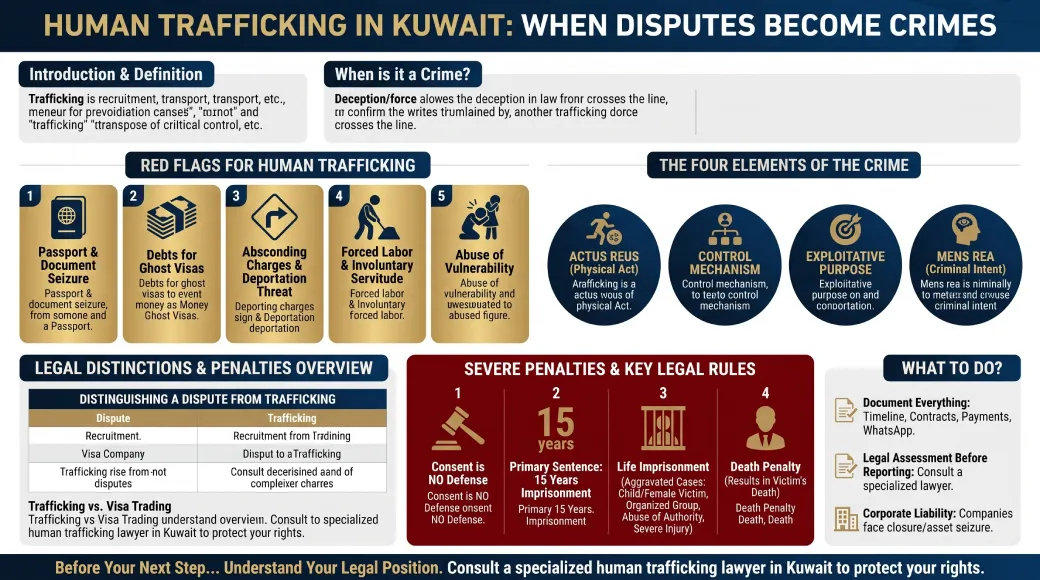
What Is Human Trafficking Under Kuwaiti Law?
Human trafficking under Kuwaiti law means recruiting, employing, transporting, harboring, or receiving a person, within Kuwait or across borders, by means such as threats, force, deception, abuse of authority, or exploitation of a position of vulnerability, for the purpose of exploitation.
Kuwaiti law uses the expression “trafficking in persons,” which is the legal term used in Law No. 91 of 2013, while the public commonly uses the term “human trafficking” to refer to the same meaning.
Signs and Indicators of Suspected Human Trafficking in Kuwait
The existence of a dispute with an employer is not sufficient by itself to classify the situation as human trafficking, but the presence of several indicators may move the case from an ordinary dispute to a criminal suspicion.
Withholding a Passport or Personal Documents
Withholding a passport alone is not sufficient to establish human trafficking, but it becomes an important indicator when it is used as a means of pressure that prevents the person from leaving the job, seeking assistance, or protecting their legal position.
The seriousness increases if this conduct is accompanied by threats, unpaid wages, preventing the worker from changing employers, or forcing the worker to accept inhumane conditions.
Paying Money for a Work Visa Without Genuine Employment
Paying money for a visa may be an important indicator, especially where the person remains without genuine employment, is burdened with debts, or their legal status is exploited to force them to make payments or accept unfair conditions.
Threatening an Absconding Report or Administrative Deportation
Using an absconding report as a threat to force a worker to accept unfair conditions may be an indicator of exploitation, particularly where the purpose is to prevent the worker from leaving employment or claiming their rights.
However, if the report is based on accurate facts and is legally proper, the legal characterization may differ depending on the documents and surrounding circumstances.
Forced Labor or Servitude
Forced labor occurs when a person is compelled to work without free will, without pay, under threat, or for hours and under conditions that go beyond legal and humane limits, while having no realistic ability to leave the work.
Forced labor may occur in different sectors, including domestic work, construction, services, or any activity in which a person’s need or lack of knowledge of the law is used to control them.
Elements of the Crime of Human Trafficking Under Kuwaiti Law
The crime of human trafficking consists of interconnected elements, and the existence of one isolated fact is not sufficient by itself to classify a case as human trafficking without a full examination of the circumstances.
First: The Material Act
The material act includes conduct such as recruitment, employment, transportation, harboring, or receiving a person. This may occur within Kuwait or across borders depending on the nature of the case.
For example, bringing people for work, transporting them, housing them, or controlling their presence in a specific location may fall within the material act if it is connected to an unlawful means and an exploitative purpose.
Second: The Means of Control or Influence
The means used are what distinguish an ordinary relationship from an exploitative one. They may include an explicit threat, force, deception, abuse of authority, or exploitation of a person’s need or vulnerability.
Practical examples include misleading a worker about employment conditions, threatening deportation or a report, withholding documents, or exploiting the worker’s lack of knowledge of the language or procedures.
Third: The Purpose of Exploitation
Exploitation is the core element of the crime. If the element of exploitation is absent, the legal characterization may instead become a labor dispute, administrative violation, or residency violation depending on the case.
Exploitation includes forms such as forced labor, compulsory service, sexual exploitation, practices similar to slavery, or removal of organs.
Fourth: Criminal Intent
The offender’s knowledge and intention must be examined. In other words, did the person know that their actions would lead to exploitation? Did they intend to obtain a benefit from that exploitation?
For this reason, case assessment depends on messages, contracts, transfers, witnesses, housing and working conditions, and the conduct of the parties before and after the incident.
Types and Forms of Human Trafficking Under Kuwaiti Law
Forms of human trafficking vary depending on the nature of the exploitation and may overlap with employment, residency, corporate, or offenses against persons.
Forced Labor and Exploitation of Workers
Forced labor is one of the most prominent forms of human trafficking where a worker is practically prevented from leaving employment, compelled to continue under threat, or controlled through their need, documents, or wages.
Exploitation Connected to Residency Trafficking
This form appears when a visa or residency permit becomes a means of controlling the worker, such as bringing the person to Kuwait without genuine employment, requiring continuous payments, or threatening them because of their legal status.
Sexual Exploitation
This form arises when a person is employed, harbored, transported, or controlled for the purpose of sexual exploitation, particularly where deception, threats, or exploitation of need or vulnerability exists.
In these cases, the law does not look only at the outward appearance of consent but also examines the circumstances that affected the person’s free will.
Organ Removal or Practices Similar to Slavery
The law criminalizes serious forms of exploitation such as organ removal or practices similar to slavery. These are among the most serious forms of trafficking in persons and may result in aggravated penalties, particularly where serious harm or death occurs.
The Difference Between Human Trafficking and Residency Trafficking in Kuwait
The practical distinction between the two situations lies in what happens after the visa is issued: Did the matter end with a residency-related violation, or was the person’s presence in Kuwait used to pressure them or exploit their vulnerability?
| Point of Comparison | Residency Trafficking | Human Trafficking |
|---|---|---|
| Core of the situation | Selling or facilitating a visa or residency permit unlawfully | Exploiting and controlling a person |
| Presence of exploitation | May not exist in every case | An essential element of the crime |
| Status of the victim | The person may have entered into an unlawful agreement | Usually a person subjected to deception, coercion, or exploitation of vulnerability |
| Legal characterization | May constitute a residency violation or a related offense | A serious felony under the Anti-Trafficking in Persons Law |
The Difference Between Human Trafficking and a Labor Dispute
The difference between human trafficking and a labor dispute can be illustrated through the following situations:
| Situation | Likely Legal Characterization |
|---|---|
| Delayed salary without threats or control | Usually a labor dispute |
| Non-payment of salary combined with passport withholding and threats of a report | A suspicion requiring criminal review |
| Dispute over end-of-service benefits | Labor dispute |
| Forcing a person to work under threat of deportation | May constitute suspected human trafficking |
| An unlawful or unclear employment contract | Assessed according to the facts and documents |
The decisive factor is not the name of the relationship or type of contract, but how the person in authority used their position: Was the dispute capable of being resolved as a labor right, or was it used to control and subjugate the person?
The Difference Between Human Trafficking and Migrant Smuggling
The difference can be summarized as follows:
| Point of Comparison | Human Trafficking | Migrant Smuggling |
|---|---|---|
| Decisive element | Exploitation | Unlawful entry |
| Consent of the person | Does not prevent the crime where coercion or deception exists | The person may consent to being smuggled |
| Continuation of the relationship | May continue through control and exploitation | May end after arrival |
| Interest protected by law | The person’s dignity and freedom | The legal system governing entry and residency |
A single incident may fall within more than one legal framework where migrant smuggling overlaps with exploitation after arrival.
Penalty for Human Trafficking Under Kuwaiti Law
Kuwaiti law imposes severe penalties for trafficking in persons because of the seriousness of the offense and its connection to human freedom and dignity.
Original Penalty
The Anti-Trafficking in Persons and Smuggling of Migrants Law punishes anyone who commits trafficking in persons with imprisonment for fifteen years, without prejudice to any more severe penalty prescribed by another law.
When Is the Penalty Increased to Life Imprisonment?
The penalty is increased to life imprisonment if the offense is accompanied by one of the aggravating circumstances, including:
- The offense is committed through an organized criminal group.
- The offense has a transnational nature.
- The offender is the victim’s spouse, ascendant, descendant, or a person exercising authority over the victim.
- The offense is committed by two persons or by a person carrying a visible or concealed weapon.
- The offense causes serious harm to the victim or results in permanent disability.
- The offender is a public employee who abuses their position to facilitate or complete the offense.
- The victim is a child, a woman, or a person with special needs.
In all cases, the victim’s consent or approval of the acts intended for exploitation is not taken into consideration in these offenses.
When Can the Penalty Reach the Death Penalty?
The penalty is death if the crime of trafficking in persons results in the death of the victim.
This aggravated punishment reflects the seriousness of the offense and its connection to the right to life, freedom, and physical integrity.
Corporate Liability in Human Trafficking Cases
Liability in human trafficking cases is not limited to individuals. It may extend to a legal person, such as a company, where the offense is committed in its name or for its benefit and with the knowledge of its legal representative or actual manager.
Legal consequences for the company may include:
- Liability of the legal representative or actual manager where the conditions for responsibility are met.
- Dissolution of the legal person.
- Closure of the head office or branches.
- Permanent or temporary closure as determined by the court.
- Confiscation of funds or proceeds connected to the offense.
For this reason, companies, particularly those dealing with workers, recruitment, or contracting, need to review their contracts, records, and internal procedures to reduce the risk of improper criminal characterization or unlawful practices.
Does the Victim’s Consent Prevent the Crime From Being Established?
One of the most important rules in human trafficking cases is that the victim’s consent or approval does not prevent the crime from being established where the conduct is intended for exploitation.
A person may appear to consent because of need, fear, lack of knowledge of the law, pressure from an employer, or fear of deportation. Therefore, the law examines the circumstances surrounding the consent rather than its outward form alone.
This highlights the importance of reviewing messages, contracts, financial transfers, housing conditions, the manner in which the person was treated, and whether authority, threats, or exploitation of vulnerability were present.
Where Are Human Trafficking Crimes Reported in Kuwait?
Kuwait has a national framework for dealing with crimes of trafficking in persons and smuggling of migrants, involving several authorities depending on the nature of the case. Relevant authorities include:
- The Public Prosecution, which is responsible for investigating, taking action, and prosecuting offenses stipulated in the Anti-Trafficking in Persons and Smuggling of Migrants Law.
- The Ministry of Interior and relevant security authorities.
- The Permanent National Committee concerned with preventing trafficking in persons and smuggling of migrants.
- Medical and social authorities and shelters where a victim requires protection or care.
- The Public Authority for Manpower in cases connected to the workplace, depending on the legal characterization of the incident.
The wording of a report or response must be precise, as the choice of language and supporting documents may determine whether the case is understood as a labor dispute or a criminal incident.
What Should You Do If You Believe You Are a Victim of Human Trafficking?
If you believe that you have been subjected to unlawful exploitation or control, begin by documenting the facts as calmly as possible and do not rely only on a general description. It is important to prepare the following:
- A copy of your passport or passport details, if possible.
- The employment contract or any correspondence relating to the agreement.
- WhatsApp or text messages containing threats or requests for money.
- Transfer or payment receipts.
- Photographs or evidence of housing or working conditions, if available.
- Names of witnesses or co-workers.
- Any reports, summonses, or official documents.
- A short chronological summary explaining when the problem began and how it developed.
After collecting these materials, the incident can be assessed more accurately: What evidence is available? What are the weaknesses? What is the least risky route for protecting your rights?
When Do You Need a Human Trafficking Lawyer in Kuwait?
Early legal advice may be necessary in any of the following situations:
- A passport or personal documents have been withheld together with threats or pressure.
- There are messages threatening an absconding report or deportation.
- Money was paid for a visa without genuine employment being provided.
- Wages are unpaid while the worker is prevented from leaving employment.
- You have been summoned for investigation in a matter relating to trafficking in persons or residency trafficking.
- A report has been filed against your company or one of its officials.
- There is suspected worker exploitation, unsuitable housing, or forced labor.
- You do not know whether the correct route is a criminal report, labor complaint, or administrative procedure.
Taking action early helps organize the facts, reduce mistakes, and understand the correct legal route before taking any formal step.
The Role of Lawyer Riyadh Matni Al-Fadhli in Assessing These Cases
The lawyer’s role begins by reading the facts as they will be presented before the competent authority, then testing the available evidence and identifying strengths and weaknesses before determining the appropriate reporting or defense strategy.
The lawyer may assist with:
- Reviewing documents, messages, and contracts.
- Analyzing whether the element of exploitation is present.
- Distinguishing between an administrative error and criminal liability.
- Preparing a report or defense memorandum according to the person’s legal position.
- Guiding the victim toward the appropriate legal route.
- Helping companies review their contractual and labor position.
- Organizing the facts before dealing with the competent authorities.
Lawyer Riyadh Matni Al-Fadhli aims to provide a clear legal assessment that helps explain the available options before any communication or formal procedure is undertaken.
Frequently Asked Questions About Human Trafficking Under Kuwaiti Law
What is human trafficking under Kuwaiti law?
Human trafficking under Kuwaiti law includes recruiting, employing, transporting, harboring, or receiving a person through threats, force, deception, abuse of authority, or exploitation of vulnerability for the purpose of exploitation. Kuwaiti legislation uses the term “trafficking in persons” under Law No. 91 of 2013.
What are the main elements of human trafficking in Kuwait?
The main elements include the material act, such as recruitment or transportation; the means of control, such as threats, deception, or abuse of authority; the purpose of exploitation; and criminal intent.
Is withholding a worker’s passport considered human trafficking?
Withholding a passport alone does not automatically establish human trafficking. However, it may become an important indicator when it is used to prevent a worker from leaving employment, seeking help, or protecting their legal rights, especially when combined with threats or unpaid wages.
What is the difference between human trafficking and a labor dispute?
A labor dispute may involve matters such as delayed wages or end-of-service benefits. Human trafficking involves additional elements of control, coercion, deception, or exploitation. For example, unpaid wages combined with passport withholding and threats may require criminal review.
What is the difference between human trafficking and residency trafficking in Kuwait?
Residency trafficking generally concerns unlawful dealings involving visas or residency permits, while human trafficking centers on exploiting and controlling a person. Exploitation is an essential element of human trafficking but may not exist in every residency-related violation.
What is the penalty for human trafficking in Kuwait?
The article states that trafficking in persons is punishable by 15 years’ imprisonment. The penalty may be increased to life imprisonment when certain aggravating circumstances exist.
When can the penalty for human trafficking reach life imprisonment?
Life imprisonment may apply in circumstances such as involvement of an organized criminal group, a transnational offense, abuse of authority, serious injury or permanent disability to the victim, or where the victim is a child, woman, or person with special needs.
Can human trafficking in Kuwait be punishable by death?
Yes. According to the article, the death penalty applies where the crime of trafficking in persons results in the death of the victim.
Does the victim’s consent prevent a human trafficking charge?
No. The victim’s apparent consent does not prevent the offense from being established where the conduct was aimed at exploitation. The surrounding circumstances, including fear, pressure, vulnerability, and threats, must be examined.
Where can human trafficking crimes be reported in Kuwait?
Relevant authorities may include the Public Prosecution, the Ministry of Interior, the Permanent National Committee concerned with preventing trafficking in persons and migrant smuggling, the Public Authority for Manpower in employment-related cases, and relevant medical, social, or shelter authorities.
Can a company be held liable in a human trafficking case?
Yes. Liability may extend to a company or other legal person where the offense is committed in its name or for its benefit with the knowledge of its legal representative or actual manager. Possible consequences may include dissolution, closure, and confiscation of related funds or proceeds.
What evidence may help a victim of human trafficking?
Useful evidence may include passport details, employment contracts, WhatsApp or text messages, payment receipts, evidence of housing or working conditions, witness names, official reports or summonses, and a chronological summary of the events.
In conclusion, human trafficking cases under Kuwaiti law require calm and careful handling from the beginning because the wording of the report and the organization of evidence may change the direction of the case. This is where consulting a lawyer in Kuwait before taking any action becomes important.
If you are facing a report, summons, or possible exploitation situation, do not rush into taking a formal step before organizing the essential documents. You can send a clear summary of the incident via WhatsApp to contact lawyer Riyadh Al-Fadhli to assess the situation and determine the most appropriate legal route.
You may also be interested in: Related Money Laundering Crimes
Legal Disclaimer: This content is intended for general educational purposes and does not constitute direct legal advice, as the legal characterization of each case varies depending on its facts and documents.

Lawyer in Kuwait, Registration No. 8342. Through this personal platform, he provides educational legal content covering contracts, companies and investment, arbitration, and commercial dispute resolution. The content is presented in a clear and precise manner to help individuals and businesses understand their legal options and reduce potential risks.