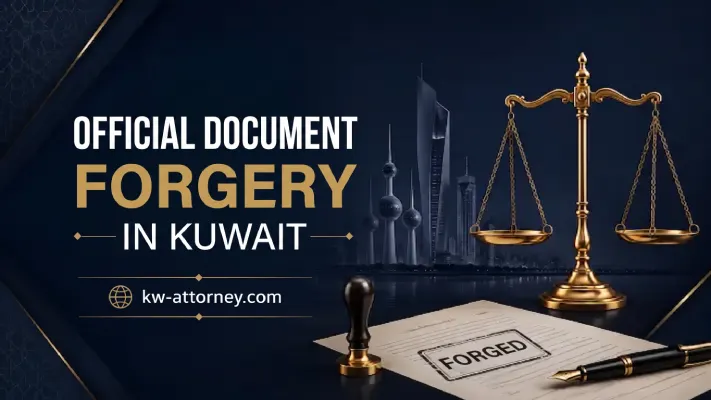
Official Document Forgery in Kuwait is a serious legal matter that goes beyond doubts about a document or signature, as it may expose a person to criminal liability or threaten rights established through an official record.
Cases involving Official Document Forgery in Kuwait require careful handling from the outset. Giving statements too quickly, filing a complaint without proper legal wording, or submitting a disputed document without review may affect the course of the case. For this reason, understanding the legal position before taking action is especially important when the document is connected to a government authority or a transaction with legal consequences.
Are you facing an accusation of forging an official document, or have you discovered a forged document being used against you and are concerned about your next step? Do not let anxiety lead you into taking an action that could complicate your position. Attorney Riyadh Matni Al-Fadhli is ready to assess your case and develop a legal defense strategy that protects your rights and addresses potential weaknesses.
Table of content
When Do You Need a Lawyer for Official Document Forgery in Kuwait?
In forgery cases, the first step may make the difference between protecting your legal position and making it more complicated. Giving inaccurate statements, filing a complaint using inappropriate wording, or responding to a technical report without legal review may affect the direction of the case from the beginning.
Therefore, you should not delay consulting a lawyer if you are in any of the following situations:
- You have been summoned before the Kuwaiti Public Prosecution for questioning in a forgery case.
- You have been accused of using a forged document.
- You discovered a forged power of attorney, certificate, or official document being used against you.
- You have a forensic evidence report that requires legal review.
- A suspicious document has been submitted against you in a civil or commercial dispute.
- You want to file a forgery complaint but do not know the appropriate wording or required documents.
- You used a document obtained from another person and are concerned that it may not be genuine.
In these situations, consulting a lawyer in Kuwait can help you understand your position before giving statements, filing a complaint, or taking any action that may affect the course of the case. If you are facing an accusation or dealing with a suspicious document, early legal consultation can help determine the most appropriate next step before the matter becomes more complicated.
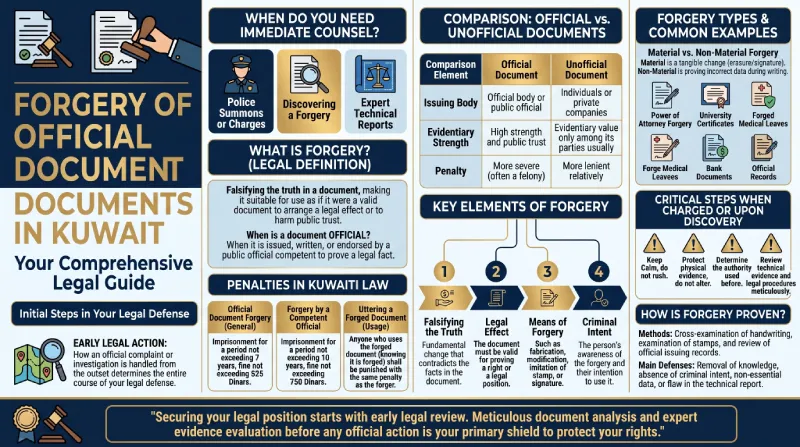
What Does Forgery Mean Under Kuwaiti Law?
Under Kuwaiti law, forgery generally means altering the truth in a document in a way that makes it capable of being used as though it were genuine, where such alteration may create a legal effect or undermine confidence in documents.
Forgery is not limited to imitating a signature or seal. It may also occur by creating a false document, altering its information, or recording facts that do not correspond to the truth.
Examples of document forgery include:
- Creating an entire document and falsely attributing it to an authority or person.
- Changing a date, name, capacity, or amount stated in a document.
- Adding a signature or seal without authorization.
- Recording false information in an official document.
- Using a forged document while knowing that it is not genuine.
When Is a Document Considered Official in Forgery Cases?
A document is considered official when it is issued by a competent official authority, prepared by a public employee within the scope of their authority, or prepared or authenticated with the involvement of such an employee in the course of their duties to establish information or facts that carry legal consequences.
Some of the most common examples of official documents include:
- Official powers of attorney.
- Birth and death certificates.
- Marriage and divorce documents.
- Official reports and records.
- Certificates and statements issued by government authorities.
- Documents approved or authenticated by public authorities.
- Documents presented in the form of an official instrument and falsely attributed to a public employee or competent authority.
A document does not become official merely because it is printed, carries the logo of a particular authority, or is written in formal language. The legal assessment considers the authority that issued it, the capacity of the person who prepared or approved it, the purpose for which it was prepared, and whether it is capable of creating legal consequences or being relied upon against third parties.
Penalty for Forging an Official Document in Kuwait
The Kuwaiti Penal Code, as amended, generally imposes more severe penalties where forgery involves an official document or bank paper, due to the evidentiary value and public confidence associated with such documents in official and financial transactions.
| Type of Act | General Legal Penalty |
|---|---|
| Forgery of an official document or bank paper | Imprisonment for a term not exceeding 7 years, with the possibility of an additional fine not exceeding KWD 525. |
| Forgery committed by the employee responsible for recording the information | Imprisonment for a term not exceeding 10 years, with the possibility of an additional fine not exceeding KWD 750. |
| Using a forged document with knowledge of its forgery | The person using the forged document is subject to the same penalty prescribed for the person who committed the forgery of that document. |
The legal characterization of the case is particularly important because the applicable penalty may vary depending on the nature of the document, the person’s role in the incident, and whether knowledge of the forgery can be established when the document was used.
The Difference Between Forgery of an Official Document and a Private Document
Understanding the distinction between official and private documents helps assess the seriousness of the accusation and determine the appropriate defense or complaint strategy.
| Comparison | Official Document | Private Document |
|---|---|---|
| Authority Connected to the Document | A government authority or competent public employee | Individuals, companies, or private transactions |
| Evidentiary Weight | Greater evidentiary effect and connection to public confidence | Generally serves as evidence between its parties depending on its nature |
| Penalty | More severe due to its connection with public confidence | Relatively less severe than forgery involving official documents |
| Method of Challenge | May require a criminal complaint, a forgery challenge, or technical examination | May begin with denial of a signature or another form of challenge depending on the case |
Elements of the Crime of Forging an Official Document in Kuwait
The mere existence of doubts about a document is not enough to establish the crime of forgery. Specific legal elements must generally be present, the most important of which include:
- Alteration of the truth in the document: This means making a substantial change contrary to reality in a document intended to establish a right or fact with legal consequences. An unintended mistake does not by itself constitute forgery unless accompanied by criminal intent.
- Existence of a document with legal effect: The document must be capable of being relied upon or used to establish a right or legal status. Insignificant information or oral statements alone are not sufficient.
- Use of a method of forgery: Forgery may occur through fabrication, alteration, addition, deletion, applying a forged signature or seal, or recording information contrary to the truth.
- Criminal intent: The person must know that the information is false and intend to alter the truth or use the document contrary to reality.
- The document must be capable of use: The document must be capable of being used in a way that could lead others to believe it is genuine or produce a legal effect.
The Difference Between Material and Intellectual Forgery
The form of forgery varies depending on how the truth is altered within the document. It generally appears in two principal forms:
| Comparison | Material Forgery | Intellectual Forgery |
| Meaning | A visible or tangible alteration to the form or contents of a document | Recording an untrue fact in the substance of the document while it is being prepared |
| Examples | Imitating a signature, changing a date, fabricating a seal, erasing or adding information | Recording false information in an official report, certificate, or record |
| Method of Proof | Often requires technical examination of a signature, handwriting, or seal | Depends on comparing the contents of the document with the actual facts and surrounding circumstances |
| Nature of the Dispute | Leaves a physical alteration that may be visible or technically examined | May not be apparent from the physical form of the document, but rather from the accuracy of the information recorded in it |
Penalty for Using a Forged Official Document in Kuwait
A person does not necessarily have to be the individual who forged the document in order to face criminal liability. Liability may arise where a person uses a forged official document while knowing that it is not genuine.
The practical distinction is between several situations:
- A person who forged the document: They may be held responsible for the act of forgery itself if their connection to the alteration or fabrication is established.
- A person who used the forged document: They may be held responsible if it is established that they used or relied upon it while knowing that it was forged.
- A person who merely possessed the document without using it: Possession alone is generally insufficient unless accompanied by other relevant evidence.
- A person who obtained the document from another party in good faith: The manner in which the document was obtained and the related communications may be important factors when assessing responsibility.
Therefore, merely possessing or submitting the document is not by itself enough to establish liability. Knowledge, the method of use, and the purpose for which the document was presented must also be examined.
Common Forms of Official Document Forgery in Kuwait
Forgery involving official documents may take different forms depending on the type of document, how it is used, and the authority to which it is attributed. Common situations that may arise in practice include:
Forgery of Official Powers of Attorney
Forgery of an official power of attorney may involve fabricating a false power of attorney, changing the details of the principal or agent, or using an expired or revoked power of attorney to make it appear that it remains valid. The risks increase if the power of attorney is used to sell property, dispose of assets, or access a bank account.
Forgery of Certificates and Government Documents
This may include academic certificates, experience certificates, official statements, or any document falsely attributed to a government authority. The source of the document, how it was obtained, and whether it was used to obtain a benefit or establish a legal status may all be examined.
Forgery of Sick Leave and Medical Documents
A forged medical leave certificate may develop from an administrative violation into criminal liability if it is falsely attributed to a competent authority or used with knowledge that it is not genuine, depending on the circumstances and the manner in which the document was used.
Forgery of Bank Papers
Forgery may involve documents issued or approved by a bank where a material alteration has been made to their information, signatures, or authentication. In such cases, it is important to distinguish carefully between forgery involving bank papers and offenses connected with cheques or banking transactions.
Forgery of Official Reports or Records
This type of forgery may occur when false information is entered into an official report, register, or document, provided that the information is material and intended to establish a fact that carries legal consequences.
What Should You Do If You Are Accused of Forging an Official Document?
An accusation of forgery requires calm and organized handling. One of the first mistakes some people make is treating the summons as a routine procedure or providing detailed statements without understanding the legal characterization of the incident.
Follow these steps:
- Do not provide broad or unconsidered statements before understanding the accusation: First determine the type of document, the nature of the allegation, and whether the accusation concerns forgery itself or the use of a forged document. The distinction can be important when preparing a defense.
- Keep copies of documents connected to the incident: Collect messages, receipts, contracts, correspondence, copies of the document, and evidence showing how you obtained it. These details may support good faith or help demonstrate that you had no involvement in the forgery.
- Do not sign anything you do not understand: Read any report or statement carefully before signing and avoid rushed answers that could be interpreted differently from what you intended.
- Review any technical evidence report: A forensic or technical expert report may be important, but it does not necessarily determine the entire case. It may require discussion, clarification, or a request for another expert committee if it is inconclusive or deficient.
- Consult a lawyer before questioning or responding: Legal assistance at this stage can help you understand your position, organize the relevant documents, and identify appropriate defenses before the proceedings become more complicated.
What Should You Do If You Discover a Forged Official Document Being Used Against You?
If you discover that a power of attorney, certificate, authenticated contract, government document, or bank paper has been improperly used against you, avoid acting impulsively. Start with the following steps:
- Keep a clear copy of the document.
- Do not alter or tamper with the original if it is in your possession.
- Collect evidence of the harm caused or the attempted use of the document.
- Identify the authority or proceeding before which the document was used.
- Consult a lawyer to determine whether the appropriate step is to file a criminal complaint, challenge the document for forgery, or pursue parallel civil or criminal proceedings.
In some cases, the objective may be to seek punishment of the person responsible. In others, the immediate priority may be to exclude the document from a civil or commercial dispute or prevent legal consequences from being based on it.
How Is Forgery of an Official Document Proven in Kuwait?
Forgery is not established merely through personal suspicion. It depends on evidence, surrounding circumstances, and technical examination where necessary. Common methods of proof may include:
- Examining the original document.
- Comparing signatures and handwriting.
- Examining seals and recorded information.
- Reviewing the records of the competent authority.
- Tracing the source of the document and how it was obtained.
- Examining communications connected with its use.
- Determining whether a person had an interest or benefit in relying on the document.
The appropriate method of proof varies according to the type of document, the nature of the alteration, and whether the dispute concerns a signature, seal, or the substance of the information recorded.
Key Legal Defenses in Forgery Cases in Kuwait
The available defenses in forgery cases vary according to the nature of the document, the accused person’s role, and the evidence contained in the case file. Some of the defenses that may be raised include:
- Lack of knowledge of the forgery: Particularly where the accusation concerns the use of a forged document.
- Absence of criminal intent: Where the incident resulted from an error or misunderstanding without an intention to alter the truth.
- The altered information was not material: Where the information in question did not affect the purpose or legal effect of the document.
- The document does not qualify as an official document: Where the requirements for an official document are not satisfied.
- Deficiencies in the technical report: Where the report is inconclusive or was not based on the original document or sufficient comparison samples.
- No established connection between the accused and the document: Where there is insufficient evidence linking the accused to the fabrication, alteration, or use of the document.
When Does a Forgery Offense Become Time-Barred in Kuwait?
The limitation period applicable to a forgery offense depends on its legal classification and whether it constitutes a felony or misdemeanor. Certain procedural steps may interrupt the limitation period or affect how it is calculated.
In official document forgery cases in Kuwait, the limitation period should not be assessed in general terms without examining the type of document, the date of the incident, the most recent official procedure taken in the case, and whether the forged document was subsequently used.
How Can a Forgery Lawyer in Kuwait Help You?
The importance of legal representation in forgery cases is not limited to preparing a defense. It also includes protecting the client’s legal position from mistakes that could be interpreted against them from the beginning of the case.
A lawyer’s role in these cases may include:
- Preventing confusion between the act of forgery and the use of a forged document.
- Assessing whether the document legally qualifies as an official document and determining its legal effect.
- Reviewing statements and documents before they are submitted.
- Identifying weaknesses in expert reports or technical evidence.
- Determining whether the most appropriate legal course is a defense, criminal complaint, forgery challenge, or compensation claim.
- Organizing evidence that supports good faith or challenges the existence of knowledge or criminal intent.
- Handling the matter as an integrated legal case rather than as a rushed response to an accusation or suspicious document.
Frequently Asked Questions About Official Document Forgery in Kuwait
What is considered official document forgery in Kuwait?
It generally involves altering the truth in an official document in a way capable of creating a legal effect or misleading others.
What is the penalty for forging an official document in Kuwait?
Forgery of an official document may be punishable by imprisonment for up to 7 years, with a possible additional fine.
What is the penalty for forgery committed by a public employee?
Where the responsible employee commits the forgery within their role, imprisonment may extend up to 10 years, with a possible fine.
Is using a forged official document a crime in Kuwait?
Yes. A person who knowingly uses a forged document may face the same penalty prescribed for the underlying forgery.
What is the difference between an official and a private document?
An official document is issued or authenticated by a competent public authority, while a private document generally arises between individuals or companies.
How is official document forgery proven in Kuwait?
Evidence may include examining the original document, comparing signatures, reviewing seals, official records, communications, and forensic reports.
In conclusion, Official Document Forgery in Kuwait can involve serious legal consequences, whether you are accused of forging or using a document or have discovered a forged official document being used against you. The nature of the document, the evidence, the person’s knowledge and intent, and the way the document was used can all affect the legal assessment of the case.
Therefore, if you are facing an accusation or dealing with a suspicious official document, contacting Attorney Riyadh Matni Al-Fadhli can provide a clearer legal assessment before you take any step that may later affect your position.
You may also be interested in: Similar legal defenses in embezzlement cases
Disclaimer: The information provided in this article is intended for general legal awareness only and does not constitute legal advice or a substitute for consulting a qualified lawyer. Procedures and outcomes vary depending on the facts and documents associated with each individual case.

Lawyer in Kuwait, Registration No. 8342. Through this personal platform, he provides educational legal content covering contracts, companies and investment, arbitration, and commercial dispute resolution. The content is presented in a clear and precise manner to help individuals and businesses understand their legal options and reduce potential risks.