

The detention of goods by customs may develop from a temporary procedure into a significant legal matter if its course is not properly understood from the beginning. Handling customs files requires careful assessment of the nature of the procedure and the potential risks facing the importer or company.
In this article, we explain the key points that importers and business owners need to know about Customs Smuggling in Kuwait, including potential penalties, detained goods, shipment recovery procedures, and the legal options available depending on the circumstances of each case.
Have your goods been detained by Kuwait Customs and are you concerned that the matter may develop into a customs smuggling case? Do not rush to sign any declaration that could complicate your legal position. Attorney Riyadh Matni Al-Fadhli is ready to assess your case promptly and guide you through the appropriate steps to seek recovery of your shipment and protect your business interests.
Table of content
Do You Have Goods Detained by Kuwait Customs?
If your shipment has been stopped by customs, the important issue is not only when it will be released, but also why it has been detained and whether the detention is merely a temporary procedure or the beginning of a case requiring more careful legal handling.
Greater attention may be required if the case involves:
- A discrepancy in the value, description, or origin of the goods.
- Incomplete or disputed invoices.
- Restricted or prohibited goods requiring special approvals.
- A possibility of confiscation of the shipment or the imposition of fines.
- A request to sign a declaration or settlement before understanding its legal consequences.
In these situations, early legal review can help assess the matter carefully and avoid any response or signature that may later affect the position of the importer or company.
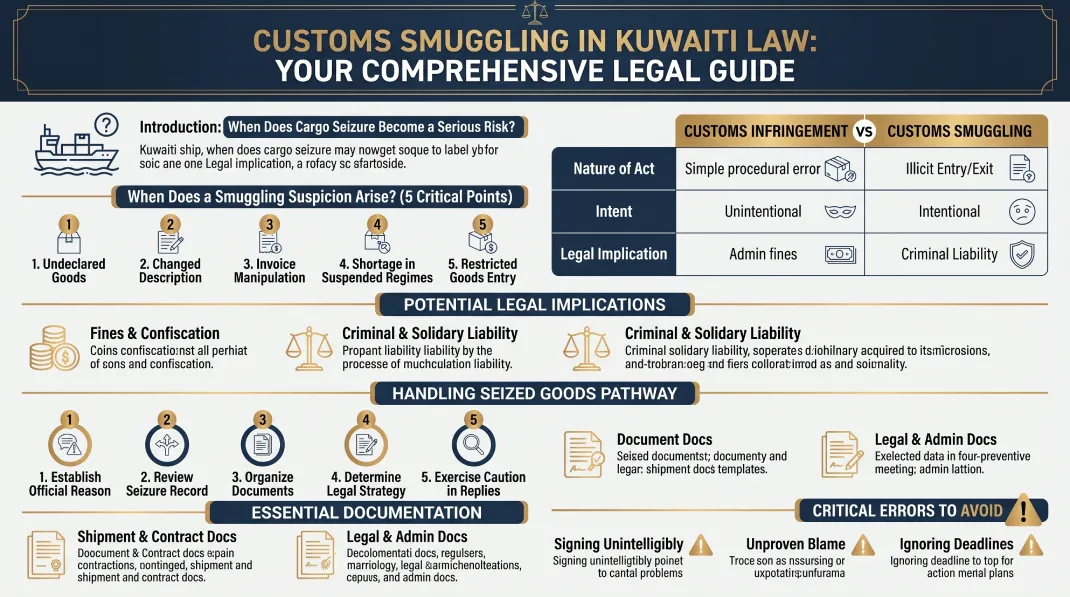
What Is Customs Smuggling Under Kuwaiti Law?
Customs smuggling involves bringing goods into Kuwait or taking them out of the country, or attempting to do so, in violation of the customs legislation set out in the Unified Customs Law, whether the purpose is to avoid paying customs duties in whole or in part or to violate prohibitions or restrictions imposed on particular types of goods.
Therefore, the level of risk in customs cases is not assessed solely according to the value of the goods. It also depends on the manner in which they were imported or exported, the documents submitted, and whether there is evidence of intent, knowledge, manipulation, or concealment.
The Difference Between a Customs Violation and Customs Smuggling in Kuwait
Not every error in a customs declaration constitutes smuggling, and not every detention of goods means that a crime has occurred. The primary distinction lies in the nature of the act and the surrounding circumstances.
| Element | Customs Violation | Customs Smuggling |
|---|---|---|
| Nature of the Act | An error, omission, or procedural violation | Importing, exporting, or attempting to import or export goods in violation of customs duties, prohibitions, or restrictions |
| Intent | May be unintentional | May involve an intention to evade duties, conceal information, or manipulate procedures |
| Consequences | Often fines or administrative procedures | May result in a seizure report, confiscation, fines, and criminal liability |
When Does Detention of Goods Become Suspected Customs Smuggling?
Customs detention may cease to be merely an inspection or document-completion procedure, particularly in situations such as the following:
- Undeclared goods: Such as discovering goods that were not included in the customs declaration or were placed in a manner that is difficult to justify commercially.
- Changing the description of the goods: Such as using a description that reduces customs duties, conceals the true nature of the shipment, or allows it to enter despite being subject to special restrictions.
- Discrepancies in value or invoices: Such as the existence of multiple invoices or inconsistencies between the declared value, financial transfers, or purchase contracts.
- Shortages in transit goods or suspended customs regimes: Where there is an unexplained shortage, substitution, or removal of goods without completing the required procedures.
- Importing restricted goods without authorization: Where the shipment requires prior approval and the information or permits submitted are insufficient to justify its importation.
What Is Deemed Customs Smuggling?
Deemed customs smuggling refers to situations that the law treats as smuggling even where the goods were not caught crossing the border in the traditional manner. This may apply to certain acts that affect the core of customs supervision, such as:
- Failing to proceed to the first customs office.
- Failing to follow the designated routes.
- Discovery of undeclared goods.
- An unexplained shortage in goods placed under a suspended customs regime.
Penalty for Customs Smuggling in Kuwait
The penalty for customs smuggling under Kuwaiti law varies according to the type and value of the goods, the customs duties payable, whether the goods are prohibited or restricted, and whether there is repetition, use of fraudulent methods, forgery, or concealment.
In general, the legal consequences in customs smuggling cases may include:
- Customs fines: These may be linked to the amount of customs duties or the value of the goods depending on the circumstances.
- Confiscation of the goods: Particularly where the goods are the subject of smuggling or are prohibited, counterfeit, or undeclared.
- Confiscation of the means of transport in certain cases: Where the legal conditions related to its use in smuggling are satisfied.
- Criminal liability: In cases that go beyond an administrative violation and fall within the scope of smuggling or attempted smuggling.
- Joint liability: Liability may extend according to the role of the importer, carrier, customs broker, or person who submitted the information and documents.
It is important not to treat the penalty as a fixed figure because customs cases vary considerably. Some matters may be addressed through an objection, settlement, or completion of missing documents, while others may require a full legal defense if they develop into allegations of smuggling, forgery, or importing prohibited goods.
Can Goods Detained by Customs Be Recovered?
Recovery of detained goods may be possible in certain cases through procedures for the customs release of imported goods, but this depends on the reason for the detention and the stage of the case. Detention caused by a missing document or a dispute over classification differs from a case involving a smuggling report, prohibited goods, or a confiscation decision.
Steps for Handling Goods Detained by Customs
When goods are detained, it is advisable to handle the matter through an organized sequence of steps, including:
- Identify the official reason for the detention: This helps determine whether the issue is documentary, technical, or connected to suspected smuggling.
- Review the seizure report or customs observations: The wording of the report may influence the direction of the case later.
- Organize the import documents: Such as the invoice, certificate of origin, shipping documents, financial transfers, and supplier correspondence.
- Determine the appropriate course of action: The solution may involve completing documents, submitting an objection, exploring a settlement, or preparing a legal defense.
- Avoid rushed action: Particularly if you are asked to sign a declaration or provide a response before understanding its legal consequences.
Amicable Settlement in Customs Smuggling Cases
In customs smuggling cases under Kuwaiti law, amicable settlement may be an important option in certain cases and may allow the dispute to be concluded in accordance with the applicable legal requirements where the necessary conditions are satisfied. However, it is not an automatic solution for every case and should not be regarded as a guaranteed outcome before reviewing the nature of the incident, the stage of the case, the amounts involved, and the nature of the goods.
Settlement may be particularly relevant where an importer or company seeks to reduce the impact of the case, avoid prolonged proceedings, and resume commercial activity without exposing its business record or reputation to greater risks. Nevertheless, accepting a settlement or drafting a settlement request may itself carry legal consequences that should be understood before proceeding.
Forgery of Customs Invoices and Changing the Description of Goods
One of the more serious forms of customs disputes arises where an importer or customs broker is accused of submitting inaccurate invoices, changing the description of the goods, or understating their value. Such situations are often not treated simply as accounting discrepancies but may be considered evidence of an attempt to evade customs duties or circumvent prohibitions or restrictions.
However, not every discrepancy in value or description necessarily means that forgery or criminal intent exists. The disagreement may arise from a technical customs classification issue, an error by a foreign supplier, inaccurate translation, or a difference between the commercial description and the customs description.
A defense in this type of case may therefore require establishing the complete documentary chain, including:
- The original commercial invoice.
- Proof of payment or financial transfer.
- Contracts or purchase orders.
- Supplier correspondence.
- Certificate of origin.
- Shipping documents.
- Any document supporting good faith or explaining the nature of the error.
Liability of the Customs Broker and Importer
An importer may assume that liability always rests with the customs broker, while the broker may argue that they merely acted on documents provided by the client. However, liability in customs cases is not determined through such general assumptions. Instead, it is assessed according to:
- The role of each party in preparing or submitting the information.
- Who provided or approved the documents.
- The extent to which any party knew about the violation.
- Who benefited from the error or manipulation.
- Whether the documents were clear or affected by manipulation or omissions.
Liability may extend to more than one party if participation, knowledge, or material negligence is established. Companies and importers may therefore need to review the case with a commercial lawyer in Kuwait to understand how the detention or seizure report may affect the business and its relationship with the supplier or customs broker.
Importing Counterfeit Goods into Kuwait
Importing goods bearing forged or counterfeit trademarks may create an additional legal issue alongside the customs proceedings because it involves trademark protection and intellectual property rights. This may result in the suspension of the shipment’s release, confiscation, or destruction in certain cases, in addition to other potential liabilities depending on the circumstances.
This issue often arises where a trader imports products believed to be “similar” or “second grade,” only to discover that they use a registered trademark or trade appearance that raises concerns about counterfeiting. Importers should therefore verify the source of the shipment, its invoices, and any licenses authorizing use of the trademark rather than relying solely on assurances from the supplier.
Common Mistakes That Increase the Risks of a Customs Smuggling Case
In customs smuggling cases under Kuwaiti law, the problem may not arise only from the original incident but also from the way the case is handled after the goods are detained. Common mistakes to avoid include:
- Signing a report or declaration without understanding its contents.
- Providing a rushed and unorganized response before reviewing the documents.
- Blaming the customs broker without written evidence.
- Ignoring official deadlines and notices.
- Delaying follow-up until storage charges accumulate or the goods enter a sale process.
- Submitting replacement invoices or documents without a clear explanation.
- Treating the detention solely as a customs clearance issue despite indications of suspected smuggling.
- Failing to retain supplier correspondence or payment documents.
- Attempting a settlement without understanding its legal consequences.
How Can Attorney Riyadh Matni Al-Fadhli Assist With a Customs Case?
Attorney Riyadh Matni Al-Fadhli provides structured legal review of customs cases based on the facts and documents, without exaggeration or advance promises regarding the outcome. Legal assistance may include:
- Reviewing the seizure report and the reason for detention.
- Examining invoices, the certificate of origin, and shipping documents.
- Determining whether the incident is more likely to constitute a customs violation or suspected smuggling.
- Assessing technical disputes concerning classification or value.
- Preparing an objection or legal response where necessary.
- Considering the possibility of an amicable settlement according to the circumstances of the case.
- Explaining the legal risks before signing any declaration or application.
- Organizing documents that support good faith or challenge an allegation of intent to smuggle.
What Documents Should You Prepare Before Making Contact?
To allow for a clearer assessment of your case, it is preferable to prepare the following:
- A copy of the seizure report or customs notification, if available.
- The commercial invoice.
- The certificate of origin.
- The bill of lading or cargo manifest.
- The customs declaration.
- Payment or bank transfer documents.
- Correspondence with the supplier or shipping company.
- Any prior permits or approvals associated with the goods.
- Details of the customs broker.
- A copy of the commercial registration if the goods are imported in the name of a company.
Having these documents does not guarantee the release of the goods or a settlement, but it can help clarify the case and identify the issues that need to be addressed accurately.
Frequently Asked Questions About Customs Smuggling in Kuwait
What is customs smuggling in Kuwait?
It generally involves importing or exporting goods, or attempting to do so, in violation of customs duties, prohibitions, or restrictions.
Does every customs violation amount to customs smuggling in Kuwait?
No. A documentary or procedural error may constitute a customs violation without necessarily being treated as customs smuggling.
When can detained goods raise suspicion of customs smuggling?
Suspicion may arise from undeclared goods, inaccurate descriptions or values, false documents, or restricted goods imported without authorization.
What are the possible penalties for customs smuggling in Kuwait?
Depending on the case, consequences may include customs fines, confiscation of goods, criminal liability, and other legal measures.
Can goods detained by Kuwait Customs be recovered?
Possibly. Recovery depends on the reason for detention, the type of goods, the available documents, and the stage of the customs case.
Can a customs smuggling case in Kuwait be settled?
An amicable settlement may be available in certain cases if the applicable legal requirements are met, but it is not automatic or guaranteed.
In conclusion, Customs Smuggling in Kuwait requires careful handling from the moment goods are detained or a customs seizure report is issued. Understanding the reason for the detention, reviewing the relevant documents, and choosing the appropriate legal response can help protect the position of the importer or company before the matter develops into a more complex dispute.
In such cases, having a lawyer in Kuwait familiar with customs procedures can help clarify the available legal options. To request a review of your documents and an assessment based on the facts of your case, contact Attorney Riyadh Matni Al-Fadhli through the WhatsApp button at the bottom of the screen.
You may also be interested in: International Trade and Customs Cases
Legal Disclaimer: This content is provided for general educational purposes and does not constitute individual legal advice. The legal outcome varies according to the type of goods, documents, seizure report, stage of the case, and competent authority. Each matter should therefore be reviewed on the basis of its own documents before any action is taken.

Lawyer in Kuwait, Registration No. 8342. Through this personal platform, he provides educational legal content covering contracts, companies and investment, arbitration, and commercial dispute resolution. The content is presented in a clear and precise manner to help individuals and businesses understand their legal options and reduce potential risks.