

Bribery in Kuwait is a criminal matter that requires careful legal handling from the very beginning, because it does not depend solely on the existence of a benefit or a particular act, but also on the context of the incident, the status of the parties, and the relationship between the benefit and the act requested.
This is why understanding the legal framework of the offense is important before taking any step, whether the person is a whistleblower, an interested party, or someone summoned to give a statement.
In this article, we explain the concept of bribery in Kuwait, its legal elements, penalties, the difference between bribery and a gift, how to report it, and when a lawyer’s intervention may be important to protect your legal position.
Have you encountered a situation involving suspected bribery and are worried that taking the wrong legal step could harm your position? Do not let uncertainty control the situation. Lawyer Riyadh Matni Al-Fadhli is ready to organize your documents and explain your legal position with complete confidentiality and professionalism to help protect your future.
Table of content
When Do You Need a Lawyer If Bribery Is Suspected in Kuwait?
In bribery cases, the first step can affect the entire course of the case. Acting hastily, using messages without organizing them properly, filing an unclear report, or giving an unprepared statement may place a person in a more complicated legal position.
You should consider consulting a lawyer in Kuwait if you are facing any of the following situations:
- You were asked to pay money or provide a gift in exchange for completing a transaction.
- You have messages, transfers, or conversations connected to a suspected bribery incident.
- You want to file a report and need help organizing the facts and documents.
- You have been summoned to give a statement and want to understand your position before the investigation.
- Commissions or gifts have appeared within a company that may raise criminal concerns.
You can present a summary of the incident and the available documents to the lawyer to review the risks and determine the most appropriate next step confidentially, without promises of a predetermined outcome.
What Is the Crime of Bribery in Kuwait?
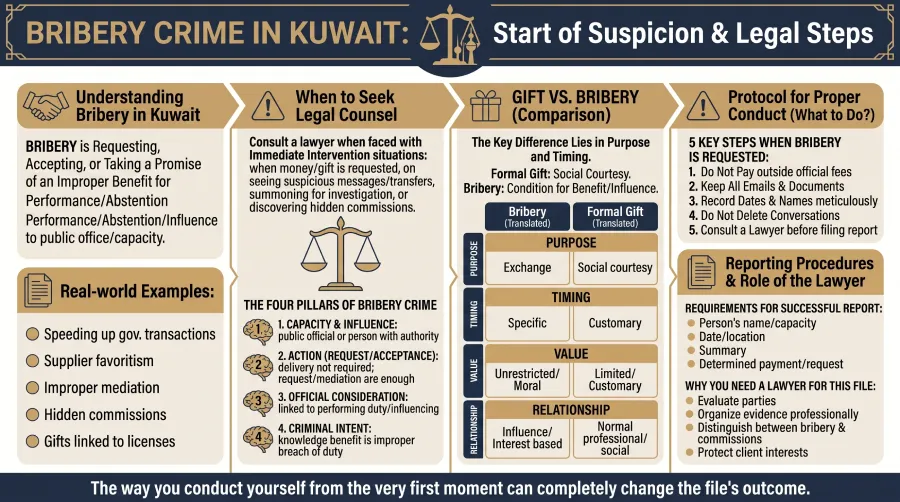
Bribery is the request, acceptance, or receipt of a promise, gift, or unlawful benefit in return for an act connected to a person’s position, official capacity, or influence. The essence of the offense is the use of a position, authority, or influence as a means of obtaining a private benefit.
In practice, bribery may arise in several contexts, including:
- Government transactions where money is requested to accelerate a procedure or overlook a requirement.
- Tenders or contracts where one party is favored in exchange for a benefit.
- Unlawful intermediation where a person claims to be able to influence an employee or authority.
- Undisclosed commissions within companies or procurement processes.
- Gifts or advantages offered at a time connected to a decision, license, or service.
The benefit does not have to be money. It may take the form of a service, discount, travel, employment opportunity, commercial interest, or any other advantage of value depending on the circumstances.
What to Do If You Are Asked for a Bribe in Kuwait
If you are asked to pay money or provide a gift in exchange for completing a transaction, do not react hastily. Payment, a promise, or the improper use of recordings may alter your legal position. Follow these steps:
- Do not pay any amount outside the official fees.
- Preserve messages, conversations, and documents without publishing them.
- Record the date of the incident, the person’s name and position, and exactly what was requested.
- Do not delete any conversations or transfers related to the incident.
- Consult a lawyer before filing the report to determine the wording and competent authority.
This does not mean ignoring the incident. Rather, it helps you present it in an organized manner that protects your position and clearly explains the details to the competent authority.
Elements of the Crime of Bribery Under Kuwaiti Law
The mere existence of money or a gift is not enough to establish bribery. Legal and factual elements must show that the benefit was linked to an act, omission, or breach of duty.
First: The Status of the Person Connected to the Incident
Bribery generally arises where the act is connected to a public official, a person treated as such, or someone who has authority or influence within a particular body. In some circumstances, criminal liability may also extend to the private sector, private legal entities, or international institutions and organizations depending on the relevant statutory provisions and amendments.
The important issue is not simply the person’s job title, but the connection between that person and the requested act, whether they actually had authority, claimed to have authority, or appeared capable of exercising influence.
Second: Request, Acceptance, Receipt, or Promise
Bribery can occur in several forms, and actual delivery of money is not always required. The request alone may be subject to criminal examination if it is shown to have been made in return for an official act or an unlawful benefit.
Common forms include:
- Requesting money or a gift.
- Accepting an offer from an interested party.
- Receiving money or another benefit.
- Accepting a promise of a future benefit.
- Acting as an intermediary between the bribe giver and recipient.
Third: The Benefit Must Be Connected to the Position or Capacity
The benefit must be connected to an act, omission, or breach of duty, such as completing a transaction, accelerating a procedure, overlooking a violation, facilitating a contract, favoring a supplier, or influencing a decision.
Suspicion may arise even where the interested person is seeking something they believe they are legally entitled to, because the problem is not necessarily the legality of the underlying transaction, but the payment of an unlawful consideration to complete or influence it.
Fourth: Criminal Intent
Criminal intent means that the person knew the benefit was not ordinary or innocent, but was offered or requested in return for an act, omission, or breach of duty. Intent may be inferred from messages, timing, the nature of the relationship, the value of the benefit, the circumstances of delivery, and the context of conversations between the parties.
Penalty for Bribery in Kuwait
The Kuwaiti Penal Code provides several penalties for bribery offenses, depending on the status of the accused person, the nature of the benefit, and whether the offense was completed or remained at the stage of an offer or promise.
In the basic form of the offense, a public official who requests or accepts, for themselves or another person, a promise or gift in return for performing or refraining from an act within the duties of their position may face imprisonment for up to seven years and a fine equal to the amount given or promised, subject to a minimum fine of fifty Kuwaiti dinars.
The main situations can be summarized in the following table:
| Situation | General Legal Characterization | Legal Note |
|---|---|---|
| A public official requests or accepts a benefit in return for an official act | Bribery of a public official | One of the most serious forms because it affects the integrity of public office |
| An interested party offers or promises a benefit | Bribe giver | May be punished depending on their role, and early reporting may affect their legal position |
| A person acts as an intermediary between the parties | Intermediary | Liability depends on knowledge and participation in the arrangement |
| A bribe is offered but not accepted | Offer of a bribe without acceptance | Differs from completed bribery because the official did not accept the offer |
| A gift is given after completion of the act | Unlawful subsequent reward | Timing, any prior agreement, and the connection to the act are examined |
| A hidden commission in a company or contract | Suspected corruption or bribery | Requires review of contracts, correspondence, and the benefit obtained |
The final penalty cannot be determined solely from the title of the incident because the legal characterization depends on the status of the parties, the type of benefit, whether there was a prior agreement, the strength of the evidence, and the timing of the report.
When Does the Bribe Giver or Intermediary Become a Party to the Crime of Bribery in Kuwait?
Not every person connected to the incident automatically becomes an accused party. However, liability may arise if it is established that the person was not merely conveying information or acting as an interested party, but participated in offering, arranging, or delivering the benefit while knowing its unlawful purpose.
Matters commonly considered include:
- Did the person offer or encourage the benefit?
- Did the person negotiate or transfer messages between the parties?
- Did the person know that the consideration was linked to an official act or decision?
- Did the person benefit from completion of the arrangement?
- Did the person continue participating despite the unlawful nature of the incident becoming clear?
Accordingly, the liability of the bribe giver or intermediary depends on their actual role, not merely on the appearance of their name in conversations or their acquaintance with one of the parties.
Bribery in the Private Sector in Kuwait
Bribery or related forms of corruption may also arise in the private sector under circumstances addressed by more recent amendments, particularly where the person involved is a board member, manager, employee, or worker of a private legal entity, or where the benefit is linked to a decision, contract, supply arrangement, or unlawful commercial advantage.
These cases commonly arise in:
- Procurement and contracts.
- Selection of suppliers.
- Undisclosed commissions.
- Conflicts of interest.
- Passing bids or pricing information in favor of a particular party.
- Concealing documents or information relating to suspected corruption.
Companies therefore need clear policies on gifts, commissions, and conflicts of interest, because poor documentation may turn a commercial act into a criminal suspicion or a complex dispute.
The Difference Between Bribery and a Gift in Kuwait
Not every gift constitutes bribery, but a gift may raise criminal suspicion if it is connected to an official act, decision, facilitation, or omission. The main distinction lies in the purpose, timing, and relationship between the parties.
| Comparison | Ordinary Gift | Bribery |
| Purpose | A social courtesy unrelated to a decision | Consideration for an act, omission, or influence |
| Timing | Not connected to a specific procedure | Before, during, or after a matter involving an interest |
| Value | Usually limited and customary | May involve significant value or an influential benefit |
| Relationship | Ordinary social or professional relationship | Relationship involving an interest, authority, or influence |
| Legal Effect | Does not constitute an offense by itself | May result in criminal liability |
Therefore, if a gift is offered to an employee, official, or person capable of influencing a decision concerning the giver, it should be examined very carefully, especially if it is preceded or followed by messages, requests, or promises.
When Does a Commercial Commission Become Suspected Bribery?
Not every commission in contracts or procurement constitutes bribery. The risk arises when the commission is hidden, undocumented, or connected to improperly favoring one party over another.
Suspicion becomes stronger in the following circumstances:
- A commission is paid without being stated in the contract or invoice.
- The benefit is concealed from the company or interested party.
- The commission is linked to awarding a contract or approving a bid.
- There is a special relationship between the employee and supplier.
- Messages or transfers appear that are inconsistent with the nature of the commercial relationship.
In corporate and procurement contracts, accurate documentation is extremely important because disputes often arise not from payment of the commission itself, but from failure to disclose it or from its connection to a biased commercial decision.
How Is Bribery Proven in Kuwait?
Proof of bribery does not always depend on a single piece of evidence. It often relies on a combination of evidence and circumstantial indicators assessed together. Evidence may include:
- WhatsApp messages or emails referring to a request or promise.
- Financial transfers or receipts.
- Witnesses who attended the agreement or delivery.
- Documents related to the transaction or contract.
- Unusual timing of the benefit.
- A direct connection between the payment and the requested act.
- Indicators of unexplained enrichment or benefit in some cases.
The strength of each piece of evidence depends on how it was obtained, its legality, and its connection to the incident. The evidence should therefore be organized before it is submitted or relied upon.
How Do I Report Bribery in Kuwait?
Suspected bribery or corruption may be reported to the competent authority depending on the nature of the incident and the status of the person being reported. In corruption matters, the Kuwait Anti-Corruption Authority “Nazaha” receives reports falling within its jurisdiction, while the Public Prosecution may also be competent to conduct criminal investigations.
Before filing the report, it is preferable to prepare the following information:
- The name of the person or entity being reported, if known.
- The person’s position and relationship to the transaction.
- The date and place of the incident.
- A clear summary of what occurred without exaggeration.
- Messages, documents, or names of witnesses.
- Whether money was actually paid or merely requested.
- Whether there was pressure, a threat, or blackmail.
The more organized and specific the report is, the easier it is to review and the less likely it is to be misunderstood or closed because of ambiguity or insufficient information.
Exemption from the Bribery Penalty for the Bribe Giver or Intermediary
A bribe giver or intermediary may benefit from exemption in circumstances provided by law if they take the initiative to report the crime to the authorities in accordance with the applicable legal requirements. The purpose of this mechanism is to uncover bribery offenses and dismantle unlawful arrangements.
However, the exemption should not be understood as absolute or automatic. The following matters must be examined:
- The timing of the report.
- The seriousness and credibility of the information.
- The person’s role in the incident.
- Whether the report was made before the offense was discovered or afterwards.
- The extent to which the report contributed to uncovering the truth.
- Whether the person was the bribe giver, intermediary, or bribe recipient.
Therefore, if you are involved in a bribery incident and want to report it, consulting a lawyer before providing detailed statements can help protect your position and ensure the information is presented appropriately.
Key Defenses in Bribery Cases in Kuwait
Defense in bribery cases is not based solely on denial. It requires examining the legal elements of the offense, the legality of the evidence, and the specific circumstances of the incident. Depending on the case, possible defenses may include:
- Absence of criminal intent.
- No clear official consideration connected to the payment.
- Failure to prove a request or acceptance.
- The amount was a debt or an independent financial transaction.
- Invalidity or weakness of technical evidence.
- Contradictions in the statements of the reporting person or witnesses.
- Lack of seriousness or sufficiency of investigations.
- Absence of the required official status or lack of connection between the person’s position and the requested act.
- Unlawful method of obtaining evidence.
- Insufficient evidence to establish guilt beyond the required level of certainty.
These defenses should not be used as standard templates because the strength of the defense depends on a careful review of the investigation file, documents, recordings, and correspondence.
What Should You Do If You Are Summoned in a Bribery Case?
If you are summoned to give a statement in a bribery case, do not treat the matter as a simple or routine procedure. Bribery investigations may begin with one question and expand depending on the answer and the documents involved. Follow these steps:
- Do not give disorganized details: Speak only after understanding the reason for the summons and the capacity in which you are being questioned.
- Keep copies of important documents: Such as messages, contracts, transfers, or any document explaining the nature of the relationship.
- Do not delete conversations or files: Deletion may be interpreted against you or create additional suspicion.
- Request the presence of a lawyer: A lawyer can help you understand the questions, organize your answers, and avoid contradictions.
- Do not over-explain: Excessive unnecessary detail may create inconsistencies, while a clear account supported by documents is preferable.
You may also be interested in: Legal Defenses in Embezzlement Cases
How Does a Lawyer Review a Bribery Case Before Reporting or Investigation?
In bribery cases, a lawyer does not merely listen to a general account of what happened. The incident is reorganized around three main elements: the status of the parties, the nature of the benefit, and the strength of the evidence. The lawyer’s role may include:
- Identifying the status and role of each party in the incident.
- Sorting evidence into messages, transfers, witnesses, recordings, or documents.
- Assessing whether the available evidence is sufficient or requires further support.
- Distinguishing between bribery, gifts, commissions, and commercial disputes.
- Preparing the report or defense memorandum in a precise legal form.
- Alerting the client to statements or conduct that may weaken their legal position.
Frequently Asked Questions About Bribery in Kuwait
What is bribery under Kuwaiti law?
Bribery generally involves requesting, accepting, offering, or receiving an unlawful benefit in return for an act, omission, or influence connected to a position or authority.
What is the penalty for bribery in Kuwait?
Penalties vary depending on the person’s role and the circumstances of the offense. In some cases, imprisonment and financial penalties may apply.
Is every gift considered bribery in Kuwait?
No. A gift may raise bribery concerns when it is connected to an official act, decision, favor, or influence rather than being an ordinary social courtesy.
Can offering a bribe be a crime even if it is refused?
Yes. Offering an unlawful benefit may have legal consequences even if the intended recipient does not accept it.
Can a commercial commission be considered bribery?
It may raise suspicion if it is hidden, undocumented, or linked to improperly influencing a contract, supplier selection, or commercial decision.
What evidence can be used in a bribery case?
Evidence may include messages, emails, financial transfers, receipts, witness statements, contracts, recordings, and documents related to the transaction.
How can I report suspected bribery in Kuwait?
A report may be submitted to the competent authority depending on the circumstances, including relevant anti-corruption or criminal investigation authorities.
Can a bribe giver or intermediary receive an exemption?
An exemption may apply in certain legally defined circumstances, but it depends on factors such as timing, cooperation, and the person’s role in the offense.
What should I do if I am summoned in a bribery case?
Preserve all relevant documents and communications, avoid deleting evidence, understand why you were summoned, and consider seeking legal advice before giving a detailed statement.
When should I contact a bribery lawyer in Kuwait?
Legal advice is especially useful if you were asked for a benefit, have evidence of suspected bribery, intend to report the matter, or have been summoned for investigation.
This brings us to the conclusion of our article on bribery in Kuwait. As explained above, the way an incident is handled may be just as important as the incident itself. The legal position may differ depending on the timing of the report, how the evidence was preserved, the status of the parties, and the connection between the benefit and an act, decision, or authority.
You can contact lawyer Riyadh Matni Al-Fadhli through the WhatsApp button at the bottom of the screen to discuss your legal position and determine the available options based on the details of your case.
Legal Disclaimer: This article is provided for general educational purposes and does not replace legal advice based on the documents and facts of the individual case.

Lawyer in Kuwait, Registration No. 8342. Through this personal platform, he provides educational legal content covering contracts, companies and investment, arbitration, and commercial dispute resolution. The content is presented in a clear and precise manner to help individuals and businesses understand their legal options and reduce potential risks.